
Livraison le jour même ou le lendemain

Qualité garantie

Débloquez vos offres de bienvenue: Livraison GRATUITE | Jusqu'à -80 % | 30 jours d'essai gratuits à JoyPlus
Téléchargez l'application
A leak around a window, rooflight or gutter can quickly damage a roof, a motorhome interior or a wooden terrace. Waterproof butyl tape offers a practical way to seal certain areas, provided you choose the right width and prepare the surface carefully.
Product listings are nevertheless full of claims such as ‘extreme resistance’ and ‘universal adhesion’. These phrases are not enough to distinguish between rolls. Here are the criteria to check before buying butyl sealing tape.
A 50 mm tape may be suitable for a window seal or a small crack. It will provide less coverage on a roof joint, a long awning seam or an uneven area. For a roof, gutter or boat tarpaulin, a width of 100 to 150 mm will often help reduce the number of joins.
Leave an overlap on each side of the crack. A strip that is only just wide enough to cover the defect may allow water to seep in around the edges.
Even waterproof adhesive tape does not remove the need for thorough preparation. Dust, grease, condensation and moisture prevent butyl from adhering evenly to the surface. Applying leak-sealing tape in the rain can therefore cause it to peel away prematurely.
The product listings featured recommend a clean, dry surface, as well as protection from rain for 24 hours. This precaution is particularly important when waterproofing a motorhome roof or repairing a caravan awning.
Butyl generally adheres to many materials, but the condition of the surface remains crucial. A crumbly, rusty or very porous surface, or one covered with an old seal, can compromise the application. Before covering a large area, test it on a less visible section.
For a pipe exposed to high pressure, a structural leak or a gas installation, the tape should not automatically be considered a substitute for professional repairs.
Butyl is a flexible material that conforms to uneven surfaces. Aluminium butyl tape adds a metallised PET, polyester or other reinforcement layer, depending on the product listing. This top layer can help protect the strip against UV rays and the weather, while also making the repaired area easier to identify.
Also check the thickness. The 50 and 100 mm TAPEBEAR models state a thickness of 39.37 mil, or approximately 1 mm. A thicker strip may fill a small uneven area more effectively, but it will also be more noticeable on a neat finish.
To choose roof repair tape, measure the crack or joint, then add an overlap allowance. Some useful guidelines:
The total length matters just as much as the width. For a one-off job, a roll of around 5 m may be sufficient. For several vehicles, regular maintenance work or a terrace, a pack containing several rolls will save you from having to place multiple orders.
Read the temperature guidance before buying. Some of the models featured state an operating range of –40 °C to 80 °C, while the wood terrace tape from the same range specifies a range of –29 °C to 110 °C. These values correspond to the specifications stated in the product listings and do not guarantee the same result on every surface.
To apply it:
On a cold surface, the listing for the joist tape recommends gently warming the strip with a hairdryer. However, avoid any excessive source of heat.
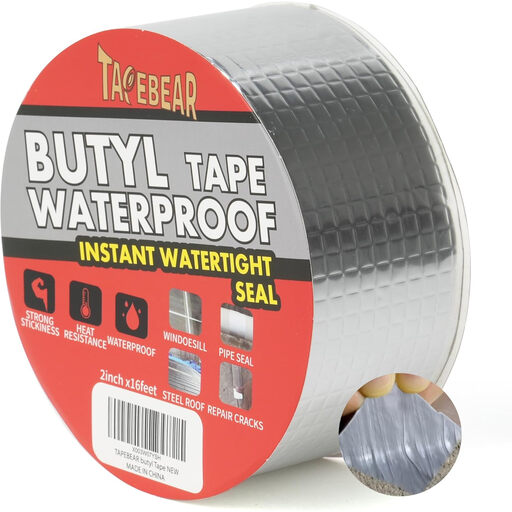
Why this choice suits this profile : Its compact format is suitable for first repairs on a window, PVC pipe, glazing or a small roof area.
The 50 mm width is clearly stated, helping you avoid overestimating the area covered in the event of a significant leak.
Butyl tape with an aluminium PET sheet, a length of 5 m and a stated thickness of 39.37 mil.
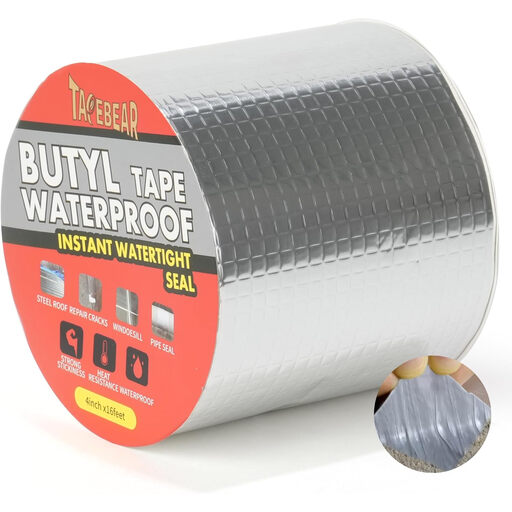
Why this choice suits this profile : Its wider format is suitable for roof finishing, motorhome waterproofing and visible joints that require more generous coverage.
The 100 mm width limits the number of joins and reduces the risk of leaving an edge inadequately covered.
Stated aluminium PET sheet reinforcement and ageing-resistant film, with declared compatibility with metal, tiles, wood, fibreglass and concrete.
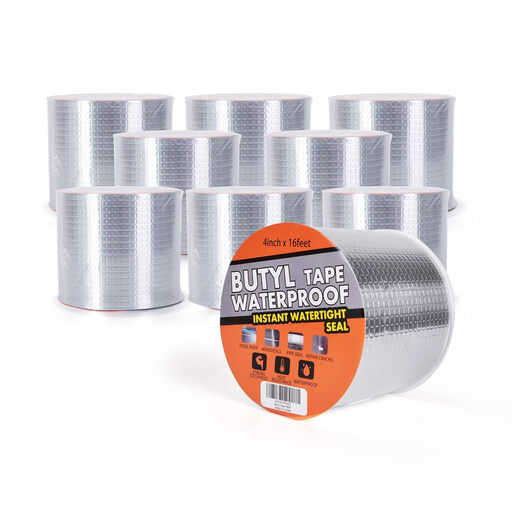
Why this choice suits this profile : This pack is suitable for maintaining several vehicles, a large house or building up a stock for repeated repairs.
The stated quantity lets you carry out several repairs without having to switch between different widths for different jobs.
Nine 100 mm x 5 m rolls, with butyl, aluminium sheet and polyester, according to the product listing.
We have selected a complete, real-time updated list of products that meet these demanding criteria and European safety standards.
The listings for the models featured recommend leaving the strip in place without moving it and protecting it from rain for 24 hours. This time may vary depending on the temperature, surface and tape width. Applying it in dry weather helps promote initial adhesion.
The listings state that it adheres to PVC, EPDM, glass, wood, metal and fibreglass. Even so, you should clean the surface, check that it has not been treated with an incompatible product and test it on a small area. On an old or deteriorated EPDM roof, remove any loose sections before applying the tape.
It may be suitable for a localised repair on a boat, awning or terrace, provided the surface is clean, dry and sufficiently stable. On a wooden terrace, the self-adhesive outdoor tape intended for joists should be applied without stretching it and pressed carefully onto the beams. It does not replace proper ventilation, the replacement of damaged wood or the restoration of a weakened structure.