
Livraison le jour même ou le lendemain

Qualité garantie

Débloquez vos offres de bienvenue: Livraison GRATUITE | Jusqu'à -80 % | 30 jours d'essai gratuits à JoyPlus
Téléchargez l'application
A waterproof bike frame bag can make daily commutes, road rides and mountain bike trips easier. You still need to choose the right model. Some bags quickly become cumbersome, move around while riding or show their limitations at the first shower. Before buying, there are three potential pitfalls to watch out for.
The first concerns the waterproofing claimed. “Waterproof” does not necessarily mean that the bag can withstand immersion. Protection depends on the fabric, seams, type of fastening and the way the compartment is closed.
The second pitfall is capacity that may be overstated. A large-capacity bike bag may seem appealing, but too much volume near your knees or handlebars can affect handling and cause rubbing.
Finally, a poorly adjusted attachment can lead to movement, noise and sometimes contact with cables or your legs. A bike top tube bag should therefore be chosen according to the frame geometry, not just its appearance.
For urban use or a ride in moderate rain, choose coated fabric, protected fastenings and, where possible, welded or carefully reinforced seams. A rating such as IPX4 means that the bag is resistant to water splashes, but not that it can remain submerged.
Even a waterproof bike bag must be closed properly before setting off. In heavy rain, place sensitive items — your phone, documents or wallet — in an additional inner pouch.
A triangle bike bag generally makes use of the space between the top tube and the down tube. Before choosing one, measure the available length and check that there is enough room between the bag, your knees and the cables.
A profile measuring around 6 cm wide reduces the risk of contact with your legs while pedalling. On a road bike, choose a slim, stable shape. For a mountain bike bag, material durability and stability on rough terrain are the top priorities. For trekking, a more generous capacity can be useful, provided the contents are distributed properly.
Adjustable straps make it possible to fit a bag to different frames, but they must be tightened evenly. Before every ride, check that the bag does not move and does not interfere with steering, the brakes or gear changes.
The empty weight also matters. A lightweight bag helps preserve handling, while a load that is too heavy and positioned high on the frame can affect the bike’s behaviour. Follow the maximum load specified by the manufacturer and distribute bulky items evenly.
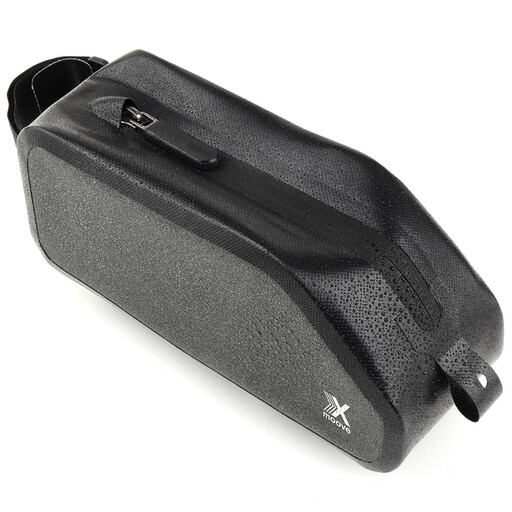
Why this choice suits this type of cyclist : Its three adjustable straps are suitable for urban journeys, daily commutes and cyclists who want to fit a bag easily to most frames.
The straps can be tightened separately, and the product listing recommends checking stability before every ride. Its water protection is described as splash-resistant, but it is not suitable for prolonged immersion.
Three adjustable straps, a lightweight, slim design, carry handles and space for a phone, keys, documents and small tools.
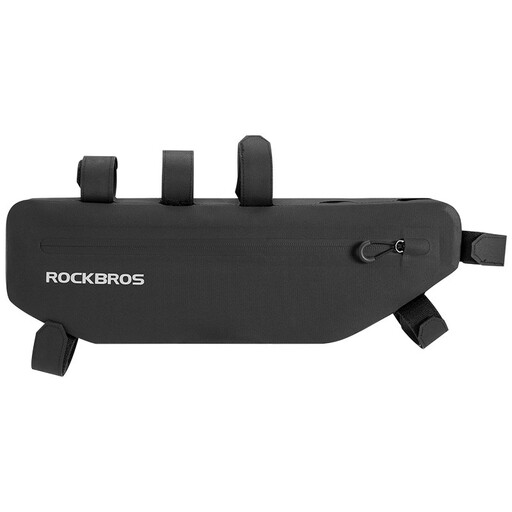
Why this choice suits this type of cyclist : Its stated capacity of 3 or 4 litres is suitable for road cyclists, mountain bikers and anyone who wants to carry more accessories without using several bags.
The 840D nylon combined with TPU, the fastenings described as waterproof and the internal panels help prevent the bag from collapsing. However, the product listing specifies IPX4 resistance, so it is best to avoid any immersion.
3 or 4 litre capacity, approximately 6 cm wide, multi-point attachment using hook-and-loop straps and reflective elements on both sides.

Why this choice suits this type of cyclist : This option is intended for parents looking for a 16-inch children's bike for a child aged 4 to 7, suitable for the stated height range of 105 to 135 cm, rather than a frame bag.
The product listing links the bike size to a specific age range and height range. Before buying, measure the child and check the adjustment of the saddle, brakes and handlebars.
Hi-Ten steel frame, single-speed transmission, 16 × 1.95-inch tyres, front V-brake, rear coaster brake and full chain guard.
We have put together a complete, real-time selection of products that meet these demanding criteria, while also taking European safety regulations into account.
To install a waterproof bike frame bag correctly, follow these steps:
After riding in the rain, wipe the bag and leave it to air dry. Avoid storing it while it is still damp: water can remain trapped in the folds and around the fastenings. Also check the condition of the straps and seams regularly.
Not necessarily. A bag described as water-resistant will generally protect against rain and splashes, but not always against immersion or prolonged exposure. Check the protection rating, the design of the fastenings and the manufacturer’s recommendations.
Choose a model that is compatible with your frame geometry, position it centrally and then tighten the straps evenly. Test it empty and turn the handlebars before setting off. If the bag touches your legs or the cables, reposition it or choose another model.
Its lifespan depends on how often it is used, the weight carried, rubbing and exposure to the weather. To make it last longer, do not overload it, avoid placing sharp objects inside and dry the fabric after every wet ride.