
Livraison le jour même ou le lendemain

Qualité garantie

Débloquez vos offres de bienvenue: Livraison GRATUITE | Jusqu'à -80 % | 30 jours d'essai gratuits à JoyPlus
Téléchargez l'application
Choosing from the many watercolour sets available online can quickly become a headache. A box full of colours isn't necessarily suited to your technique, while a compact kit might show its limitations just as you start to progress. To avoid an unnecessary expense, it's best to compare the format, the type of medium and the accessories that are actually included.
A 60-shade set might seem more appealing than a 12-colour palette, but quantity doesn't guarantee a better experience. For beginners, a more limited range helps you understand colour mixing and is easier to carry around. On the other hand, illustrators and regular users may want more shades to reduce the need for mixing.
Also check whether the colours come as pans, half-pans, tubes, or are built into watercolour pencils and watercolour pens. Each format corresponds to a different technique and way of working.
Even a well-formulated watercolour paint can give disappointing results on paper that's too thin. Washes are likely to buckle, and water can soak right through the sheet. For wet techniques, choose paper designed for watercolour, with a weight that suits the amount of water you use.
Watercolour markers can also bleed through ordinary paper, especially when you layer them. A thick-paper sketchbook or dedicated sheets should therefore be part of your budget.
Some sets contain only the colours. Others add a brush, a mixing palette, a sharpener or even an instructional guide. For working on the go, these details are far from trivial. A travel set with a closed case and a mixing area saves you from having to carry several separate accessories.
For products aimed at children, check the warnings on the packaging. Several items featured here are not suitable for children under 3 years old due to small parts or sharp points.
A mention like "water-soluble" means the pigment or ink can be moved with a damp brush. This does not mean the result becomes waterproof once dry. The Talens Art Creation set, for example, states that the paint remains reactivatable with water after drying.
For pencils, look for a lead that is clearly described as water-soluble. The Bruynzeel, STAEDTLER and Faber-Castell sets featured below are designed for both dry and wet use, according to their product descriptions.
A metal tin protects the pencils and slips easily into a bag. Watercolour palettes with a lid and mixing area are practical for travel. For markers, keeping the caps on tightly is essential to prevent the tips from drying out. A well-organised case also makes it easier to find the shades you need.
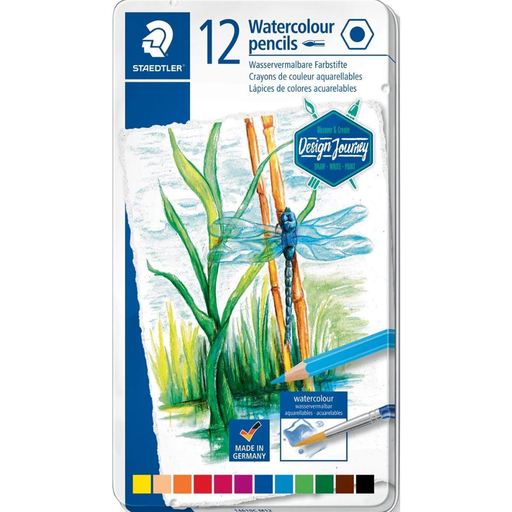
Why this choice suits this profile: Twelve pencils let you gradually explore dry drawing and water effects. The metal case is equally at home in class or for creative hobbies.
The limited format stops you paying for shades you'll rarely use, while the pencils can be used without any wet materials to get started.
12 water-soluble pencils, metal case, hexagonal barrel and the option to work dry or with a damp brush.
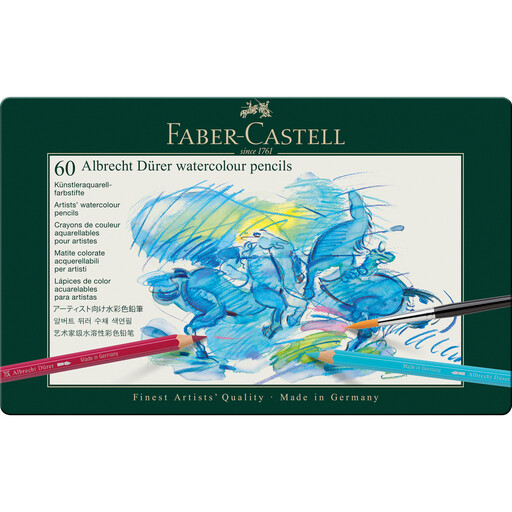
Why this choice suits this profile: A palette of 60 colours is ideal for detailed illustration projects, portraits and users who want to minimise colour mixing.
The product page specifies a 3.8 mm lead, a water-soluble binder and a metal case – concrete details that are far more useful than a vague promise of "intense colours".
60 colours, pigments described as lightfast and dual use: dry drawing or brush washes.
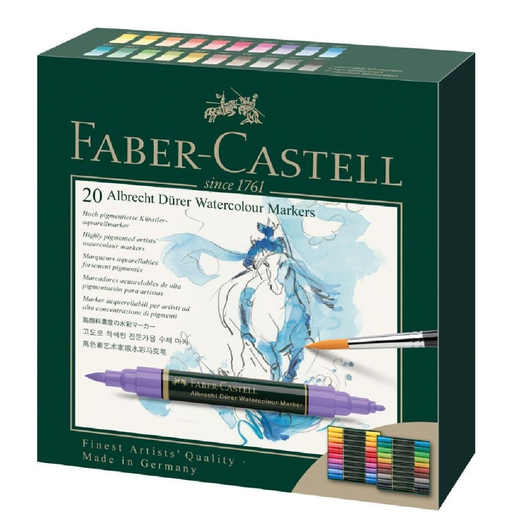
Why this choice suits this profile: The dual tip meets the needs of illustrators, sketchbook enthusiasts and anyone who alternates between fine details and broad brushstrokes.
Having both a brush tip and a fine tip means you don't need to buy two separate tools for the same illustration.
20 markers, water-based water-soluble ink, storage case and a flexible brush tip paired with a fine tip.
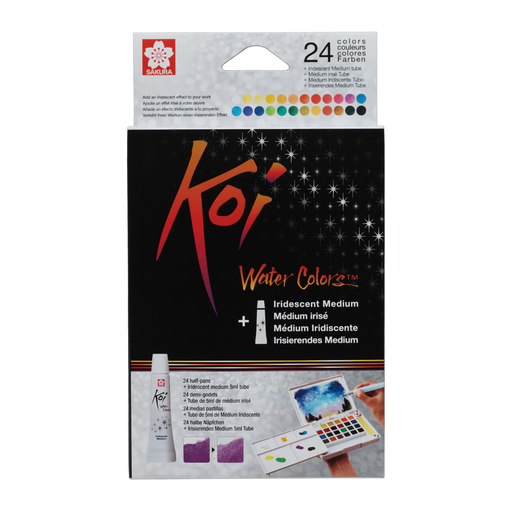
Why this choice suits this profile: Its pocket-sized format, 24 half-pans and iridescent medium are perfect for urban sketching, travel and painting sessions outside the studio.
The compact case with a mixing area reduces the number of accessories you need to carry and protects the colours between uses.
24 half-pans, iridescent medium, pocket-sized case and integrated mixing palette.
We've put together a comprehensive list, updated in real time, of products that fully meet these strict selection criteria as well as European safety regulations.
A set of 12 to 24 colours is usually enough to learn mixing and washes. Watercolour pencils suit people who like to start by drawing, while a pan palette is more geared towards brush painting.
The lifespan depends on how often you use it, how much paint you apply and your storage conditions. Pans can be re-moistened, while markers need to be closed carefully to prevent drying out. Pencils should be protected from moisture and sharpened with a suitable tool.
A brush, watercolour paper and a container for water are often necessary. Some kits already include a brush or a mixing palette. Check the list of included items before comparing prices so you can work out the real cost of your watercolour materials.