
Livraison le jour même ou le lendemain

Qualité garantie

Débloquez vos offres de bienvenue: Livraison GRATUITE | Jusqu'à -80 % | 30 jours d'essai gratuits à JoyPlus
Téléchargez l'application
Watercolour pencils promise the best of both worlds: the precision of drawing and the fluidity of painting. But be warned, the market is flooded with products whose tempting promises quickly lead to disappointment. A pretty box isn't everything, and certain technical characteristics, often ignored, are crucial for achieving a result that lives up to your ambitions.
As the Head of Product Recommendations at Joybuy, my mission is to guide you through this jungle of options. This guide breaks down the pitfalls to avoid and gives you all the keys to choosing THE perfect set of watercolour pencils for you, whether you're a seasoned artist, a crafting enthusiast, or a parent looking for a gift to spark creativity in a young one.
Don't be fooled by marketing. Here are three classic traps that turn a promising purchase into a regret:
To avoid falling into the trap, take a close look at these three characteristics that signify the true quality of a watercolour pencil.
The quality of a watercolour pencil comes down to two things: pigment concentration and the nature of the binder. A high-end pencil is distinguished by a high density of fine pigments, ensuring rich and vibrant colours even when used dry. The binder, for its part, must be perfectly water-soluble so that the pencil stroke transforms into a smooth, even wash without leaving any grainy residue. Brands like Faber-Castell are renowned for their formulas that ensure flawless dissolution.
Lightfastness measures the ability of pigments to resist fading over time when exposed to light. On professional watercolour pencils, this information is crucial. It is often indicated on the pencil barrel or packaging via a star system or a rating (like the Blue Wool Scale). High lightfastness is essential if you plan to sell, exhibit, or simply preserve your works. For recreational use or in a sketchbook, this criterion becomes less of a priority.
A lead that breaks with the slightest turn of a sharpener is the height of annoyance and waste. The lead's durability depends on its diameter and manufacturing process. Faber-Castell's SV (Secural Bonding) process, for example, bonds the lead to the wood along its entire length, making it much more resistant to impact. The diameter is also a key factor: an XXL lead like that of the Stabilo Woody 3-in-1 (10 mm) is perfect for watercolour pencils for children. It's nearly unbreakable and offers an excellent grip. For artists, a 3.3 to 3.8 mm lead represents the best compromise between strength and fine-line capability.
Rather than an endless list, here are our targeted recommendations by user profile. Each product has been chosen to meet specific needs while sidestepping the pitfalls we've just discussed.
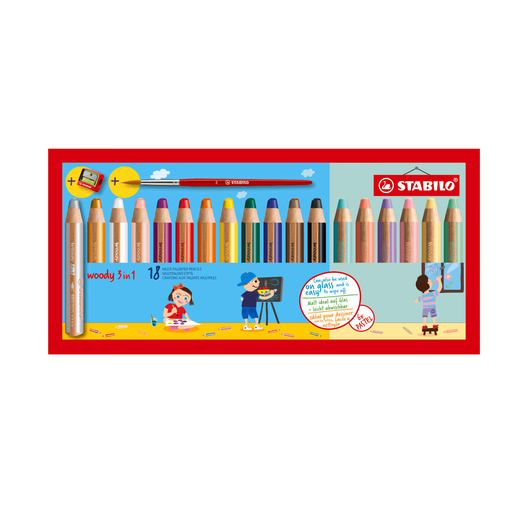
Why it's a smart choice: This set is the star of the playground. Its 3-in-1 formula (coloured pencil, wax crayon, and watercolour) and its ultra-durable, easy-to-grip 10 mm XXL lead make it the ultimate tool for creative development. It writes on almost anything (paper, glass, metal) and wipes off smooth surfaces with a cloth.
It doesn't pretend to be a professional artist's tool. Its strength lies in its durability and versatility. This is honest positioning that's perfectly suited to its target audience, far from the "fake quality" mirage.
Nearly unbreakable 10 mm lead. Intense, high-coverage colours. Complete set with sharpener and brush.
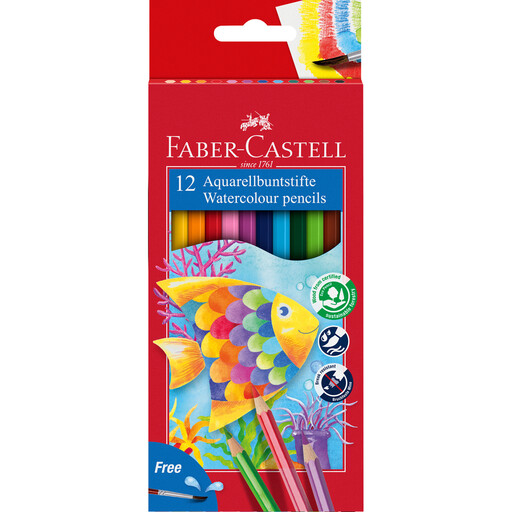
Why it's a smart choice: The perfect balance between quality and price. Ideal for art students, amateur illustrators, or crafting enthusiasts. The 24-colour palette is sufficiently versatile, and the quality pigments ensure beautiful blends and a pleasant application.
It sidesteps the quantity-over-quality trap. Instead of a myriad of mediocre colours, it offers a selection of 24 effective and mixable shades, which is more than enough for most projects.
Good pigment solubility. Break-resistant lead thanks to SV bonding. Ready-to-use set with an included brush.
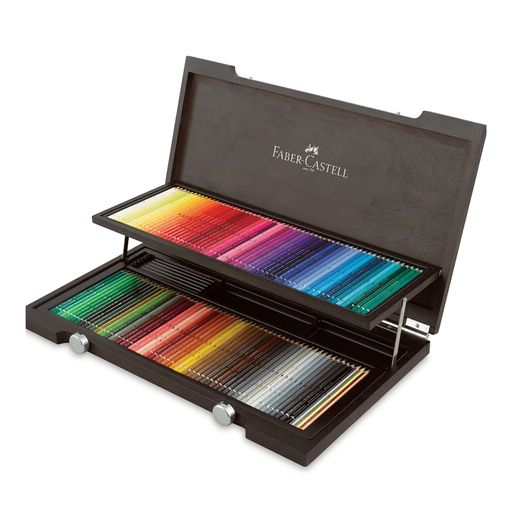
Why it's a smart choice: This is THE absolute gold standard for professional artists. This set combines exceptional pigment quality, maximum lightfastness, and an exhaustive colour range. Presented in a magnificent wooden case, it's a long-term investment for works destined to stand the test of time.
This set is the antidote to the trap of fading artwork. It guarantees top-tier lightfastness, ensuring the longevity of your creations. Here, the exceptional quality of the pigments fully justifies the premium positioning.
Unmatched pigmentation and solubility. Maximum lightfastness on the majority of shades. Thick (3.8 mm) and robust lead. Wooden case for perfect preservation.
We've put together a complete selection of products that meet our rigorous selection criteria.
What's the difference between watercolour pencils and classic coloured pencils? The entire difference lies in the lead's binder. The binder in watercolour pencils is water-soluble: when touched with a wet brush, it transforms a drawing into a watercolour-style painting. Conversely, classic coloured pencils use a non-soluble wax or oil-based binder, intended only for dry drawing.
Do you need special paper for watercolour pencils? Yes, it's essential for the wet technique. To get good results, opt for watercolour paper with a weight of at least 300 g/m?. It's designed to absorb water without buckling or tearing, unlike standard printer paper which would quickly become soaked. For dry use, however, any drawing paper will do.
How should I care for the brush that comes with watercolour pencils? If your box of watercolour pencils includes a brush, proper care will extend its life. After each session, rinse it thoroughly with clean water until no colour residue remains. Gently reshape the tip with your fingers and let it dry flat or hanging with the tip down. This prevents water from pooling in the ferrule (the metal part), which could loosen the bristles over time.