For a watercolorist, the choice of paper is not a minor detail: it's the foundation of the artwork. The wrong paper guarantees buckling, pigments losing their vibrancy, or even the surface tearing. And with a jungle of options available, it's hard to know where to start.
This guide is here to help you sort through them. We'll break down the essential criteria and review a selection of sketchbooks with diverse profiles. Our goal: to help you find the perfect companion for your practice and projects.
Buyer's Guide: The 3 Key Criteria for Choosing a Watercolor Sketchbook
Before you dive in, let's review a few technical concepts that make all the difference in the performance of a watercolor paper.
1. Paper Weight: Your Main Defense Against Water
Expressed in grams per square meter (gsm), paper weight is the primary indicator of the paper's thickness and, most importantly, its ability to handle water without buckling.
- Under 200 gsm: More budget-friendly, this paper is suitable for dry drawing, ink, or very light washes. Forget about very wet techniques, as it will buckle almost instantly. A notable exception: some papers, like the one in the Ohuhu sketchbook, receive a special treatment (for alcohol markers, for example) that compensates for their lower weight.
- Around 200 gsm: An excellent compromise for mixed media and watercolor, provided you control your water usage. Its resistance is decent, making it a good choice for a professional travel sketchbook.
- 300 gsm and up: This is the gold standard for watercolor. It soaks up water without complaint, allowing for "wet-on-wet" work and layering with almost no risk of buckling.
2. Paper Texture: The Signature of Your Work
The surface texture, or "grain," is more than just a detail: it directly influences the final look of your paintings.
- Cold press: The most versatile, and often the most recommended for beginners. Its lightly textured surface offers an excellent balance between line precision and beautiful textural effects.
- Hot press: Exceptionally smooth, its surface is the ideal playground for detailed illustration, pen work, and perfectly uniform color washes.
- Rough press: With its very pronounced texture, it catches pigments in its crevices to create spectacular granulation effects. It's a favorite among landscape artists and those with an expressive style.
3. Format and Binding: A Matter of Practice
The choice of format and binding depends entirely on your habits: do you work in a studio, on the go, for quick sketches, or for finished pieces?
- Spiral-bound: The champion of convenience. It opens a full 360 degrees for a perfectly flat and stable work surface. Bonus: the pages are often micro-perforated to be torn out cleanly.
- Stitched or glued binding: More elegant and durable, this is the "beautiful object" finish, perfect for archiving your creations like in an art book. Look for models with a lay-flat opening for optimal comfort.
- Glued pad: Here, the sheets are glued on one or four sides. The four-sided glue binding is a real advantage: it keeps the sheet perfectly taut while drying and significantly limits buckling.
Recommended Watercolor Sketchbooks
We have selected three standout products, each meeting a specific need: from the chic travel sketchbook to the budget-friendly study pad.
MOLESKINE A4 Watercolor Sketchbook
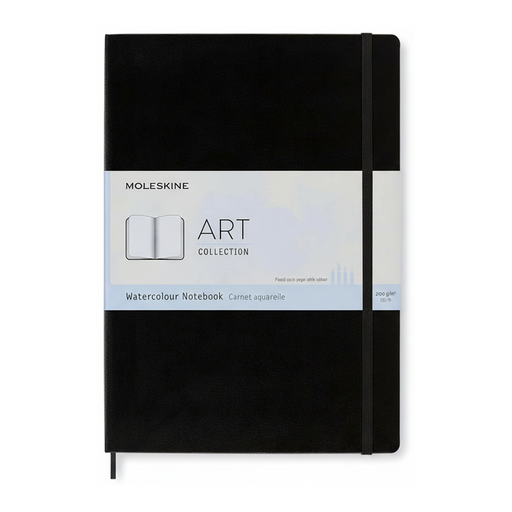
Why we love it
Moleskine needs no introduction, with its iconic design and impeccable craftsmanship. With its hardcover and famous elastic closure, it's the ideal travel companion for protecting your creations. Its stitched binding allows it to open perfectly flat, a major asset for painting across a two-page spread.
Key features
- 200 gsm ivory paper: An acid-free paper that performs very well with water, keeping buckling to a minimum for this weight.
- Premium finish: Hardcover, elastic closure, and the traditional expandable inner pocket for slipping in notes and inspiration.
- Lay-flat opening: The stitched binding ensures a comfortable and continuous work surface on this A4 drawing notebook format.
- FSC certified paper: An assurance that the paper comes from sustainably managed forests.
Who is it for?
For nomadic artists and illustrators who want a professional sketchbook that is as beautiful as it is practical, suitable for watercolor, ink, and mixed media. It's also a superb object for archiving your work.
CLAIREFONTAINE Aquapad Spiral Notebook A4+
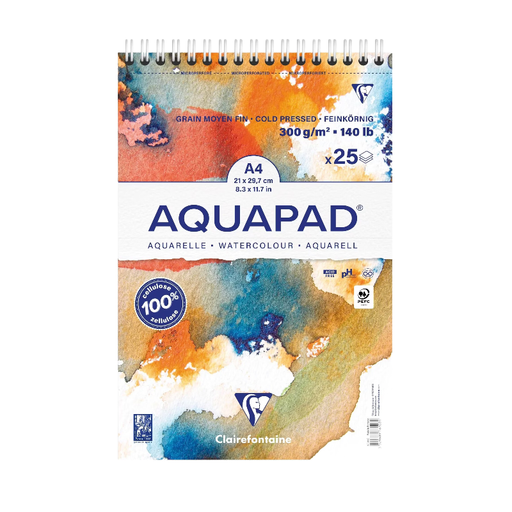
Why we love it
The Clairefontaine Aquapad is the choice for pure watercolor performance. With its 300 gsm paper, it offers impeccable absorption and resistance to buckling, all at a very accessible price point.
Key features
- Heavyweight 300 gsm: Perfect for water-heavy techniques, like large washes or wet-on-wet work.
- Versatile cold press grain: Its 100% cellulose surface offers just enough texture for beautiful effects without sacrificing detail precision.
- Practical spiral binding: The 360° opening makes it equally at home on a studio desk or out in nature.
- Optimal preservation: Its acid-free paper ensures excellent color retention and prevents your artwork from yellowing over time.
Who is it for?
For art students and artists who produce numerous studies in watercolor or gouache. Its excellent quality-to-weight ratio makes it the ideal practice pad for honing wet techniques without fear of the paper buckling.
Ohuhu Sketchbook - Double-Sided 150GSM
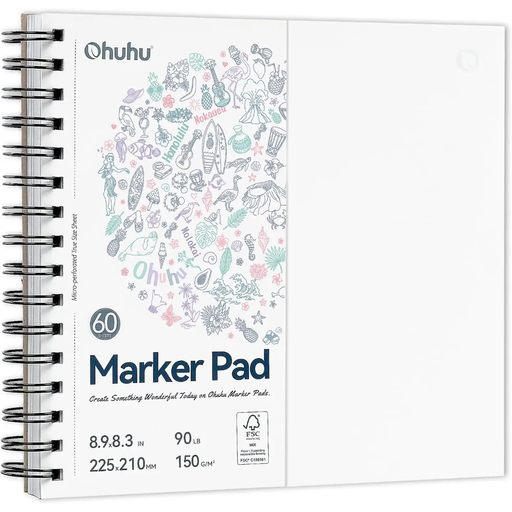
Why we love it
This Ohuhu sketchbook is unconventional, with paper optimized for alcohol markers and a trendy square format. Don't be fooled by its light 150 gsm weight: its paper is treated to be bleedproof, which is the holy grail for illustrators.
Key features
- Bleedproof paper: Marker ink doesn't feather or bleed through. The result: you can use both the front and back of every sheet!
- Square format and detachable pages: Its 8.9 x 8.3" (22.6 x 21.1 cm) format is perfect for Instagram compositions, and its micro-perforated pages tear out cleanly.
- Sturdy spiral binding: It allows the sketchbook to lay completely flat for maximum comfort.
- Versatile: Optimized for markers, it also works very well with pencil, ink, and very light watercolor washes.
Who is it for?
Clearly for illustrators, mangakas, and creatives who work primarily with alcohol markers. It's the quintessential alcohol marker sketchbook, while still being flexible enough for venturing into dry or low-moisture mixed media.
Looking for other options?
Our selection highlights sketchbooks with distinct profiles. But the world of art paper is vast! To explore other formats, textures, or brands, feel free to browse our complete collection.
Discover our complete collection of manual drawing books
Frequently Asked Questions (FAQ)
1. What paper weight should a beginner choose for a watercolor sketchbook? To start, a paper of at least 200 gsm is a good baseline for learning to manage water. That said, a 300 gsm paper like the one in the Clairefontaine Aquapad will be much more forgiving: it handles excess water and allows you to experiment freely, without the fear of the paper buckling.
2. Can you use alcohol markers on classic watercolor paper? It's possible, but not ideal. Classic watercolor paper, especially with a very textured grain (rough press), tends to "drink" the ink unevenly and can even prematurely damage your marker nibs. For a flawless result, nothing beats a smooth, bleedproof paper like the one in the Ohuhu sketchbook.
3. How do you prevent watercolor paper from buckling? The first step is to choose a heavy weight (300 gsm or more). If you're working on lighter paper or with a lot of water, a useful trick is to stretch your sheet by taping all four edges to your work surface with masking tape. Only remove it once your painting is completely dry. Finally, pads that are glued on all four sides are specifically designed to counteract this phenomenon.


