
Livraison le jour même ou le lendemain

Qualité garantie

Débloquez vos offres de bienvenue: Livraison GRATUITE | Jusqu'à -80 % | 30 jours d'essai gratuits à JoyPlus
Téléchargez l'application
The watercolor pencil is a fascinating hybrid tool, sitting halfway between drawing and painting. It combines the precision of a line with the fluidity of watercolor. However, choosing the right set can quickly become overwhelming. Faced with flashy packaging and sometimes vague marketing promises, it's easy to end up with a product that falls short. To help you avoid these pitfalls, let's review the most common mistakes.
The 3 Mistakes to Avoid When Buying Watercolor Pencils:
To navigate the watercolor pencil jungle, you just need to focus on a few technical details that make all the difference.
By understanding what defines a good watercolor colored pencil, you can make an informed choice that is perfectly suited to your practice and your budget.
These two aspects go hand in hand. High pigmentation means the pencil deposits a large amount of color on the paper with little effort. This is your guarantee of achieving rich, vibrant hues, whether used dry or diluted.
Solubility is the ability of these pigments to dissolve in water. A quality pencil will dissolve completely and evenly when a wet brush is passed over it, creating smooth washes without leaving ugly pencil marks or grainy residue. The test is simple: create a patch of color, run a wet brush over it, and observe. The transition should be perfectly seamless.
The robustness of the lead is a guarantee of comfort and durability. Manufacturers like Faber-Castell use specific bonding processes (such as SV or Secural Bonding) to fuse the lead to the pencil barrel along its entire length, making it much more resistant to breakage. A thick lead, between 3.3 and 3.8 mm in diameter, is often a good indicator of strength, especially on professional watercolor pencils.
Lightfastness (or permanence) measures how well the colors last over time. It is usually indicated by a star system or a code directly on the pencil barrel or packaging. For a watercolor drawing meant to last for years, choose pencils with the highest lightfastness rating.
The packaging is more than just an aesthetic detail. A metal watercolor pencil set is lightweight, compact, and effectively protects the pencils, making it ideal for travel. A more prestigious wooden case is perfect for studio storage and makes an excellent gift for an artist.
In terms of colors, a well-chosen set of 12 to 24 shades is more than enough for beginners to practice mixing. Larger sets (72 colors and up) are aimed at experienced artists seeking an extensive palette for nuanced work.
To help you see more clearly, we've matched a few user profiles with products that meet their specific needs.
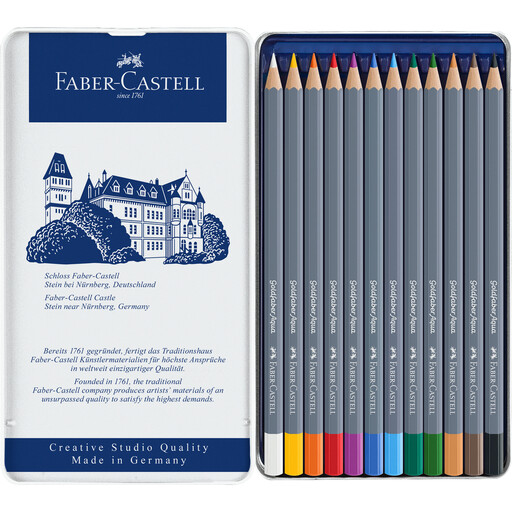
Why we chose it: It's the ideal entry point for learning the technique with the quality of a major brand. Its price-performance ratio is perfectly positioned for art students or hobbyists who want reliable materials without upgrading to a professional range.
It offers rich pigmentation and perfect solubility, which prevents the disappointment of dull washes typical of low-end products. The lead is robust for regular use.
Exemplary solubility for smooth gradients and even application. The sturdy metal tin is a bonus for transport.
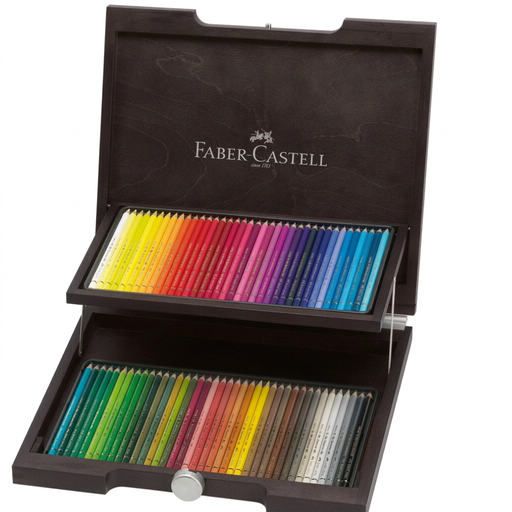
Why we chose it: This is THE benchmark for professional artists. This set is for those who demand maximum performance, color permanence, and an extensive palette for uncompromising work. The wooden case protects this investment while adding to its value.
It checks all the boxes: ultra-concentrated pigments, exceptional lightfastness (indicated on each pencil), and a thick 3.8 mm lead with anti-break SV bonding.
Archival quality. Its acid-free pigments and high lightfastness ensure the longevity of artworks. The 72-color palette offers nearly infinite creative freedom.
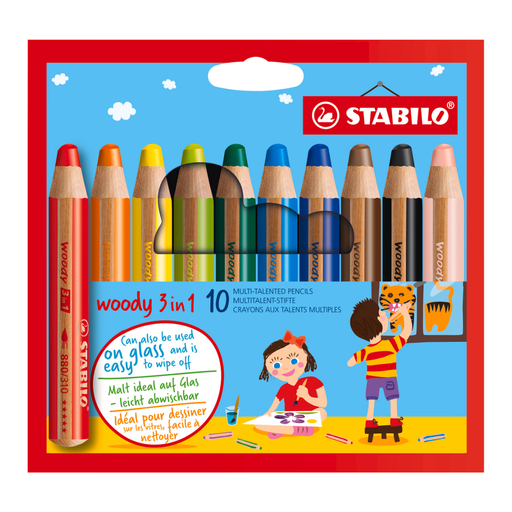
Why we chose it: This product is the Swiss Army knife of family creative activities. Its chunky barrel is easy for little hands to grip, and its XXL lead is designed to withstand the roughest handling. A tool that's as fun as it is versatile.
Its 10 mm lead is nearly unbreakable, which definitively solves the problem of repeated breakage. Its 3-in-1 formula means you don't have to buy three different products (wax crayon, colored pencil, and watercolor).
3-in-1 versatility. It writes on multiple surfaces (paper, cardboard, glass, metal...) and wipes away from smooth surfaces with a damp cloth. A real bonus for parents!
Discover our full, updated selection of products that meet our quality criteria and current safety standards.
The fundamental difference lies in the binder that holds the pigments together. The binder in a watercolor pencil is water-soluble, allowing the colors to be diluted and behave like watercolor paint. Conversely, a traditional colored pencil uses an oil- or wax-based binder, which is water-resistant and therefore does not dissolve.
For optimal results, it is essential to use paper specifically designed for watercolor. A fine-grain or hot-press paper with a weight of at least 200 g/m? (and ideally 300 g/m?) will withstand moisture without buckling or tearing. Standard printer paper (80 g/m?) should be avoided.
To preserve their quality, store them in their original case (metal or wood) to protect the leads from impact. Keep them in a dry place, away from direct sunlight and humidity, which could damage both the pigments and the wood of the pencils. If you have dipped the tip directly in water, make sure it is completely dry before putting the pencil away.