
Livraison le jour même ou le lendemain

Qualité garantie

Débloquez vos offres de bienvenue: Livraison GRATUITE | Jusqu'à -80 % | 30 jours d'essai gratuits à JoyPlus
Téléchargez l'application
By the Joybuy Editorial Team | Published August 28, 2026
The water flosser, also known as a water irrigator or oral irrigator, has established itself as an essential tool for perfecting your oral hygiene routine. Its promise? A deep interdental cleaning, making it a valuable ally for those with braces, implants, or sensitive gums. However, faced with an overwhelming number of options, it's easy to fall for marketing traps and end up with an unsuitable device.
This guide is here to help you see things more clearly, decode the spec sheets, and choose the model that will truly meet your needs—without the unnecessary frills.
Before comparing models, let's first break down the design flaws and misleading marketing claims that can quickly turn a good deal into a daily hassle.
To ensure you make the right choice, here are the three technical points that will make all the difference in the daily use of your future oral irrigator.
Water pressure, expressed in PSI (Pound-force per Square Inch), is the power of your device. Forget the race for the highest PSI; what's important is having a choice, with a wide adjustment range and various modes.
These two elements depend on your profile: for home use or on the go?
The tips, or nozzles, allow you to adapt the water jet to specific needs.
Ergonomics is another point not to be overlooked: a 360° rotating tip makes it much easier to access the most difficult-to-reach areas of the mouth.
Let's get practical with our selection of models that tick the right boxes for different user profiles.
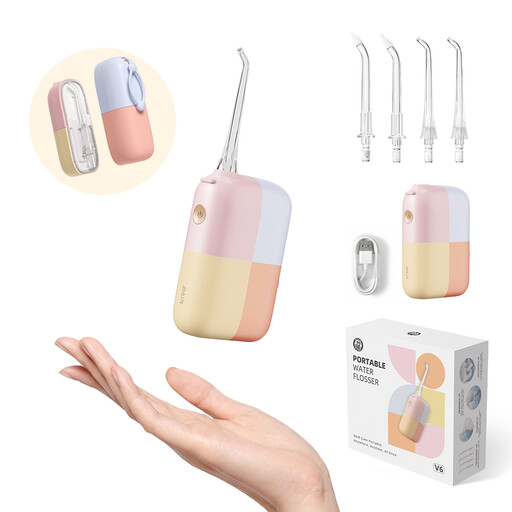
Why it's for you: Designed for life on the go, this model retracts to become as compact as a smartphone. Add a 30-day battery life and integrated tip storage, and you have the ideal travel companion.
It shatters the "false portability" myth with its ultra-compact design and feather-light weight (145 g). Its magnetic reservoir, which is incredibly simple to clean, also eliminates the risk of it becoming a bacterial breeding ground.
Patented retractable design; 30-day battery life and USB-C charging; integrated tip storage.
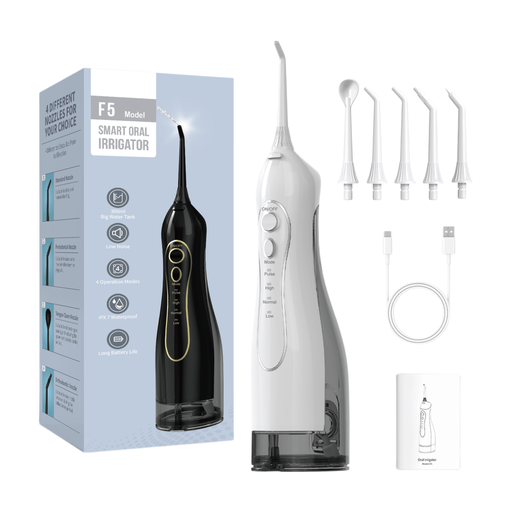
Why it's for you: Perfect for those with braces or sensitive gums. Its secret? A wide pressure range and 5 specialised tips, including an orthodontic and a periodontal one.
It avoids the "single-pressure" trap with its 5 adjustable modes. This allows you to start gently (40 PSI) and gradually increase the intensity, an ideal approach to accommodate all sensitivity levels.
5 pressure modes for tailored care; 5 specialised tips included; easy-to-maintain 300 ml removable tank.
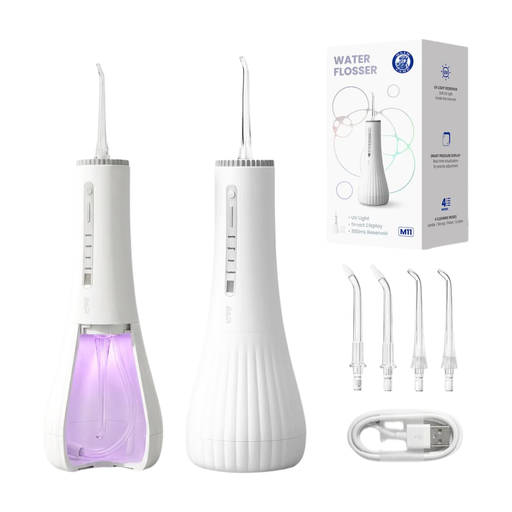
Why it's for you: Aimed at those who want a complete and flawless solution for daily use. Its large 360 ml tank and UV tip sanitization make it a staple in the family bathroom.
It tackles the "unsanitary tank" trap head-on with its UV sanitization feature, which claims to eliminate 99.9% of bacteria on the tip. Its large reservoir is also a model of practicality for filling and cleaning.
UV tip sanitization; generous 360 ml tank; IPX8 waterproof rating.
We have curated a complete range of products that meet our demanding selection criteria and European safety standards.
No, the water flosser and dental floss aren't mutually exclusive; they're complementary. The water flosser excels at dislodging food debris and cleaning hard-to-reach areas (around braces, under dental bridges). Dental floss, meanwhile, retains its advantage for removing sticky plaque through direct mechanical action on the tooth's surface. For impeccable hygiene, the combination of both is often the best strategy.
To ensure its longevity and hygiene, the best practice is to empty the reservoir after each use. A weekly cleaning of the tank with warm, soapy water, followed by a thorough rinse, is recommended. For monthly descaling, run the device with a mixture of water and white vinegar (two parts water to one part vinegar), then run a cycle with clean water to rinse the system thoroughly.
As a general rule, stick to lukewarm water. Some manufacturers allow the addition of diluted mouthwash, but it is essential to always check your model's user manual. Using unauthorised liquids can damage the water flosser's internal circuits. And if you do use an approved and diluted mouthwash, always remember to rinse the device by running a full cycle with clean water immediately after.