People with a narrow recess or limited access route
Compare the width, depth, height and opening space separately. Que Choisir states that top-loading washing machines sold in France are generally 40 to 46 cm wide.


Measure the space, delivery route, opening area and connections before choosing a format: the smallest model is not always the most practical. A top-loading machine is best when width is limited and its lid remains accessible, while a slim front-loader is useful when depth is restricted but there is still clear access to the door. Capacity should then match your usual washing loads.
Compare the width, depth, height and opening space separately. Que Choisir states that top-loading washing machines sold in France are generally 40 to 46 cm wide.
Check the electrical position and the area around a shower or bath before comparing formats. Promotelec states that a washing machine must be earthed, protected by a 30 mA residual-current device and installed beyond zone 2.
A slim model can reduce how far the appliance projects into the room, but the door and loading area still require clear space in front of the machine. Capacities vary between models, including among reduced-depth washing machines.
Start with the space that is genuinely available for use, then check the capacity, installation requirements and consumption information for the exact model.
| Priority | What to check | Your needs |
|---|---|---|
| Dimensions and opening | Measure the exact washing machine’s width, depth and height. Allow for the delivery route, connections and the space needed for the door or lid. | I want the appliance to fit into the recess without obstructing a door, drawer or everyday loading. |
| Loading format | A top-loader mainly saves width, but the area above it must remain clear. A slim front-loader reduces the depth of the cabinet, while still requiring front access. | My main constraint may be width, depth or a lack of space above the machine. |
| Useful capacity | Compare the rated capacity in kg with your usual loads. According to Que Choisir, a drum that is too small can mean running more cycles, while a large drum that is poorly filled can lead to unnecessary consumption. | I want a capacity that covers my regular washing without choosing a bulkier format than necessary. |
| Bathroom installation | Check the position in relation to the room’s zones, the earthing and the 30 mA residual-current protection. In a cupboard, consider the doors when open to assess the installation area properly. | Near a shower or bath, I need to confirm that the location is suitable before ordering. |
| Energy label | Compare the energy-label information and the capacity of the reference programme. The European Commission specifies that energy labelling applies to household washing machines. | I want to compare regulated data between models, without assuming that a smaller or larger appliance will use less energy for every type of use. |
A slim front-loader reduces the appliance’s depth, but you still need to open the door and load the washing. A narrow top-loader, meanwhile, requires clear space above the lid.
Measure the closed appliance and the opening area, then mark both on a plan of the room alongside doors, drawers and nearby fixtures.
The width-saving benefit of a top-loader is lost if a worktop or shelf prevents you from opening the lid and loading the washing.
Choose a top-loader only if the area above it remains accessible. For under-worktop installation, consult the documentation for the front-loading or integrated model you are considering.
The presence of a cupboard and the reduced size of a washing machine do not make the location suitable if it is within zone 2. Promotelec specifically asks users to consider the cupboard doors when open.
Check the zones, earthing and 30 mA residual-current protection before buying. If you are unsure about the positioning, consult a qualified professional.
Depending on the room layout, the electrical installation or connections may need to be adapted or moved.
A drum that is too small can mean running more cycles. Conversely, an appliance that is regularly underloaded may use water and electricity unnecessarily, according to Que Choisir.
Start with your usual laundry volume and washing frequency, then choose the smallest capacity that covers these needs without requiring extra cycles.
Electrolux provides a useful benchmark for comparing a narrow top-loader with a slim front-loader. The official product pages cited include a 7 kg EW6T5127BG top-loader and a 6 kg EW6S1064NA slim front-loader with a depth of 411 mm.
Candy can be used as a comparison point for reduced-depth front-loaders and high capacities in a compact format. The ProWash 550 BP 48SBL6-S specification states 8 kg, 59,5 × 48,8 × 88 cm and 1 400 rpm.
Whirlpool is a useful benchmark when integrating the appliance into furniture is a priority. The official specification for an 8 kg integrated washing machine states that it is 59,5 cm wide, 54,5 cm deep and 81,5 cm high.
Bosch’s French range includes front-loading, compact and integrated washing machines, allowing you to compare several installation families.
These Joybuy options illustrate two formats suited to different constraints: a top-loader for a narrow recess and a standard front-loader where the space can accommodate greater depth.
 Image unavailable
Worth considering for a narrow recess: its stated width of 40,5 cm may fit where a front-loader close to 60 cm wide will not.
Stated dimensions: 86 × 40,5 × 60 cm. Top loading, 6 kg capacity, 17 programmes, B energy rating and 1 400 rpm. Leave sufficient clearance above the machine for the lid.
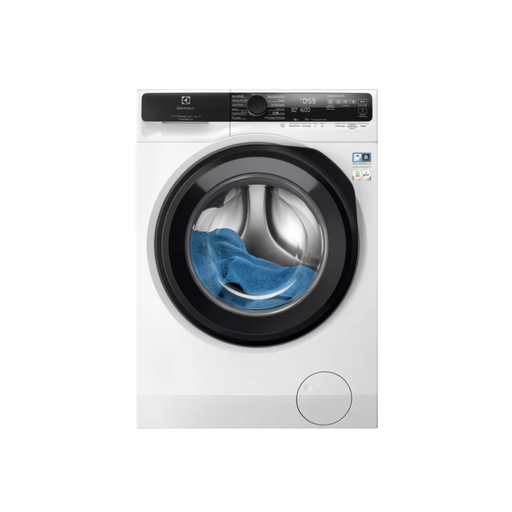 Image unavailable
This standard front-loader is suitable only if the space can accommodate its width and depth, with clear access in front of the door.
Stated dimensions: 84,7 × 59,7 × 66 cm. 9 kg capacity, front loading, A energy rating and 1 600 rpm. Check the manual for under-worktop installation and the required clearances.
No. Measure the width, depth and height, then check the delivery route, access to the water inlet and waste connections, and the opening area for the door or lid. Que Choisir also lists under-worktop installation and a removable top among the points to check.
It is mainly narrower. Que Choisir gives a width of 40 to 46 cm for top-loaders, but their depth can still be close to 60 cm; the Electrolux EW6T5127BG example measures 89 × 40 × 60 cm. You also need to leave space above the machine to open the lid.
Yes, but the term ‘slim’ does not guarantee a particular capacity. The official specifications cited range from a 6 kg Electrolux with a depth of 41,1 cm to an 8 kg Candy with a depth of 48,8 cm. Compare the exact model with your usual loads.
Yes, subject to certain conditions. Promotelec states that it must be earthed, supplied by a circuit protected by a 30 mA residual-current device and positioned beyond zone 2. With a walk-in shower, Promotelec specifies that zones 0, 1 and 2 remain excluded, even with 30 mA protection.
Not necessarily. Que Choisir states that a drum that is too small can mean running more cycles, while an appliance that is too large and insufficiently filled can lead to unnecessary consumption. Choose a capacity that matches the loads you actually wash after confirming that the appliance will fit.