Which households is it for?

One- or two-person households with moderate washing needs

Your main aim is likely to avoid a drum that is too large for loads that are often only partly filled. UFC-Que Choisir states that a capacity of 5 to 7 kg is generally sufficient for one person or a couple, depending on sorting habits and bulky fabrics.

Families who regularly wash bedding, towels or children's clothes

A capacity of 8 to 10 kg is worth considering when laundry baskets are regularly full or bulky items are common. However, check the permitted loads for synthetic, denim and wool programmes.

People living in homes with limited laundry space

Choose between a narrow top-loader, a shallow front-loader or a front-loader that fits beneath a worktop. The clearance in front of or above the appliance matters just as much as the dimensions of the recess.

Buying priorities

Standard front-loader

Consider it if: you have around 60 cm of width and enough space in front of the door for a versatile capacity.

Good to know: the door needs clearance at the front, and a large drum only makes sense if it is regularly filled properly.

Top-loader

Consider it if: available width is the main constraint or loading from above would be more convenient.

Good to know: you need to leave space above the lid, and capacity rarely matches that of a family-sized front-loader.

Shallow front-loader

Consider it if: depth is limited but standard front-loader width is still possible.

Good to know: compare the total depth with the door, connections and opening taken into account, rather than relying solely on the word ‘slim’.

Priority What to check Your needs
Capacity and fabrics Compare the capacity in kg with your usual dry laundry loads. Also check the limits for each programme for synthetics, denim and woollens. I want to wash my usual loads without running multiple cycles, while avoiding a drum that is often underfilled. UFC-Que Choisir generally recommends 5 to 7 kg for one person or a couple, and 8 to 10 kg for a family with children.
Size and installation Measure the width, height, total depth, connections and door or lid clearance. A top-loader is commonly 40 to 46 cm wide, while a front-loader is generally around 60 cm wide. In a narrow room, I need to choose between saving width with a top-loader or reducing depth with a compact front-loader, without forgetting the space needed to open it.
Noise, duration and spin Check the Eco 40-60 duration, spin noise in dB, noise class and spin-drying efficiency class on the label. Compare these figures for the same reference programme. If the appliance is close to a living area or laundry often dries indoors, I want to assess noise, cycle duration and spin performance before choosing.
Maintenance and durability Locate the filter, seals and maintenance compartments in the manual. Compare the durability index shown for the exact model and the information available on spare parts. I prefer an appliance whose routine maintenance is easy to access and whose repair information is straightforward to compare.

Mistakes to avoid before buying

  • Relying solely on the stated capacity

    An 8 or 9 kg drum does not necessarily accept that load on synthetic, denim or wool programmes. A drum that is too small can also mean running more cycles.

    Base your choice on your usual dry laundry loads and check the load table in the manual for the exact model.

  • Measuring the recess without allowing for the opening

    A front-loader needs clearance in front of the door, while a top-loader requires free space above it. A slim model often still has a standard width.

    Before ordering, measure the width, height, total depth, door or lid clearance, access to water inlets and connection space.

  • Comparing only the energy class

    UFC-Que Choisir identifies wash duration and spin noise among the areas for improvement highlighted by its respondents. The energy label also shows the Eco 40-60 duration, noise level and spin-drying efficiency.

    Place the label figures for your shortlisted models side by side, using the same reference programme. Consider spin performance if laundry is often dried indoors.

  • Putting off filter, seal and descaling maintenance

    ADEME states that 50 to 70% of appliance breakdowns are linked to insufficient maintenance or incorrect use. Access to the filter is also cited by UFC-Que Choisir as an area for improvement.

    Before buying, locate the filter in the manual. After installation, regularly maintain the filter, seals and appliance in accordance with the manufacturer’s instructions.

    ADEME states that the Repair Bonus can range from 25 € to 50 €, depending on the type of repair and the size of the appliance, when using an approved repairer.

Brand guide

Bosch

Worth considering for a household looking for a 9 kg front-loader in a standard format.

  • Bosch Électroménager France lists the WAN28219FR as having a 9 kg capacity, 1 400 rpm spin speed and dimensions of 845 × 598 × 590 mm.
  • Its depth of almost 59 cm must be compatible with the recess, connections and door clearance.

Electrolux

A top-loader option to consider when available width is close to 40 cm.

  • Electrolux France presents the YW7T3713DA as a 7 kg top-loader measuring 890 × 400 × 600 mm.
  • The reduced width comes with a more limited capacity than an 8 to 10 kg family-sized front-loader.

LG

Worth considering if you want to combine reduced depth with a high stated capacity, after checking the model’s full dimensions.

  • LG presents the F92SR50WHS as a 9 kg slim front-loader with a depth of 53.5 cm.
  • LG states a repairability index of 8.6/10 for this model; this declaration applies to this specific model and not to the entire range.

Miele

An 8 kg front-loader option to compare if you are looking for an intermediate capacity.

  • Miele states that the WWA120 WCS has an 8 kg capacity and a spin speed of 1 400 rpm.
  • The brand’s claims about service life or features should be considered alongside the applicable warranty, programmes and model dimensions.

Washing machine options on Joybuy

Joybuy options for comparing front-loading washing machines, a top-loader and a shallow model according to your household’s laundry volume and available space.
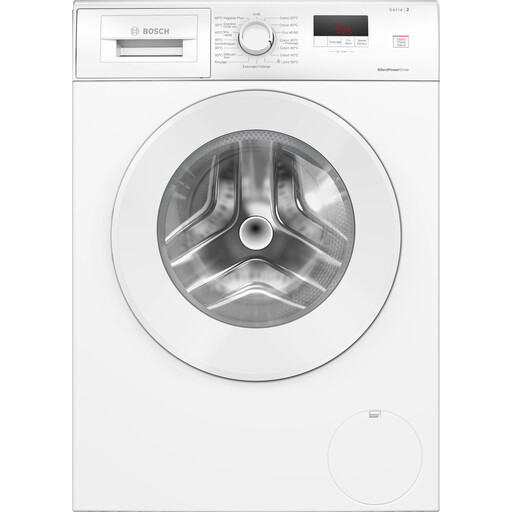
Bosch WGE02407FR 7 kg front-loading washing machine

Bosch WGE02407FR 7 kg front-loader, 1 400 rpm

Worth considering for a one- or two-person household with moderate loads, provided a front-loader with a door can be installed.

7 kg capacity, 1 400 rpm and energy class A. The total depth with the door is stated as 63.2 cm: also check the door clearance and connections.

Joybuy
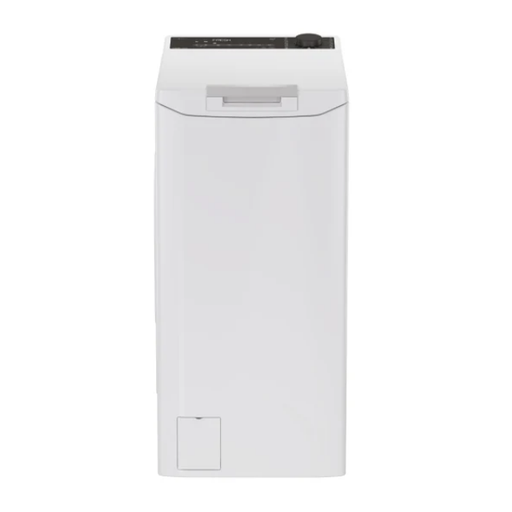
Haier T Series 7 THASN276TM6-S 7 kg top-loading washing machine

Haier T Series 7 THASN276TM6-S 7 kg top-loader

This top-loader format may suit you when a narrow width is the priority and there is free space above the lid.

7 kg capacity, 1 200 rpm spin speed, energy class A and stated width of 40.5 cm. The stated spin noise is 77 dB(A), class C.

Joybuy
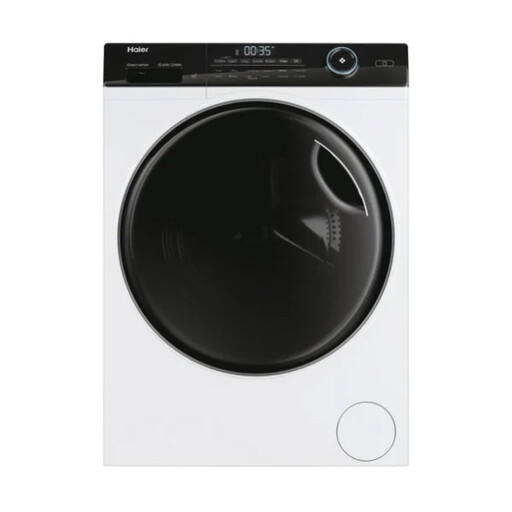
Haier HW90-B14959U1 I-Pro Series 5 9 kg front-loading washing machine

Haier HW90-B14959U1 I-Pro Series 5, 9 kg

A capacity worth considering for families who regularly wash bedding, towels or other bulky loads.

9 kg capacity, 1 400 rpm, energy class A, width of 595 mm and depth of 583 mm. The stated spin noise is 70 dB(A), class A.

Joybuy
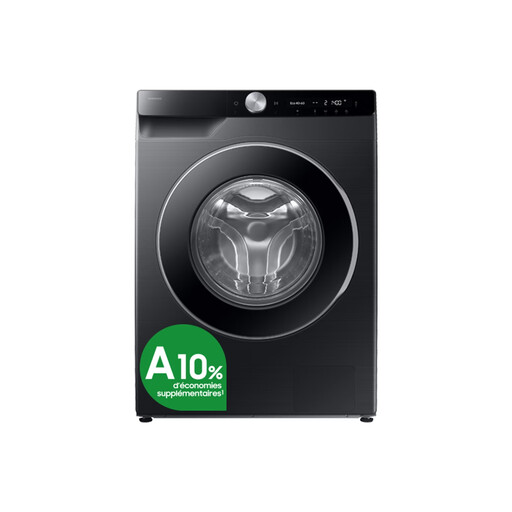
Samsung WW90DG6U85LBU3 AI Wash 6000 Series 9 kg front-loading washing machine

Samsung WW90DG6U85LBU3 AI Wash 6000, 9 kg

A 9 kg front-loader option for a household with regularly full laundry baskets, provided you can install a standard-width model.

9 kg capacity, energy class A and stated depth of 55 cm without the door, or 63 cm with the door. Spin noise is listed at 72 dB and the Eco 40-60 duration at 3 h 48.

Joybuy
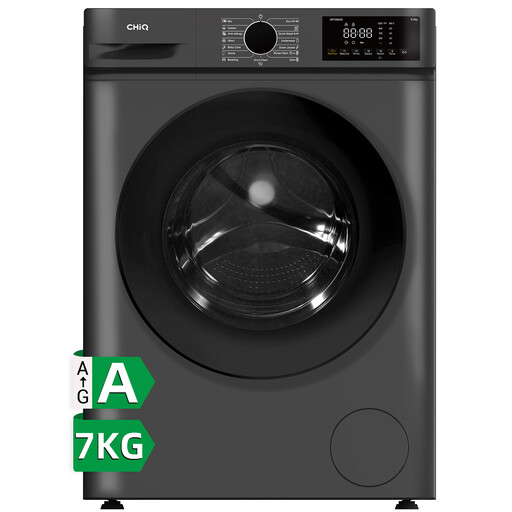
CHiQ JW75883G 7 kg front-loading washing machine

CHiQ JW75883G 7 kg front-loader, 1 200 rpm

Worth considering for a household with moderate loads that has the width for a front-loader but wants to limit depth.

7 kg capacity, energy class A, 1 200 rpm and stated depth of 47 cm. Measure the depth with the door and connections before installation.

Joybuy

Frequently asked questions

Does the stated capacity in kg apply to every programme?

No. The capacity refers to the weight of dry laundry accepted for cotton or the Eco 40-60 programme. UFC-Que Choisir states that an 8 kg appliance may have lower load limits for synthetics, denim or wool: check the manual if these fabrics are common in your household.

What should you check on the energy label before buying?

Compare the energy class from A to G, kWh per 100 cycles, litres per cycle, Eco 40-60 duration, spin noise and its class, as well as the spin-drying efficiency class. The European Commission explains that these figures relate to the reference programme and do not describe every programme duration.

Is the durability index useful when choosing a washing machine in France?

Yes, it is useful information to compare for the exact model. The French decree of 5 April 2024 governs the calculation, communication and display of the durability index for the categories concerned, while the order issued on the same day sets the criteria applicable to household washing machines.

How can you limit breakdowns and maintenance costs after buying?

Follow the instructions in the manual, descale the appliance regularly, and clean the filters and door seals. ADEME states that 50 to 70% of appliance breakdowns are linked to insufficient maintenance or incorrect use. If a fault occurs, the Repair Bonus may apply when using an approved repairer, depending on the repair required.