Households whose laundry baskets fill up quickly
Towels, clothes and bedding pile up regularly. The aim is to wash your usual loads without running extra cycles or choosing a drum that is rarely full.


Choose a capacity based on your usual loads, rather than how often you do the washing. ADEME says 7 kg is often enough, while UFC-Que Choisir generally recommends 8 to 9 kg for a household of 3 to 4 people, reserving 10 to 12 kg for households that regularly wash genuinely large loads. A front-loader is a good option if its door and dimensions fit the space; a top-loader is mainly suited to situations where width is an issue. Then compare the energy and water consumption, noise, spin performance and durability index of the specific model.
Towels, clothes and bedding pile up regularly. The aim is to wash your usual loads without running extra cycles or choosing a drum that is rarely full.
Whether it’s going in a kitchen, bathroom or cupboard, you need to consider the depth, how the door or lid opens and access to the connections—not just the width.
If the appliance will be used frequently, compare the stated energy and water consumption, spin noise and information on repairability and reliability for each model.
Consider it if: you regularly wash 8 to 9 kg loads and there’s enough room to open the door.
Bear in mind: you’ll need to allow for the machine’s depth, connections and access for maintenance, as well as the space it occupies.
Consider it if: there isn’t enough width for a front-loader and the lid can open freely.
Bear in mind: check that the model’s capacity is enough for your household’s loads, especially larger washes.
| Criteria | What to check | To suit your needs |
|---|---|---|
| Capacity | Compare the loads you actually wash with the machine’s rated capacity. Also check the maximum load for the programmes you use with different fabrics. | “My laundry baskets are often full, but I don’t want to run lots of small cycles.” ADEME says 7 kg is often enough; UFC-Que Choisir generally recommends 8 or 9 kg for households of 3 to 4 people, and suggests 10 to 12 kg when large loads are a regular occurrence. |
| Space | Measure the width, height and depth, then check the clearance needed for the door or lid. Make sure you can access the water inlet and waste outlet. | “Space is tight, but I still need to be able to load the machine once it’s in place.” UFC-Que Choisir says top-loading models are generally 40 to 46 cm wide. |
| Everyday use | Compare the kWh per 100 cycles, litres per cycle, eco programme duration and noise level on the energy label. Check the spin-drying efficiency class separately. | “The machine will be near living areas” or “I dry my washing indoors”: in these cases, spin noise and spin performance matter just as much as the stated consumption. ADEME recommends checking this information on the energy label. |
| Durability | Compare the durability index and its component criteria for the exact model. Check the dimensions, noise level and programmes separately: they aren’t measured by the index. | “I plan to use this appliance often and want to compare its reliability and repairability.” According to the French Ministry of the Economy, the durability index has applied in France to domestic front-loading and top-loading washing machines since 8 April 2025. |
An unsuitable capacity can lead to excessive consumption or, conversely, more frequent washing, as UFC-Que Choisir points out. How often you run a cycle doesn’t, by itself, tell you what capacity to choose.
For a week or two, keep an eye on the size of your laundry loads and how often you have larger washes. Then compare them with the capacities of the programmes you’ll use.
A front-loader needs enough room for its door to open; a top-loader needs space for its lid. You’ll also need access to the connections once the appliance is in place.
Measure the whole space and check the installation instructions for the exact model before ordering, especially if you’re installing it in a bathroom.
The maximum spin speed alone doesn’t tell you how noisy the machine is or how much energy and water a cycle uses. ADEME points out that the energy label lets you compare this information on a consistent stated basis.
Consider the litres per cycle, kWh per 100 cycles, eco programme duration, noise level and spin-drying efficiency class in light of how you’ll use the machine.
The index gives an indication of reliability and repairability based on its criteria. It doesn’t measure washing performance or noise, and it doesn’t guarantee how long a particular appliance will last.
Check the details of the index for the model you’re considering, then look separately at its capacity, dimensions and maintenance requirements.
These points relate to specific models or manufacturer statements. Always compare the exact model that suits your space and laundry loads.
Worth considering for a front-loader with a standard capacity, and for information on spare parts for a specific model.
Compare its front-loaders in different depths and capacities by checking the specifications for each exact model.
Worth considering when limited width points you towards a top-loading model.
Worth considering if the manufacturer’s published endurance information is one of your comparison criteria.
These models include 8 or 9 kg front-loaders for regular loads, as well as a 6 kg top-loader for spaces where width is limited. Before choosing, compare the capacity with your laundry loads, check the installation space and consult the durability index that applies to the model sold in France.
 Image unavailable
Worth considering if your loads regularly reach 8 kg. The model name indicates a maximum spin speed of 1 400 tr/min; check the space needed for the door and the load limits for each programme.
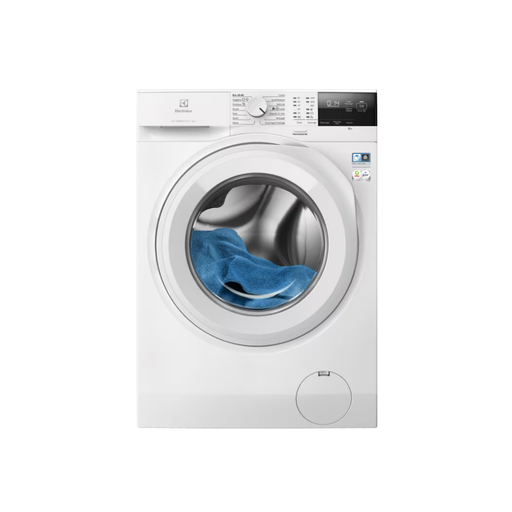 Image unavailable
Worth comparing for regular, medium-sized loads. Electrolux lists a spin speed of 1 400 tr/min and a depth of 576 mm for this model; also allow enough clearance for the door.
 Image unavailable
A top-loader is worth considering if width is your main constraint, provided there’s room to open the lid. With a stated capacity of 6 kg, compare it with your usual larger loads; the model name indicates a maximum spin speed of 1 400 tr/min.
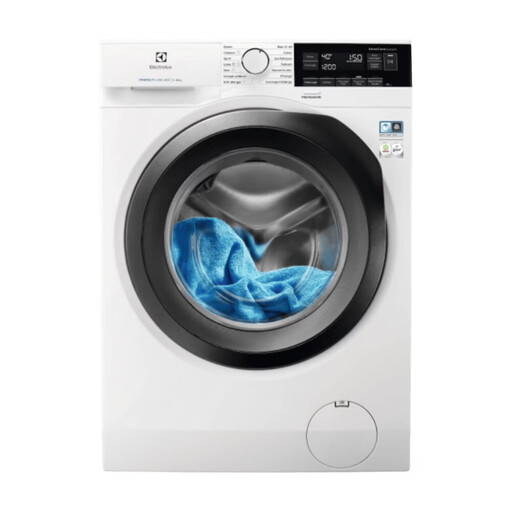 Image unavailable
Worth considering if 8 kg loads suit your laundry routine. The model name indicates a maximum spin speed of 1 400 tr/min and energy class C; check the energy label to compare consumption on a like-for-like basis.
 Image unavailable
The stated 9 kg capacity is worth considering if you regularly wash large loads, rather than just occasionally. The model name indicates a maximum spin speed of 1 600 tr/min; check the available depth and the maximum loads for the programmes you use.
Start with the size of the loads you actually wash, not just the number of cycles. ADEME says 7 kg is often enough; UFC-Que Choisir generally recommends 8 or 9 kg for a household of 3 to 4 people, reserving 10 to 12 kg for households that regularly wash genuinely large loads.
No: the rated capacity doesn’t necessarily apply to every programme. Check the manual for the permitted load for the fabrics you wash often, particularly synthetics, wool and delicates.
It may be a good option if width is an issue, provided the lid can open freely and the capacity is enough for your household. UFC-Que Choisir says top-loaders are generally 40 to 46 cm wide; also measure their depth and the space above the appliance.
It helps you compare the repairability and reliability of the models covered, but doesn’t guarantee how long each appliance will last. According to the French Ministry of the Economy, it has applied in France to domestic front-loading and top-loading washing machines since 8 April 2025; check the details of the criteria for the model you’re considering.
Installation depends on the location and the bathroom’s electrical safety. Promotelec says, among other things, that a washing machine in a bathroom must be earthed, protected by a 30 mA residual-current device and installed outside electrical safety zone 2. If you’re unsure whether these conditions are met, have the installation checked, then follow the instructions for your model.