A narrow alcove
If a standard front-loader won’t fit between your units, a top-loader is worth considering. Check its depth too, and make sure there’s enough room to open the lid fully.


If width is limited, consider a top-loading washing machine first, provided you have room to open the lid. If depth is the issue, compare slim front-loaders and leave enough space in front of the door. A standard front-loader may also work if the space, connections and door clearance allow it. In every case, compare your measurements with the installation diagram for your chosen model, then check that its capacity suits your laundry needs.
If a standard front-loader won’t fit between your units, a top-loader is worth considering. Check its depth too, and make sure there’s enough room to open the lid fully.
If there’s enough width for a front-loader but the machine could obstruct the walkway, compare slim models. Make sure you can still open the door once the appliance is in place.
If there’s enough depth and space in front of the machine, a standard front-loader may offer a capacity suited to your household’s laundry. If you’re fitting it under a worktop, check the height and the instructions for the specific model.
First identify which dimension is causing the problem, then check the opening, capacity and installation requirements. Measuring the appliance alone isn’t enough to confirm it will fit in your room.
Consider one if: width is your main constraint and the lid can open freely.
Bear in mind: a narrower width doesn’t necessarily mean a shallower appliance, or one that can be installed under a worktop.
Consider one if: depth is more of a constraint than width.
Bear in mind: you’ll need to leave room in front of the door and choose a capacity that’s large enough for your household.
Consider one if: the space can accommodate its depth and front-loading is convenient for you.
Bear in mind: its overall size and door clearance must not obstruct the walkway.
| Priority | What to check | Your needs |
|---|---|---|
| Overall size | Measure the finished alcove in all three dimensions. Compare it with the exact model’s dimensions, allowing for rear connections and the delivery route. | I need to fit the machine into a narrow space without blocking the walkway or getting in the way of nearby units. |
| Opening | Check the clearance above a top-loader or the space in front of a door. Consult the installation diagram to see how much clearance the chosen model needs. | The appliance must not only fit in the alcove; I also need to be able to load and unload the laundry easily. |
| Capacity | Compare the stated capacity in kg with the loads you usually wash, including bulky items. Que Choisir points out that a drum that’s too small means running more cycles. | I’d rather avoid doing several loads when a capacity suited to my household would do. |
| Installation | Check for a suitable water inlet, drain and socket, as recommended by Que Choisir. Make sure the floor is stable. In a bathroom, get the location and electrical protection checked before installation. | In a bathroom or kitchen, I want to know before delivery whether the connections and location are suitable. |
A top-loader may be narrow but still deep: Electrolux lists the EW8T3653BA as 400 mm wide and 600 mm deep. A slim front-loader is designed to reduce depth, but you still need room to open the door.
Draw a scale plan of the space and compare it with the exact model’s dimensions, connections and door clearance.
Que Choisir points out that a drum that’s too small can mean running more cycles. So the most compact model isn’t necessarily the right choice for your household’s laundry.
Work out what capacity you need, then compare top-loading, slim and standard models that meet both your capacity requirements and the measurements of the space.
Having an alcove of the right size isn’t enough if the water inlet, drain or electrical supply isn’t suitable. Take particular care when choosing a location in a bathroom.
Check these points and the floor before delivery. If you’re unsure about the location or electrical installation, ask a qualified professional to inspect them.
Leaving the transit bolts in place or failing to adjust the feet can affect how the machine works. Kinked or trapped hoses can also restrict the water supply or drainage.
Follow the instructions for your model: remove the transit bolts, adjust the feet to level the appliance and check the hose routing.
These two models let you compare the requirements of a top-loader and a slim front-loader.
The WGE03207FR provides a point of comparison if you’re considering a standard front-loader and have enough space.
Candy’s French range of slim front-loaders is worth exploring if you’re looking for different capacity options.
This front-loading washing machine is suited to a space with enough depth and room in front of the door to accommodate a 9 kg capacity. It isn’t an example of the top-loading or slim options discussed above.
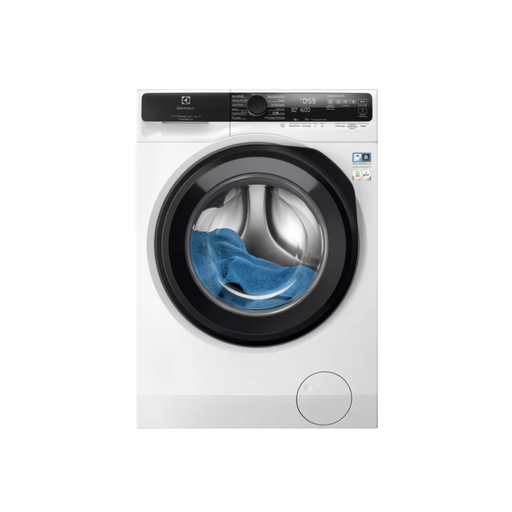 Image unavailable
Consider this 9 kg front-loader if that capacity suits your household and your space can accommodate its stated depth of 66 cm. Allow room for the connections too, and check the model’s installation diagram for the clearance needed to open the door. The product name indicates a spin speed of 1 600 rpm.
Measure the finished space’s width, height and depth, then check the delivery route, room for the connections and clearance for the lid or door. Compare your measurements with the installation diagram for the exact model, rather than relying on its headline dimensions alone.
No. The two formats are designed for different constraints. Que Choisir describes top-loaders as narrow appliances, while slim front-loaders are mainly designed to reduce depth. For example, the Electrolux EW8T3653BA is 400 mm wide but 600 mm deep, according to Electrolux France.
Check that the location is suitable for the bathroom’s layout and electrical installation. Before buying, ask a qualified professional to confirm that the planned position and circuit protection are appropriate.
Make sure there’s a suitable water inlet, drain and electrical supply, as well as enough room for the hoses. For the electrical supply, Legrand recommends a 16 A socket on a dedicated circuit protected by a circuit breaker rated at no more than 20 A. If you’re unsure about the installation, have it checked before plugging in the appliance.
Start by following the instructions: Bosch Electroménager France advises removing the transit bolts and adjusting the feet to level the machine. Also check that the feet are standing on a stable floor and that the hoses aren’t trapped.