For a very narrow space
If you have just 40 to 46 cm of width to work with, a top-loader is worth considering, as long as there’s room to open the lid. UFC-Que Choisir gives this width range for top-loading models.


Choose a format based on the measurement that’s actually limiting your installation: a top-loader is best for a lack of width, a slim front-loader for limited depth, a compact model for very small laundry loads, and an integrated model for a compatible unit. Before ordering, also check that the lid or door can open fully, that the connections are accessible and, if you’re installing it in a bathroom, that the electrical location is safe.
If you have just 40 to 46 cm of width to work with, a top-loader is worth considering, as long as there’s room to open the lid. UFC-Que Choisir gives this width range for top-loading models.
If there’s enough width for a front-loader but the appliance could stick out into the walkway, compare its depth with the space needed for the connections and to open the door.
If the appliance needs to fit inside a unit or sit near a shower or bath, have the location, connections and electrical installation checked before choosing a format.
UFC-Que Choisir distinguishes narrow top-loaders, slim front-loaders and compact models by their dimensions and capacity. Start with your main space constraint, then check that the format you choose can handle your laundry load.
Consider it: when width is limited and there’s clear space above for loading.
Bear in mind: the lid won’t open beneath a fixed worktop.
Consider it: when depth is limited but you still have close to 60 cm of width.
Bear in mind: you’ll still need space in front of the appliance to open the door and load it.
Consider it: when both width and depth are limited and you have a small laundry load.
Bear in mind: UFC-Que Choisir describes compact models as having a capacity of less than 5 kg.
Consider it: when your plans include a unit and a door panel that are compatible with your chosen appliance.
Bear in mind: integration doesn’t remove the need to check the space, door and connections.
| Criterion | What to check | Who is this for? |
|---|---|---|
| Width and loading | Measure the clear width and the overhead space needed to open a top-loader. | I need to fit the appliance into a space too narrow for the front-loader I had in mind, without making it difficult to load. Around 37% of consumers are said to prioritise this width constraint. |
| Depth and door | Check the total depth, including connections, and the space needed in front when the door is open. | I have enough width, but the appliance mustn’t get in the way when I’m loading it. Around 27% of consumers are said to prioritise depth. |
| Capacity and use | Compare the capacity with the dry laundry you usually wash, then check the energy label figures. | There needs to be enough capacity for my usual laundry and bulky items, without unnecessarily running extra cycles. This is said to be the priority for around 27% of consumers. |
| Unit and location | Check the space and access to the water supply and drain; in a bathroom, have the electrical installation checked. | I want to fit the appliance into a unit or install it in a bathroom without discovering too late that the location needs changing. Around 9% of consumers are said to prioritise this type of installation. |
A top-loader may fit into its space but leave no room to open the lid; a shallow front-loader can still block the walkway when its door is open.
Check that you can load the appliance with the lid or door open, and consult the model instructions for access to the filter and connections.
According to UFC-Que Choisir, a top-loader is best suited to limited width, while a slim front-loader mainly reduces depth.
Measure the available width, depth and height separately before comparing product specifications.
UFC-Que Choisir describes compact models as having a capacity of less than 5 kg. If your usual laundry load is larger, the smaller size may mean running more cycles.
Think about the dry laundry you regularly wash, including bulky items, then check the energy label. ADEME recommends matching capacity to your actual needs.
A unit door alone doesn’t resolve questions about location and electrical protection near a bath or shower. Promotelec also highlights the cupboard layout when its doors are open.
Ask a professional to check the plans and electrical circuit before buying the appliance or starting any work.
The LTR8C6150A offers a useful point of comparison among narrow top-loaders.
The EW6S1065NBB front-loader is a shallow model worth considering, but don’t confuse it with an appliance that’s narrow in width.
The TDLR7251FR is another top-loader worth comparing if width is limited.
Bosch offers a range of fully integrated front-loaders designed to take a furniture door panel.
This 7 kg front-loader is worth comparing if you’re looking for a front-loading washing machine for a small space. Be sure to measure the area and check the clearance required: its format alone doesn’t guarantee that it will fit.
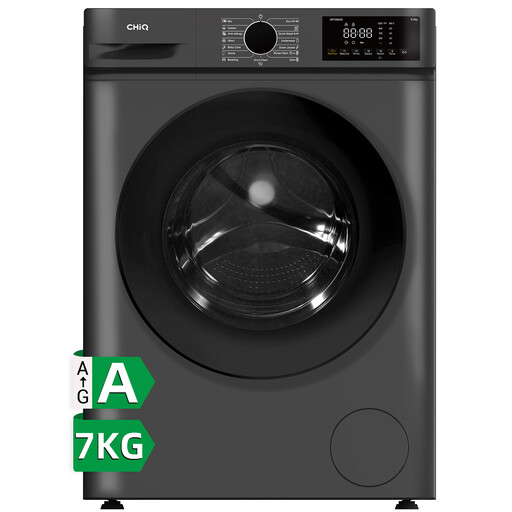 Image unavailable
Worth considering if you want to keep a front-loading design and a 7 kg capacity suits your laundry needs.
The product description lists an A energy rating, a maximum spin speed of 1 200 tr/min and 16 programmes, including a steam programme.
Before choosing this model for a narrow space, check its installation dimensions, the room needed for the connections and that the door can open fully. Compare its energy use on the energy label.
Measure the clear width, height and depth of the space, then check how much room you have to open the lid or door and load the laundry. Look out for skirting boards and connections too; check the installation diagram for your chosen model to confirm the exact clearances needed.
No. A top-loader is best suited to limited width, but it needs clear space above. UFC-Que Choisir puts the usual width at between 40 and 46 cm. If depth is the main issue and there’s enough width for a front-loader, consider slim models too.
The location needs to be assessed based on the bathroom layout and its electrical installation, particularly near a shower or bath. If you’re planning to put the appliance in a cupboard or renovate the space, ask a professional to check the connections, electrical protection and location before choosing a model.
Compare the same figures on their energy labels, including kWh per 100 cycles and litres of water per cycle, then check that the capacity suits your usual laundry load. ADEME recommends choosing a capacity to match your needs rather than basing your decision on external dimensions alone.