If your washing machine will be near a living room or bedroom, first make sure it will actually fit in the space. Then compare the stated spin-cycle noise levels and noise emission class of the models you’re considering. A top-loader is usually the answer when width is limited, while a slim front-loader suits a lack of depth. If space allows, compare standard front-loaders too, based on the capacity you need. Even a model with favourable noise ratings needs to be level, with its transit bolts removed and hoses properly secured, to help reduce vibrations.
Who is this guide for?
You’re installing the machine near a living room or bedroom
Noise during the spin cycle is an important factor in your choice. Compare the stated noise emissions and noise emission class for the specific model, and bear in mind that installation can also cause vibrations.
You have a narrow space to work with
An alcove, small bathroom or worktop can limit the width, depth or height available. Measure each dimension separately: a top-loader, slim model and under-counter model each address a different space constraint.
You want a capacity that suits your laundry
Your usual laundry load and the programmes you use matter just as much as the stated capacity. UFC-Que Choisir points out that choosing a capacity that doesn’t suit your needs can lead to excessive water and electricity consumption.
What should you look for?
First, identify which dimension limits your installation: a top-loader is primarily suited to a lack of width, while a slim front-loader is designed for spaces with limited depth. Then compare the capacity and noise data for the exact model.
| What to consider |
What to check before buying |
Who is this important for? |
| Spin-cycle noise |
Noise emissions in dB and the noise emission class for the exact model, as shown on its label. |
If the machine spins near a living room or bedroom, I want to compare how quiet it is without relying on the word ‘quiet’ alone; around 33% of consumers make this a priority. |
| Space required |
Width, depth and height, including the space needed for connections and opening the machine. |
In a narrow alcove, I need to know whether it’s the width, depth or access to the machine that’s the issue; around 33% of consumers put this need first. |
| Usable capacity |
Capacity in kg and the maximum load for the programmes you’ll use. |
For everyday laundry, bedding or bulky items, I want a drum that’s the right size so I don’t have to run extra cycles; around 20% of consumers prioritise this usable capacity. |
| Installation requirements |
Compatible connections and, for under-counter installation, the manufacturer’s instructions. |
If the machine needs to go under a worktop or next to a unit, I want to make sure it can be installed securely; around 14% of consumers make this their main consideration. |
Mistakes to avoid
-
Relying on the word ‘quiet’ alone
Stated spin-cycle noise varies from model to model. A marketing claim doesn’t give you a consistent basis for comparing two machines.
Check the dB rating during the spin cycle and the noise emission class on the label of each model you’re considering. The European Commission lists noise emissions among the details on the energy label.
-
Confusing a lack of width with a lack of depth
A narrow top-loader may still be deep, while a slim front-loader generally has the same width as a standard front-loader. So the machine might fit in the alcove but leave too little room for connections or opening the door.
Measure all three dimensions of the space and check you can open the door or lid fully before choosing a format.
-
Removing the top without checking it’s suitable for under-counter installation
Don’t assume every washing machine has a removable top. A tight fit can also cause the machine to knock against surrounding furniture.
Choose a model whose documentation explicitly allows under-counter installation or removal of the top, then check the height and connections.
Depending on the model’s instructions, an under-counter cover plate may be required.
-
Blaming the machine for all vibrations
Electrolux lists an unlevel machine, transit bolts left in place, an unevenly distributed load and loose hoses among the possible causes of noise or shaking during the spin cycle.
Install the machine on a hard, stable floor, remove the transit bolts and adjust the feet as directed in the instructions.
Brands to know for these formats
Bosch
In France, Bosch offers freestanding and integrated front-loading washing machines, as well as models designed for under-counter installation.
- The range includes models with removable tops for under-counter installation, as specified in their documentation.
- Claims about vibration or quiet motors don’t replace comparing the spin-cycle dB rating and noise emission class of the model you choose.
Whirlpool
The brand’s top-loaders are worth considering when width is your main space constraint.
- Whirlpool lists, among other options, a 40 cm-wide top-loader with a capacity of 7 kg.
- Check the depth, lid clearance and spin-cycle noise too: a top-loading design alone doesn’t tell you how quiet a model is.
Electrolux
Electrolux’s slim front-loaders may suit households whose space is particularly limited in depth.
- The brand offers slim models around 41 cm deep; check the full dimensions of the one you’re considering.
- A shallow depth doesn’t guarantee a quiet installation: Electrolux highlights the importance of levelling the machine, removing the transit bolts and securing the hoses.
Washing machines to explore on Joybuy
These two models let you explore different space constraints near a living area: consider a front-loader if depth is limited, or a top-loader if you’re short on width. Check their full dimensions and noise data before choosing.
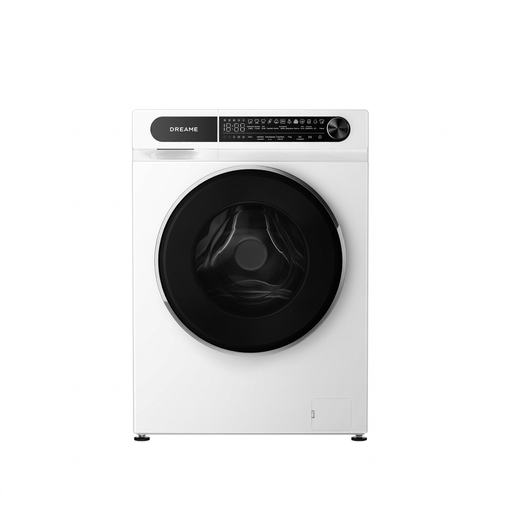 Image unavailable
Dreame DRWASHS8KG Washing Machine S, 8 kg, white
Worth considering if the depth of your space limits your choice of front-loader: check the full dimensions, connections and clearance required. The stated capacity is 8 kg; compare the spin-cycle noise and noise emission class for the exact model.
View on Joybuy
 Image unavailable
Candy TCA464TM4-S ProWash 500 top-loader, 6 kg
Consider a top-loader if width is limited; also allow room to open the lid and check the depth. The model name indicates a 6 kg capacity, a spin speed of 1 400 tr/min and 17 programmes. Compare its spin-cycle noise emissions separately: the spin speed doesn’t tell you how noisy it is.
View on Joybuy
Frequently asked questions
Which noise rating should I compare near a living room or bedroom?
Compare the spin-cycle noise emissions in dB and the noise emission class for the exact model. These details are included among the energy label information presented by the European Commission, but they don’t on their own describe vibrations caused by the installation.
Can a washing machine with a lower stated dB rating still vibrate?
Yes. The stated airborne noise rating during the spin cycle doesn’t replace correct installation. Electrolux highlights the importance of levelling the machine, removing the transit bolts, distributing the laundry evenly and securing the hoses.
Is a top-loader or slim model better for a small space?
Choose according to the dimension you’re short on: a top-loader is mainly suited to limited width, while a slim front-loader is mainly suited to limited depth. UFC-Que Choisir says top-loaders are generally 40 to 46 cm wide; whichever type you choose, check the exact model’s dimensions and the space needed to open it.
Can you remove the top of a washing machine to fit it under a worktop?
Only remove the top if the model’s documentation allows this installation. Bosch offers some models with removable tops, but this feature isn’t available on every washing machine. Follow the instructions for clearance and connections too.
What durability rating should you check when buying a new washing machine in France?
According to ADEME, a durability index has been mandatory for washing machines sold in France since April 2025. Use the index for the model you’re considering as one point of comparison, not as a guarantee of how long it will last.


