Households short on width
If your alcove can’t fit a front-loader around 60 cm wide, consider a top-loading washing machine. However, you’ll need enough clearance above the appliance to open the lid.


Choose a format based on the dimension that’s actually limiting your installation: a top-loading washing machine is best for a lack of width, while a slimline front-loader mainly reduces depth. If a standard front-loader fits under the worktop, check that there’s enough room to open the door and confirm the installation requirements too. In every case, leave space for the connections and choose a capacity that suits your household’s laundry needs.
If your alcove can’t fit a front-loader around 60 cm wide, consider a top-loading washing machine. However, you’ll need enough clearance above the appliance to open the lid.
If a front-loader’s width works for you but there’s limited space in front of the machine or under the worktop, compare the overall dimensions of slimline and standard front-loaders. Remember to allow room to open the door in either case.
If you plan to put a tumble dryer on top of your washing machine, check that both models are approved for stacking and that the stacking kit fits their dimensions. Bosch notes, for example, that some kits have model-specific exclusions.
Width, depth and access to the drum are the first things to consider when choosing a format. Then compare the specifications of the exact model you’re interested in, rather than relying on labels such as ‘slim’ or ‘compact’.
Consider it if: width is the main obstacle, or you need to keep the space in front of the machine clear.
Bear in mind: the lid needs room to open above the appliance, so this format won’t fit under a fixed worktop.
Consider it if: there’s enough width for a front-loader but limited depth.
Bear in mind: you’ll still need clearance in front to open the door, and capacity varies by model.
Consider it if: neither a top-loader nor a slimline front-loader fits your space.
Bear in mind: check the usable capacity and the space needed in front of the door before choosing a smaller appliance.
Consider it if: the width, depth and door clearance all work for your space.
Bear in mind: removing the top panel or stacking the appliances is only possible if the specific models and the manufacturer’s instructions allow it.
| Consideration | What to check | What I need |
|---|---|---|
| Dimensions and access | Measure the overall width, depth and height. Allow room to open the door or lid, as well as access to the connections. According to UFC-Que Choisir, the top-loaders it reviewed are 40 to 46 cm wide, while the slimline front-loaders it mentions mainly reduce depth, to 33–45 cm. | If width is limited, I’ll consider a top-loader. If it’s depth that’s an issue, I’ll compare slimline front-loaders and remember to leave space in front of the door. |
| Capacity | Compare the capacity in kg with the amount of laundry you usually wash and any bulky items. UFC-Que Choisir suggests 5 to 7 kg as a starting point for one or two people, and 7 to 8 kg for an average family; adjust this to suit your needs. | I want the drum to fit my usual loads, rather than choosing an appliance just because it fits the space. |
| Noise and spin cycle | Check the spin-noise figures for the exact model and follow the instructions for levelling it. Don’t assume how noisy it will be based on its format alone. | If the machine is near a bedroom or living area, spin noise matters just as much as its dimensions. |
| Energy use and durability | Compare the model’s European energy label, which ranges from A to G according to the European Commission. For a new washing machine sold in France, also check its durability index: ADEME says this has been displayed for this product category since April 2025. | I want to compare the stated energy use and durability index of appliances that fit my space, rather than making assumptions based on their size. |
| Under-worktop or stacked installation | For an under-worktop installation, check the model’s dimensions and instructions: Bosch only allows the top panel to be removed from appliances designed for this purpose. For a stacked installation, check both model numbers and any depth restrictions for the stacking kit. | If I want to use the space above the washing machine, the set-up needs to be approved for my appliances. Similar widths alone aren’t enough. |
If the capacity is too small, you may need to run more cycles. UFC-Que Choisir recommends starting with your household’s needs rather than focusing only on the appliance’s dimensions.
Think about your usual loads and any bulky items, then compare the capacities of models that fit your space.
These terms refer to different space requirements: a top-loader is loaded from above, while a slimline front-loader still has a door at the front and mainly reduces depth.
Work out which dimension is actually limiting your installation, then check the model’s overall dimensions and the clearance needed to open it.
The top panel can only be removed from models designed for this type of installation. Bosch and Electrolux stacking kits, for example, have specific size and compatibility requirements.
Check the instructions for both appliances and the details of the kit that matches their exact model numbers before planning an under-worktop or stacked installation.
A compatible kit may also be needed for stacking.
Two washing machines that fit the same space may have different energy-label ratings, including for spin noise. In France, the durability index also provides model-specific information for appliances covered by the scheme.
Once you’ve confirmed the installation will work, compare the documentation for the models you’re considering. Don’t assume the results apply to an entire format or brand.
These examples of product ranges and accessories can help you work out what to check. They don’t guarantee that a particular model will fit your space.
In France, Bosch offers front-loaders designed to fit under a worktop with the top panel removed, as well as stacking kits.
The French catalogue includes top-loading washing machines and accessories for certain washer-dryer stacks.
In France, Candy offers a range of slimline front-loaders to consider when depth is limited.
This 8 kg washing machine may be worth considering if you’re looking to fit an appliance into a small space. Before choosing this format, compare its full dimensions and door-opening style with your available space.
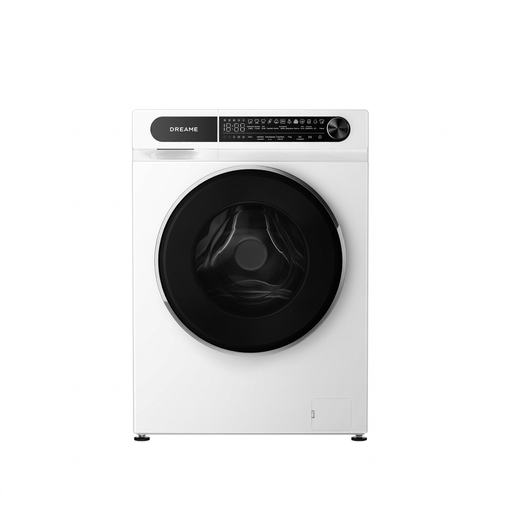 Image unavailable
If you’re fitting a washing machine into a narrow utility room or bathroom, compare its full dimensions with your available space. Remember to allow for the door to open and leave room for the connections.
It has a stated capacity of 8 kg. Before installing it under a worktop, check the loading style and installation instructions. Also compare the energy label and durability index for the model sold in France.
Measure the available width, depth and height, then allow room for the connections and to open the drum. A front-loader needs space in front of the door, while a top-loader needs enough clearance above to open its lid freely.
Not necessarily. The slimline front-loaders described by UFC-Que Choisir are still around 60 cm wide; they mainly reduce depth, to 33–45 cm. If width is your main constraint, look at the dimensions of a top-loader or compact front-loader instead.
Ask a professional to check the location and electrical installation before installing the appliance, particularly near a bath or shower. Promotelec explains that NF C 15-100 defines protection zones around these fittings, so whether a washing machine can be installed depends on the actual layout of the room.
No. Check the instructions to confirm that both models can be stacked, then choose a kit that fits their dimensions. Stacking kits aren’t universal: Electrolux, for example, limits the STA8GW4 to certain front-loaders with a depth of 47 to 60 cm, while a Bosch kit mentioned by the manufacturer requires a depth of more than 55 cm and excludes some models.
No. In France, the DGCCRF says the legal guarantee of conformity applies to goods sold by a business to a private customer, including new washing machines; a commercial warranty doesn’t replace it. The legal guarantee also covers assembly instructions and installation if the seller was responsible for arranging it.