What should you check before choosing?
First rule out any models that won’t fit, open or connect up in the space available. Then compare their capacity and usage information.
Top-loading washing machine
Worth considering: if width is your main constraint and there’s clear space above. Que Choisir gives a width of 40 to 46 cm for this format.
Bear in mind: a narrower machine isn’t necessarily less deep. For example, the Electrolux EW8T3653BA top-loader is 600 mm deep, according to Electrolux France.
Slim front-loader
Worth considering: if depth is limited, but there’s enough width and space in front of the door.
Bear in mind: the term ‘slim’ doesn’t replace checking the overall dimensions of the model you choose, including the door and connections.
Compact front-loader
Worth looking at: if both width and depth are very limited. Que Choisir distinguishes this narrower, shallow format from slim front-loaders.
Bear in mind: Que Choisir’s classification gives these models a capacity of under 5 kg. Check that this will be enough for your laundry before considering one.
Standard front-loader under a worktop
Worth considering: if your space can accommodate around 60 cm in width, the model’s depth and enough room for the door to open.
Check: the worktop, connections and clearances may prevent installation, even if the front of the machine fits into the space.
| What to consider | What to check | Who is this important to? |
|---|
| Size and installation |
Measure the space and the delivery route; compare them with the machine’s overall dimensions and connection diagram. |
When the machine has to fit between two units or through a narrow hallway, I first want to know whether it can get in and be installed. Around 36% of consumers put this first. |
| Useful capacity |
Compare the capacity in kg with your usual laundry and the large items you wash. |
If a small drum means I have to do more loads, the space saving becomes less appealing. Around 29% of consumers prioritise having a suitable capacity. |
| Access to your laundry |
Check how far the lid of a top-loader opens or how much space there is in front of a front-loader’s door, particularly under a worktop. |
In a fitted kitchen or a busy walkway, I need to be able to load the washing without bumping into furniture. Around 21% of consumers put ease of access first. |
| Everyday use |
Once you’ve checked the dimensions, compare the water and energy use, spin performance and noise shown on the label. Check the durability index too, if displayed. |
If several models fit my space, I want to compare their usage information. Around 14% of consumers prioritise energy and water use, noise or durability. |
A washing machine to consider on Joybuy
This washing machine may be worth considering if depth is a constraint in your space. Check its installation dimensions and loading type before deciding which format is right for you.
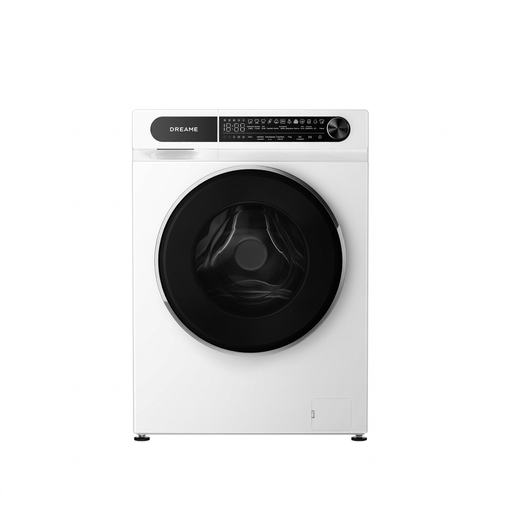 Image unavailable
Dreame DRWASHS8KG washing machine, 8 kg, white
Worth considering if you want to keep an 8 kg capacity in a space where depth matters. Before choosing it, check the overall dimensions, the room needed for connections and the loading type of this model.
View on Joybuy
Frequently asked questions
What should I measure before ordering a washing machine for a tight space?
Measure the width, height and depth of the space, as well as the route into the room and the room needed to open the lid or door. Then compare your measurements with the overall dimensions and installation diagram for the exact model, remembering to allow for the connections.
Will a top-loading washing machine fit in any tight space?
No: it’s best suited to spaces with limited width. Que Choisir says top-loaders are generally 40 to 46 cm wide, but you’ll also need room for their depth and to open the lid. If depth is the issue, compare the dimensions of slim front-loaders instead.
What capacity should I choose when space is limited?
Choose a capacity that suits the laundry you usually wash, including bulky items. ADEME says 7 kg is enough in most cases, but this doesn’t replace considering your own needs or checking the dimensions of the model you choose.
How should I choose between two washing machines that fit the same space?
Compare their capacities and energy label information, making sure you’re comparing similar programmes and capacities. ADEME says the label provides information on energy and water use, spin performance and noise. Check the durability index too, if it’s displayed.
Can I put a washing machine in a small bathroom?
The dimensions alone aren’t enough to determine whether the space is suitable. Before choosing a machine, ask a qualified professional to check the layout near the bath or shower, as well as the electrical supply.


