Start by identifying the dimension that’s preventing you from installing or using the machine. A top-loading model may fit a very narrow space, while a slim front-loader mainly takes up less depth. If both width and height are limited, consider a compact front-loader, bearing in mind that it may have a smaller capacity. Whatever you choose, measure the space including the connections, and check that the lid or door can open.
Which format is right for you?
Very limited width
If you can leave the top of the appliance clear, start by looking at top-loading washing machines. The French National Consumer Institute lists models measuring 40 to 45 cm wide; you’ll still need to check the depth and lid clearance.
Limited depth
If a front-loader fits the available width but could stick out into a walkway, look at slim models. You’ll still need to make sure the door can open and remains accessible once the machine is in place.
Too low or too narrow for a standard front-loader
A compact front-loader may work when both of these dimensions are restricted. For example, the Haier Mini Drum HW50-BP12307U1-S measures 510 × 492 × 700 mm and has a 5 kg capacity. Check that this is enough for your usual laundry loads.
What should you check before buying?
First, measure the dimension that’s causing the problem, then check the space needed to load the laundry and access the connections. Next, compare the capacity with the loads you actually wash.
| What to consider |
What to check |
Who is this for? |
| Available width |
Measure the usable width between obstacles and the model’s overall dimensions. For a top-loader, also check that the lid can open. |
In a narrow alcove, I need to be able to fit the machine and load the laundry without moving the furniture; around 33% of consumers would prioritise width above all else. |
| Depth in the room |
Check the depth, including the connections behind the machine and the space needed for the door to open in front. |
If the machine gets in the way, I want to limit how far it sticks out without losing access to the drum; this would be the priority for around 27% of consumers. |
| Space beneath a worktop |
Check the clearance beneath the worktop and the space in front of the door in the model’s installation diagram. |
If the top of the machine needs to be covered, I want to keep the front-loading door easy to use; around 20% of consumers would put this access first. |
| Washing capacity |
Compare the stated capacity with your sheets, towels and usual laundry loads. Also check the load limits for each programme. |
If I regularly wash bulky items, I don’t want a drum that’s too small for my laundry routine; capacity would be the priority for around 20% of consumers. |
Mistakes to avoid
-
Assuming “slim” means “narrow”
A slim front-loader has a reduced depth, but isn’t necessarily narrower. UFC-Que Choisir describes compact front-loaders that are still around 60 cm wide, so they won’t fit every narrow alcove.
Before choosing a format, note down the available width, depth and height separately.
-
Measuring the machine only when it’s closed
An appliance may fit in its space but leave too little room to open the door or lid. The LG F72SJ62WH product specifications illustrate the difference: the cabinet depth is 455 mm, while the depth with the door open is 980 mm. These measurements apply to this model only.
Check the installation diagram for your chosen model and make sure there’s enough clearance with the door open.
-
Choosing the smallest capacity without considering your laundry
The Haier Mini Drum HW50-BP12307U1-S compact front-loader has a 5 kg capacity, compared with 7 kg for the Whirlpool TDLR7251FR and Indesit BTW7251CFR top-loaders. If the capacity doesn’t suit your usual loads, you may need to split your laundry across more cycles.
Compare your usual loads with the permitted load for each programme, especially for bulky items.
Extra cycles also mean it takes longer to get your laundry done.
-
Forgetting the connections and installation requirements
The machine needs to remain accessible for its water supply, waste outlet and electrical connection. The SOS Accessoire guide also highlights the importance of removing the transit bolts and levelling the appliance.
Before delivery, locate the connections and check the installation instructions for your chosen model. Ask a qualified professional to assess any uncertain electrical setup.
Brands and models to consider
Whirlpool
The TDLR7251FR top-loader is worth comparing if width is your main constraint.
- According to Whirlpool France, this model measures 40 × 60 × 90 cm and has a 7 kg capacity.
- Make sure you allow for its 60 cm depth and the space needed to open the lid upwards.
Indesit
The BTW7251CFR top-loader is another 40 cm-wide model to consider.
- Indesit France lists this model as 40 cm wide, 60 cm deep and 90 cm high, with a 7 kg capacity.
- Even with its reduced width, you’ll need to keep the space above clear so the lid can open.
Haier
Consider the Mini Drum HW50-BP12307U1-S front-loader if you have limited space in both width and height.
- Haier France lists this model as measuring 510 × 492 × 700 mm, with a 5 kg capacity.
- Check whether 5 kg is enough for your laundry and whether the door can open in front of the space you have in mind.
Beko
Beko’s reduced-depth front-loaders are worth considering if you already have enough width.
- Beko France gives examples measuring 49 cm deep with a 7 kg capacity and 44 cm deep with a 6 kg capacity.
- These examples don’t represent the dimensions of every model. Check the exact model, connections and door clearance.
A front-loading washing machine on Joybuy
This front-loader is for shoppers looking to reduce the depth the machine takes up while keeping a stated capacity of 7 kg. Check the full installation dimensions before choosing it for a narrow alcove.
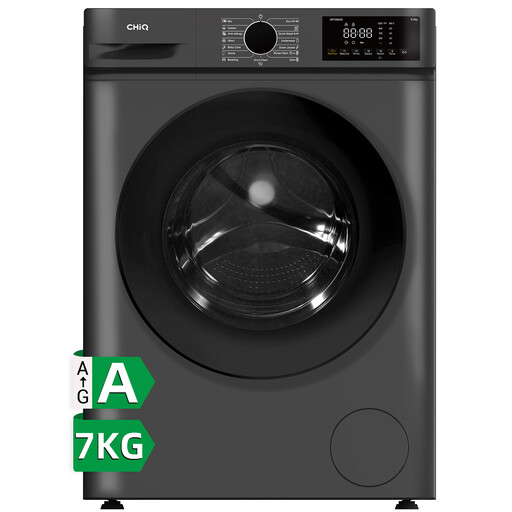 Image unavailable
CHiQ JW75883G, 7 kg dark grey front-loading washing machine
Worth considering if you’re looking for a front-loader for a shallow space and a door-opening design suits the room.
The product name lists a 7 kg capacity, a spin speed of 1,200 rpm, 16 programmes and an A energy rating.
Before buying, check the width, height, depth including connections, and the space needed in front of the door.
View on Joybuy
Frequently asked questions
What should I measure before buying a washing machine for a small room?
Measure the usable width, height and depth, then allow space for the connections and for the door to open. A slim front-loader may still be around 60 cm wide. To find out how much space you’ll need in front of the door, check the open-door dimensions for your chosen model.
Can you put a top-loading washing machine beneath a worktop?
Not beneath a fixed worktop that prevents the lid from opening. The French National Consumer Institute points out this difference between top-loaders and front-loaders. Also check the installation diagram and make sure you can access the connections for the appliance you’re considering.
What connections should I arrange before delivery?
You’ll need a cold water supply, a waste-water outlet and a suitable electrical connection at the installation point. SOS Accessoire recommends using a nearby dedicated socket rather than an extension lead. If you’re unsure about your home’s electrical setup, ask a qualified professional for advice.


