How do the formats compare?
First, work out which measurement is the real obstacle to installation: width, if you’re considering a top-loader, or depth, if you’re looking at a slimline front-loader. Fitting a machine under a worktop or stacking it with a dryer also means checking that it’s compatible with your planned setup.
| What matters |
What to check |
Who this matters to |
| Width and access to the laundry |
Measure the alcove and the route into the room. Allow space to open a top-loader’s lid or a front-loader’s door. |
If my bathroom is narrow, I want to fit the machine without blocking the way or making it difficult to load. Around 42% of consumers put width and access at the top of their list. |
| Depth and front-loader layout |
Compare the machine’s overall depth with the available space, then separately check door clearance and the installation requirements in the manual. |
With an alcove that’s wide enough but not very deep, my main aim is to limit how far the washing machine sticks out while keeping the door accessible. Depth is the priority for around 33% of consumers. |
| Capacity and everyday use |
Check the load limits for each programme, then compare the spin speed, noise level and energy label details for the exact model. |
When the laundry piles up, I want a capacity that suits my usual loads, without overlooking noise or resource use. Around 25% of consumers prioritise these everyday considerations. |
A front-loader to consider on Joybuy
This front-loader may suit a room where there’s clear access to the front of the machine. Before choosing it for a small space, compare its full dimensions and the clearance needed to open the door with your room layout.
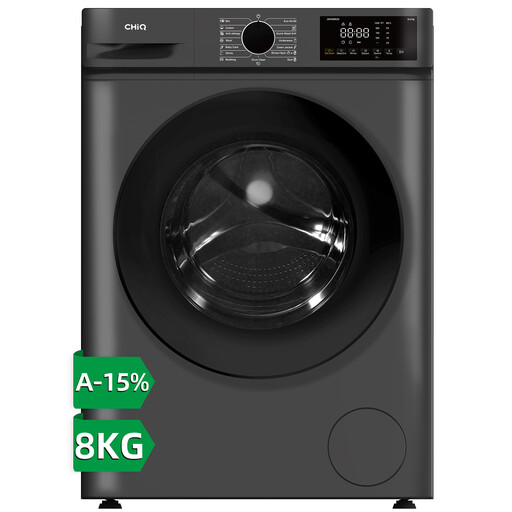 Image unavailable
CHiQ JW85883G, 8 kg front-loader, dark grey
This washing machine may suit a setup where the front-loading door is easy to access, as long as you check that it fits comfortably in the room.
The product listing gives a capacity of 8 kg, a maximum spin speed of 1 400 tr/min and 16 programmes. Before buying, check the model’s overall width, height and depth, the clearance needed for the door, and the energy label and durability index for this exact model.
View on Joybuy
Frequently asked questions
What should I measure before choosing a washing machine for a small room?
Measure the width, depth and height of the space, as well as the route into the room and the clearance needed to load the laundry. Make sure there’s room to open the door or lid, then check the dimensions and installation instructions for the exact model.
Will a slimline front-loader solve a lack of width?
Not necessarily: ‘slimline’ usually refers to reduced depth. Some models are still around 60 cm wide and need space in front of the door. If width is the main issue, compare the dimensions of top-loaders instead, and check that there’s enough room to open the lid.
Can any washing machine go under a worktop or tumble dryer?
No. The setup needs to be suitable for the appliances involved. For an under-worktop installation, check the washing machine’s installation type, the available space and its manual. For a stacked setup, follow the instructions for both appliances and check that the stacking solution is compatible. A top-loader won’t work under a worktop if the worktop prevents the lid from opening.
Is the energy label enough to compare two compact models?
No. It won’t tell you whether the machine will fit in the space or whether you’ll be able to load it easily. Also compare the overall dimensions, load limits for different programmes, spin speed and noise level. In France, the government departments responsible for environmental policy also publish a durability index for eligible household washing machines. Check the index for the model you’re considering rather than relying on the rating for another model.


