A studio with a narrow space
If the gap between two units is your main constraint, measure the available depth and height too. A top-loader needs clear space above the machine.


In a studio, start by choosing a machine to suit the dimension you’re short on. A top-loader can work when width is limited, provided there’s enough room to open the lid. A slim front-loader mainly reduces depth, and doesn’t necessarily take up less width. If you’re fitting a machine under a worktop, check the dimensions of a front-loader and leave enough room in front for the door to open, as advised by the National Consumer Institute and UFC-Que Choisir.
If the gap between two units is your main constraint, measure the available depth and height too. A top-loader needs clear space above the machine.
If there’s little room in front of the appliance, check that you can open the door and take out the washing. A top-loader avoids needing clearance at the front, as long as its lid is accessible.
If the machine needs to go under a worktop, consider a front-loader that fits the space. Make sure you can still access the door once the appliance is installed.
Measure the space and check how much room you need to open the machine before comparing capacity and other practical details.
| What to check | What to look for | Your needs |
|---|---|---|
| Dimensions | Measure the width, depth and height separately. According to the National Consumer Institute, top-loaders are generally 40 to 45 cm wide. UFC-Que Choisir describes slim front-loaders as around 33 to 45 cm deep, while retaining a standard width of 60 cm. | My space is narrow: I need to work out whether the width or depth is the issue. |
| Access to the washing | Check the clearance needed in front of a front-loader, or the free space above a top-loader. The National Consumer Institute says that a top-loader cannot be installed under a worktop. | I want to load the machine without blocking the way or getting in the way of the door opening. |
| Capacity | Compare the capacities of models that will actually fit in the space. UFC-Que Choisir says the slim front-loaders it describes generally have a capacity of 4 to 6 kg. Also check the load limits for the programmes you plan to use. | I live alone or in a small household, but I need to consider how often I do the washing and whether I need to wash bulky items. |
| Energy label and durability | Compare the energy label for the exact model on the A to G scale. In France, also check the durability index for washing machines: the ministry responsible for the ecological transition says it has been gradually replacing the repairability index since April 2025. | When two machines fit my space, I want to compare their energy and durability information rather than assume how much energy they use based on their size alone. |
A slim front-loader may be shallower but still have a standard width. UFC-Que Choisir describes models that are 33 to 45 cm deep and generally 60 cm wide.
Measure all three dimensions of your space and compare them with the overall dimensions of the model you’re considering.
A front-loader needs space in front for its door to open, while a top-loader needs clear space above for its lid. So even if a machine fits in the space, it may still be awkward to use.
Before buying, check which way the door opens and how much room you’ll need to load and unload the washing.
The stated capacity alone won’t tell you whether the machine is right for the items you usually wash and the programmes you use. UFC-Que Choisir says the slim front-loaders it describes generally have a capacity of 4 to 6 kg.
Check the capacity against the load limits in the manual, how often you do the washing and any bulky items you wash at home.
In France, the energy label has used the A to G scale since 2021, according to the ministry responsible for the ecological transition. The ministry also says the durability index has been gradually replacing the repairability index for washing machines since April 2025.
Check the information for the exact model before comparing two appliances.
The TDLR 6228 FR/N is an example of a top-loader. Whirlpool France lists dimensions of 40 × 90 × 60 cm and a capacity of 6 kg for this model.
Electrolux France offers, among others, 6 kg PerfectCare 600 top-loaders, the EW6T1265CA and EW6T3465DA, as well as the 7 kg EW6T5127CE top-loader.
The Bosch WUU28T18FR front-loader measures 845 × 598 × 590 mm and has a capacity of 8 kg, according to Bosch Home Appliances France.
This front-loader is worth considering if there’s enough space to open the door. Measure the available space before choosing it, particularly if depth is your main concern.
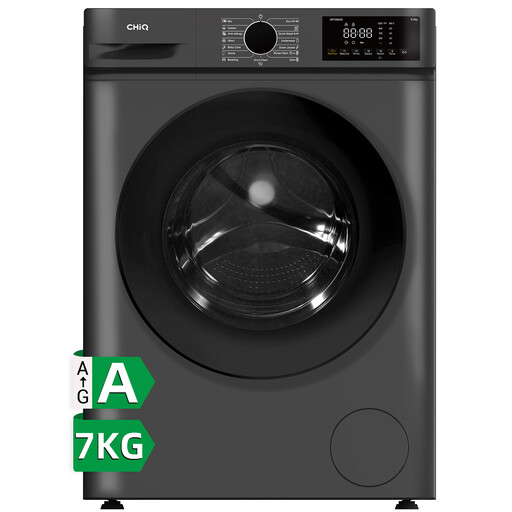 Image unavailable
For a studio, check that the overall dimensions and door clearance suit your space. The model name lists a 7 kg capacity, a 1,200 rpm spin speed, 16 programmes and an A energy rating. Compare the capacity with your usual washing loads and check the label for the exact model.
No. The National Consumer Institute says a top-loader can’t be installed under a worktop because it opens from the top. If you need to use this space, consider a front-loader and check the dimensions of the recess, along with the model’s installation instructions.
Not in width. UFC-Que Choisir says slim front-loaders mainly reduce the depth, to around 33 to 45 cm, while generally remaining 60 cm wide. If you have a narrow space, compare its measurements with those of a top-loader, which the National Consumer Institute says is generally 40 to 45 cm wide.
Choose a capacity that suits the washing you usually do rather than simply going for the largest available. Check the manual for the load limits of the programmes you use, then think about how often you wash and any bulky items you want to clean at home.
Compare the A to G energy labels for models that fit your space. The ministry responsible for the ecological transition says the durability index has been gradually replacing the repairability index for washing machines since April 2025. Check the index for the exact model before choosing between two appliances.
Follow your model’s installation instructions and make sure the appliance is stable and level. Electrolux recommends placing it on a flat, hard floor, without letting it touch a wall or other appliances.