What sets these formats apart?
The term ‘compact’ doesn’t guarantee a particular width or depth, so compare the dimensions and capacity of each model. A top-loader is designed to solve a lack of width, while a slimline front-loader helps when depth is limited. A mini model is for occasional use rather than the same everyday laundry needs.
Top-loader
Consider it: when width is your main constraint and you can keep the space above the machine clear.
Bear in mind: the top-loaders around 40 cm wide cited by Electrolux France, AEG France and Whirlpool France are still close to 60 cm deep.
Slimline front-loader
Consider it: when depth is limited, but there’s enough width and space in front of the door.
Bear in mind: according to Que Choisir, the slimline models it reviewed mainly reduce depth. Capacity and the space needed to open the door still need to be checked for each model.
Mini washing machine for occasional use
Consider it: when you can’t install a full-size appliance and your loads are small.
Bear in mind: Que Choisir describes models with a 2 to 3 kg capacity, which are less suited to bulky items and have a lower spin performance.
| Factor |
What to check |
Who it matters to |
| Size and access |
Measure the width, installed depth and space needed to open the door or lid; check the installation diagram. |
In a narrow alcove, I need to be able to fit the machine in and load the washing without blocking the walkway. This is a priority for around 31% of consumers. |
| Capacity for everyday laundry |
Compare the usual dry laundry load with the capacity allowed by the programmes you’ll use. |
If I regularly wash sheets and towels, I want to avoid running extra cycles because the drum is too small. Around 31% of consumers would put capacity first. |
| Installation in the room |
Check the floor, water supply, drainage and electrical supply. In a bathroom, confirm the position and required safety measures. |
Before comparing formats, I need to know whether the machine can be connected and used where I plan to put it. This would be the main concern for around 23% of consumers. |
| Small, occasional loads |
Check the capacity, spin performance and types of fabric the mini model can handle. |
Without room for a full-size machine, I’m mainly looking to wash small loads and accept its limitations with bulky laundry. This would be the top priority for around 15% of consumers. |
Washing machines for small spaces
These two Joybuy models offer two different options: consider a top-loader if width is limited, or a compact front-loader if you’re looking for a main appliance. Check their installed dimensions and the space needed to open them against your available space.
 Image unavailable
Candy TCA464TM4-S ProWash 500 top-loader, 6 kg
Worth considering when top access works better for your space; allow enough room to open the lid.
Listed capacity of 6 kg, spin speed of 1,400 tr/min, B energy rating and 17 programmes.
Check the width and depth once the connections are in place.
View on Joybuy
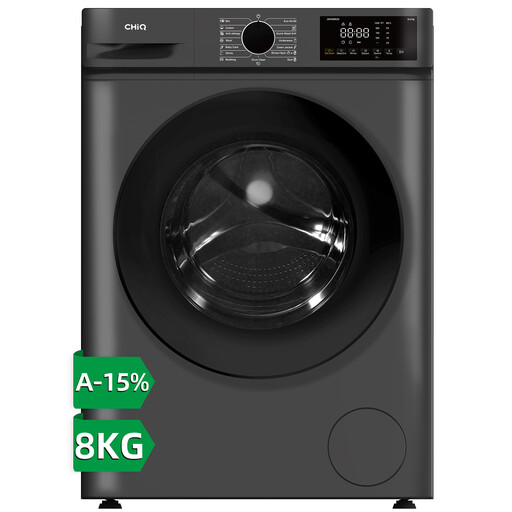 Image unavailable
CHiQ JW85883G front-loader, 8 kg
Consider it for everyday use if the space is wide enough and there’s room in front to open the door.
Listed capacity of 8 kg, spin speed of 1,400 tr/min and 16 programmes.
Before choosing this model for a narrow room, check its total width and depth, including the door and connections.
View on Joybuy
Frequently asked questions
Can you install a washing machine in a bathroom?
Check the location before installation. For the situation it describes, Promotelec specifies an earthed socket, a circuit protected by a 30 mA residual-current device and an appliance positioned beyond zone 2. Ask a qualified professional to check any existing or modified installation, especially near a shower or bath.
What else should you check besides the washing machine’s dimensions?
Check how the door or lid opens, the connections and the model-specific installation instructions. In its installation advice, Electrolux specifies, among other things, a flat, solid floor, a stable appliance and a drain outlet 60 to 100 cm above the floor. Always check the space against the instructions for the model you choose.
Is a slimline washing machine big enough for one person?
It may be suitable if its capacity covers your usual loads, including bulky items. Que Choisir generally recommends 5 to 7 kg for one person or a couple, and describes slimline models with capacities of 4 to 6 kg. So compare capacity and how often you do the washing, not just the depth.
Which durability rating should you look for in France?
According to the French Ministry of the Economy, the durability rating has replaced the repairability rating for front-loading and top-loading washing machines since 2025. Compare the ratings shown on models that already meet your requirements for dimensions, capacity and installation; the rating doesn’t replace these checks.


