Which criteria should you consider first?
To choose between a shallow front-loader, a top-loader, a mini washing machine and a washer-dryer, start with the constraint that currently prevents you from washing or drying your laundry at home.
Shallow front-loader
Consider this if: there is enough width for a front-loader, but its depth would obstruct the way.
Bear in mind: you need to be able to open the door in front of the appliance. The slim models described by UFC-Que Choisir are around 60 cm wide and 33 to 45 cm deep; these dimensions do not apply to all front-loaders.
Top-loading washing machine
Consider this if: width is the main issue or there is no room to open a front-loading door.
Bear in mind: the lid needs to open upwards, so a fixed worktop above the machine could prevent you from loading it. UFC-Que Choisir features top-loading models around 40 cm wide.
Mini washing machine
Consider this if: you cannot install a standard washing machine and mainly wash very small loads.
Bear in mind: the 2 to 3 kg mini washing machines described by UFC-Que Choisir are not well suited to bulky laundry. Their spin cycles may be limited, and some models only wash with cold water.
Washer-dryer
Consider this if: washing and drying need to share the space available for a single appliance.
Bear in mind: the drying capacity is lower than the washing capacity. You may need to split a full wash load before drying it, according to UFC-Que Choisir.
| Criteria |
What to check |
Who is this for? |
| Size and access |
Measure the space and the delivery route, then check that the door or lid can open and that there is still enough room to get past. |
When the machine could block the way, I want to be able to load my laundry without making the room impossible to use; around 33% of consumers rank access as their main requirement. |
| Wash capacity |
Assess the size of your dry laundry loads and check the limit for the programme you plan to use, not just the stated capacity. |
If I regularly wash sheets and towels, a drum that is too small will mean running several cycles; around 27% of consumers say usable capacity is their priority. |
| Secondary appliance |
If you cannot install a standard appliance, check the mini washing machine’s load capacity and spin cycle, as well as how it is filled and drained. |
Without room for a standard machine, I mainly want to wash a few clothes at home and am happy to accept smaller loads; this is the main requirement for around 20% of consumers. |
| Drying at home |
Compare the washing and drying capacities separately, then check the cycle time for the way you plan to use it. |
With no room for a separate tumble dryer, I want to dry my laundry in the same appliance, even if I have to reduce the load between the two stages; around 20% of consumers prioritise this. |
Before installing an appliance in a bathroom, also have the location, electrical supply, water inlet and drainage checked in line with the room and the appliance instructions.
Brands to consider
There are no brands to feature in this section.
Washing machines to explore on Joybuy
These appliances illustrate three of the options covered here: top-loading, front-loading and washing with integrated drying. For each one, compare the dimensions and opening clearance in its instructions with the space you actually have.
 Image unavailable
Candy TCA464TM4-S ProWash 500, 6 kg top-loading washing machine
Worth considering if you prefer top-loading and have enough room to open the lid freely.
Stated capacity: 6 kg; stated spin speed: 1 400 tr/min; 17 programmes listed in the product name.
Check the clearance above, overall dimensions, delivery access and required connections.
View on Joybuy
 Image unavailable
Hisense WF5I8043BWF, 8 kg front-loading washing machine
Worth considering if you want a front-loader and can allow enough room to open the door.
Stated capacity: 8 kg; stated spin speed: 1 400 tr/min.
Check the overall dimensions, door clearance and load limits for the programmes you plan to use.
View on Joybuy
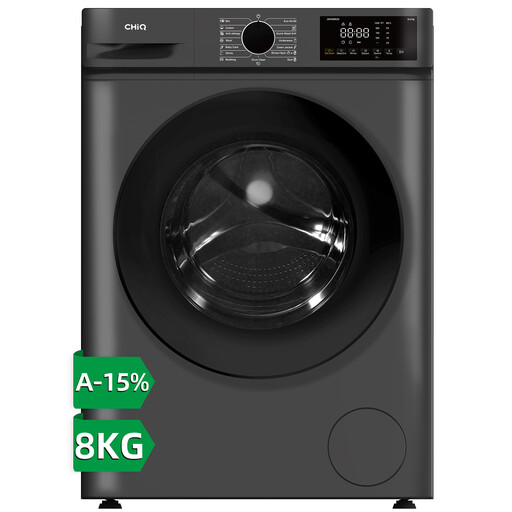 Image unavailable
CHiQ JW85883G, dark grey 8 kg front-loading washing machine
Worth considering if a front-loader suits your room and the stated capacity matches your usual loads.
Stated capacity: 8 kg; stated spin speed: 1 400 tr/min; 16 programmes listed in the product name.
Check the width, height and space needed in front of the door before deciding where to put it.
View on Joybuy
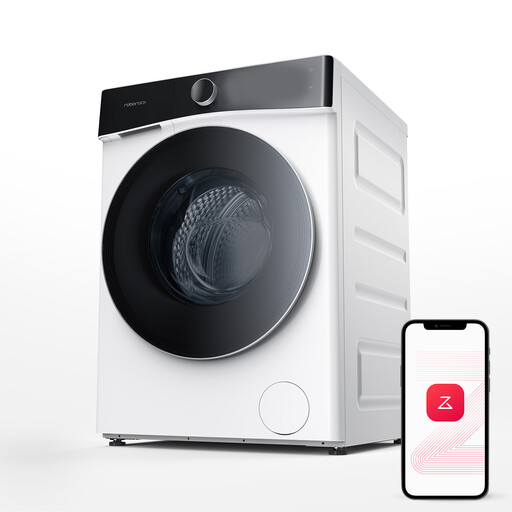 Image unavailable
Roborock Zeo Lite, white 10 kg/6 kg washer-dryer
Worth considering if you need to wash and dry in one appliance and have a suitable space for a front-loading door.
Stated capacities: 10 kg for washing and 6 kg for drying. A full wash load will need to be reduced before drying.
Check the overall dimensions, door clearance and details of the wash-and-dry cycle that suits your needs.
View on Joybuy
Frequently asked questions
Can a mini washing machine be my only appliance in a studio flat?
Yes, if you only have very small loads and its limitations suit the textiles you wash. UFC-Que Choisir describes 2 to 3 kg mini washing machines mainly as secondary appliances. Before relying on one as your only option, check its load capacity and spin performance, and whether it can wash your bulkier items.
What should I measure before ordering a washing machine for a narrow room?
Measure the width, depth and height of the space, as well as the delivery route and the clearance available when the appliance is open. Allow room in front of the door on a front-loader or above the lid on a top-loader, then check the model’s instructions for its connections and installation requirements.
Can I install a washing machine in a bathroom?
Whether you can depends on the exact location and the property’s installation; having a water supply nearby is not enough to confirm that it is suitable. Have the electrical requirements and connections checked before choosing where to place the appliance, especially if it will be near a shower or bath.
What capacity should I choose if I live alone in a small home?
According to UFC-Que Choisir, a capacity of 5 to 7 kg is generally enough for one person or a couple, but your actual laundry loads should guide your choice. Consider sheets and towels, how often you wash and the load limits of the programmes you use.


