What should you check before buying?
Measure the space with the door or lid open, then make sure the capacity suits the loads you actually wash. Que Choisir describes slim front-loaders as around 60 cm wide and 33 to 45 cm deep; top-loaders are better suited to restricted width.
| What to consider |
What to check |
What matters to shoppers |
| Access and opening space |
Measure the alcove, check how far the door or lid will open, and make sure there is still enough room to pass. |
If the door might block the walkway, I want to be able to load the laundry without losing access to the room; around 36% of shoppers would make ease of movement their top priority. |
| Width and loading |
Compare the model’s width with the alcove and measure the clear space above a top-loader. |
If my alcove is too narrow for a front-loader, I want to load the laundry from above; width would be the top priority for around 29% of shoppers. |
| Installation and connections |
Check the water supply, drainage and the model’s instructions. In a bathroom, have the location and electrical circuit checked if necessary. |
If there’s no space for a standard machine, I want to know which small machine could be connected; installation would be the top priority for around 14% of shoppers. |
| Capacity for everyday loads |
Consider items such as bedding and towels. Compare the capacity in kg of dry laundry, along with the water and energy figures listed for each model. |
For my bedding and everyday laundry, I want to avoid running extra cycles; around 21% of shoppers would prioritise a suitable capacity. |
Top- and front-loading washing machines available on Joybuy
These models let you compare two options for a narrow studio flat: loading from above when width is limited, and front-loading when there’s enough room to open the door. Before choosing, compare their dimensions and clearance requirements with the space in your home.
 Image unavailable
Haier T Series 7 THASN276TM6-S, 7 kg top-loading washing machine
Worth considering if loading from above makes the machine easier to access in your room. Check its width and the clearance needed to open the lid.
Stated capacity: 7 kg; spin speed: 1,200 rpm; energy rating: A. Also check the connections specified in the instruction manual.
View on Joybuy
 Image unavailable
Candy TCA464TM4-S ProWash 500, 6 kg top-loading washing machine
Compare this model if you’d rather load your laundry from above. Measure the alcove and the space available to lift the lid.
Stated capacity: 6 kg; spin speed: 1,400 rpm; energy rating: B. Check the connection requirements in the instruction manual.
View on Joybuy
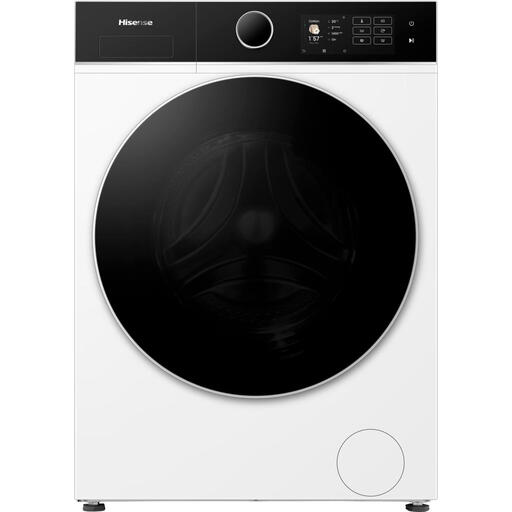 Image unavailable
Hisense WF5I8043BWF, 8 kg freestanding front-loading washing machine
Worth considering if a front-loader would be practical: measure the space, how far the door projects when open and the clearance available.
Stated capacity: 8 kg; spin speed: 1,400 rpm. For one or two people, compare this capacity with your usual loads and Que Choisir’s guide of 5 to 7 kg.
View on Joybuy
Frequently asked questions
Is a slim washing machine narrower than a standard model?
Not necessarily: the slim front-loaders described by Que Choisir are still around 60 cm wide and mainly save on depth, at 33–45 cm. Also measure the space needed in front of the door.
Can a mini washing machine handle all the laundry in a studio flat?
It’s better suited as a back-up appliance when a standard machine cannot be installed. Que Choisir cites capacities of 2 to 3 kg, often limited spin performance and difficulty washing bulky items; some models do not heat the water.
What should you check before installing a washing machine in a bathroom?
Have the machine’s position in relation to the electrical safety zones checked, along with the circuit supplying it. Promotelec sets out the key checks, including earthing and 30 mA residual-current protection. If in doubt, ask a qualified electrician for advice before installation.
Which figures should you compare on the energy label?
For the domestic washing machines covered, compare the energy rating, kWh per 100 cycles, water used per cycle, cycle duration and noise level, as explained by ADEME. Compare models that suit your loads, while also allowing for the dimensions and clearance needed in your home.


