Who are these formats for?
The best place to start isn’t capacity alone, but how much room the machine can take up without getting in the way.
A home with a narrow entrance
If width is limited or a porthole door would obstruct the way, compare a top-loading machine with other formats that fit the space. Make sure there’s enough room above it to open the lid, though: top-loading models described by Que Choisir are generally 40 to 46 cm wide.
A kitchen with space under the worktop
Measure the available height and depth, then distinguish between a front-loader designed to fit under a worktop and a model designed to take a cabinet door. Bosch describes a removable top as a feature of specific under-worktop models, not all front-loaders.
A home where depth is limited
If there’s enough width for a front-loader but space in front of the machine is tight, check the model’s depth and the room needed to open its door. A model described as “slim” still needs to be checked against these measurements, as well as the capacity that suits your household’s laundry.
What should you check before choosing?
Start by measuring the space and the areas needed to open the machine. Then compare the capacity and installation type of the models that will work there day to day.
| What to consider |
What to check |
What I need |
| Width and opening space |
Measure the width of the space and the access route; allow room in front for a porthole door to open, or above for a lid. Que Choisir gives a width of 40 to 46 cm for top-loading models. |
My access route is narrow: I’m interested in a narrower machine, as long as its lid can open freely. |
| Depth |
Compare the appliance’s depth with the space actually available, then check any protruding parts, connections and the door when open. Que Choisir describes shallow front-loaders as 33 to 45 cm deep, while noting that they retain a standard width of around 60 cm. |
I have enough width for a front-loader, but don’t want the machine or its door to obstruct the way. |
| Capacity |
Compare the stated capacity in kg with your usual load sizes and bulky items; check the capacity of the specific model rather than assuming it from its format. |
Saving space shouldn’t make it difficult to load my usual laundry. |
| Installation under a worktop |
Check the height of the space and the installation instructions; confirm whether the model is designed to have its top removed or to take a cabinet door. These are two different types of installation. |
I need the machine to fit under the worktop. If I want a cabinet door, I need to choose a model designed to take one. |
| Bathroom |
In France, Promotelec states that a washing machine must be outside electrical zones 0, 1 and 2, and the hidden zone; it must also be earthed and protected by a 30 mA RCD. |
If I’m installing it near a shower or bath, I want the position and circuit checked before choosing a model. |
What guidance do manufacturers provide?
The examples below show different dimensions and installation types. Always compare the manufacturers’ specifications with the actual space available.
Electrolux
Electrolux France product pages let you compare several formats: top-loading, slimline front-loading, freestanding front-loading and built-in.
- The top-loading EW6T5721DB is 400 mm wide and has a stated capacity of 7 kg; the slimline front-loader EW6S1064NA is 411 mm deep and has a capacity of 6 kg.
- These measurements alone don’t show how much room each model needs for opening and connections.
Bosch
Bosch Home Appliances France distinguishes between under-worktop models with removable tops and fully integrated washing machines.
- The specifications for the fully integrated WIW24348FF give dimensions of 818 × 596 × 544 mm and a capacity of 7 kg.
- Before choosing an under-worktop or integrated model, check its instructions, the available space and how the cabinet door is fitted.
LG
When LG France describes the F92SR50WHS as “slim”, check what that means alongside its stated depth.
- LG gives the F92SR50WHS a depth of 53,5 cm and a capacity of 9 kg.
- This is deeper than the 33 to 45 cm shallow front-loaders described by Que Choisir. Compare the model’s measurements rather than relying on its name alone.
A washing machine to consider on Joybuy
This option is for choosing a machine to fit a compact space. Before deciding, check its installation dimensions and door clearance against your kitchen or bathroom.
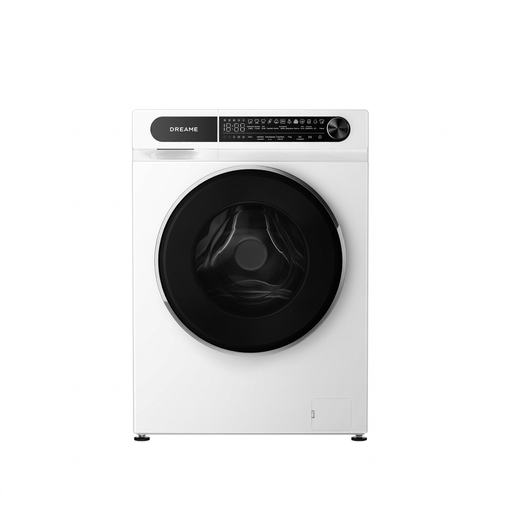 Image unavailable
Dreame DRWASHS8KG Washing Machine S 8 kg, white
If depth is your main concern, compare this model’s overall dimensions and door clearance with the space available. It has a stated capacity of 8 kg; check the instructions before installing it under a worktop or in a bathroom.
View on Joybuy
Frequently asked questions
What should I measure before buying a washing machine for a small space?
Measure the width, height and usable depth, taking connections and the space in front of the machine into account. Allow room for the porthole door to open or, for a top-loader, for the lid to open above the machine. Then compare your measurements with the instructions for the exact model.
Can any front-loading washing machine fit under a worktop?
No: having enough height doesn’t necessarily mean the machine will fit. Check that the manufacturer approves this type of installation. If you want to fit a cabinet door to the machine, choose a model designed for integration. Bosch, for example, distinguishes between under-worktop models with removable tops and fully integrated models.
When should I consider a compact washing machine?
Consider one when other formats that meet your needs won’t fit in the available space. Check the model’s stated capacity and consider whether it suits your usual loads, especially bulky items.
Can you install a washing machine in a bathroom in France?
Yes, provided you follow the positioning and electrical protection requirements set out by Promotelec: the machine must be outside zones 0, 1 and 2, and the hidden zone; it must be earthed and protected by a 30 mA RCD. If the circuit or layout needs to change, ask a qualified electrician to check the plans.


