Which criteria should you check first?
Start by identifying what limits your installation, then check the features that matter for your laundry. The following styles suit different layouts.
Top-loader
Consider it if: space is limited in width and you can still access the top to load the machine.
Bear in mind: the lid needs room to open; a fixed worktop above the machine will prevent this.
Freestanding front-loader
Consider it if: the space can accommodate your chosen model and leave room in front of the door.
Bear in mind: the machine’s depth may not include the extra space needed for the hoses.
Slim-depth front-loader
Consider it if: depth is the main obstacle, but the width and front access are suitable.
Bear in mind: check the capacity of the specific model, as it may be lower than that of a standard front-loader.
Integrated
Consider it if: your cabinet is designed for an integrated washing machine with a compatible door.
Bear in mind: the alcove, hinges, door and maintenance access must all match the model’s installation diagram.
| Criteria |
What to check |
Who this matters to |
| Size and access |
Measure the width, height, depth and delivery route. Check the space needed to open the machine and connect it against the model’s diagram. |
In a tight alcove, getting the machine in is only part of the job: you also need room to load the laundry and reach the connections. Around 33% of consumers put access and overall size first. |
| Suitable capacity |
Compare the capacity in kg with your usual loads and the bulky items you wash. |
If you often do large loads, saving space shouldn’t mean choosing a capacity that’s too small for your household. Around 27% of consumers say finding the right capacity is their top priority. |
| Noise and spin |
Check the spin noise in dB(A), the stated spin speed and any conditions specified for the model. |
If the machine is near a bedroom or in an open-plan kitchen, I want to be able to choose when I do the washing with the noise in mind. Around 20% of consumers put noise and spin performance first. |
| Durability and replacement |
Check the durability rating for washing machines sold in France and the repair information. Also plan how to remove your old machine. |
After a breakdown, avoiding another early replacement and knowing what to do with the old machine can influence your choice. For around 20% of consumers, this is their main concern. |
Front-loading washing machines available on Joybuy
Consider these two front-loading models if there’s room to open the door. The Samsung combines washing and drying. For both machines, check the model dimensions and the clearance your space requires before choosing.
 Image unavailable
Samsung WD10HG6U34BEU3, 10 kg / 6 kg washer-dryer
Consider this model if you want to wash large loads and machine-dry some of your laundry, provided your space can accommodate this front-loader. Its stated capacity is 10 kg for washing and 6 kg for drying, so a full 10 kg wash load can’t be dried in one go. Check the instructions for the dimensions, door clearance and space needed for the connections.
View on Joybuy
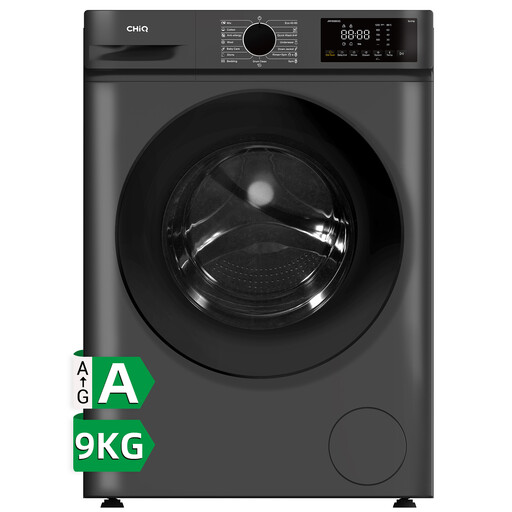 Image unavailable
CHiQ JW95883G, 9 kg front-loading washing machine
Consider this model if its stated 9 kg capacity suits your laundry and you can access the front of the machine. The product title lists a maximum spin speed of 1,400 rpm. To check whether it will fit in a narrow alcove, confirm the exact dimensions of the JW95883G using its documentation: the size information shown for this product is contradictory. Also allow room for the door and connections.
View on Joybuy
Frequently asked questions
Which rating should I check for a new washing machine in France?
For washing machines covered by the scheme in France, the durability rating replaced the repairability rating on 8 April 2025, according to the ministry responsible for ecological transition. It can help you compare models, but doesn’t replace checking their dimensions, capacity and noise levels.
Will a top-loader suit every small space?
No. Its narrow width can be useful in a tight space, but the lid must be able to open fully. UFC-Que Choisir lists top-loaders that are 40 to 46 cm wide. Also check the depth, available height and capacity of the model you’re considering.
Can you put any front-loader behind a kitchen cabinet door?
No. If you want to hide the washing machine behind a cabinet door, check that the model is designed for integrated installation and that the alcove, hinges and fixings match its installation diagram. Don’t assume a freestanding front-loader will be suitable for this type of installation.
What should you do with your old washing machine when replacing it?
In France, the ministry responsible for ecological transition says that electrical equipment can be taken to a collection point or recycling centre, or returned to a retailer. When buying a new appliance of the same type, ask the retailer how to arrange ‘one-for-one’ take-back, especially if your new washing machine is being delivered.


