People with a very narrow space
If space is tight in your bathroom or kitchen, a top-loader could be worth considering, provided there’s room above for the lid. Que Choisir lists this format as an option for cramped spaces.


Start by identifying which dimension is restricted: choose a top-loader if width is limited and there’s room above for the lid, a shallow front-loader if depth is the issue, or a compact model if both width and height are restricted. Then compare its capacity with your usual laundry loads and check the manual for the clearance needed to open it fully, connect it and access it. The dimensions of the closed appliance alone won’t tell you whether it will fit your space.
If space is tight in your bathroom or kitchen, a top-loader could be worth considering, provided there’s room above for the lid. Que Choisir lists this format as an option for cramped spaces.
If a front-loader could work but there’s limited space in front of the machine, check both its depth and how far the door opens. Que Choisir highlights the importance of allowing enough room to load the machine.
If a standard front-loader won’t fit because of width or height restrictions, a compact model may be worth considering. You’ll still need to balance its size, access to the door and a capacity that suits your usual laundry loads.
First, identify which dimension limits where you can install the machine. Then check that the format you’ve chosen suits your laundry needs and leaves enough room to load it.
| What matters | What to check | Who it suits |
|---|---|---|
| Width and access from above | Measure the available width and height; check the lid’s open height in the manual. | If my space is very narrow, I’ll consider a top-loader, while keeping the area above it clear. Around 36% of consumers prioritise the available width. |
| Depth and door clearance | Compare the machine’s depth with the pipes, walkway and space needed to open the door fully. | If there’s room for a front-loader but space in front is tight, I’ll check its depth with the door open. Around 29% of consumers put depth first. |
| Capacity in a compact size | Compare the capacity in kg with your usual loads, including bulky items, then check the model’s dimensions. | If I’m looking for the smallest possible model without compromising too much on useful capacity, I’ll compare both factors together. Around 21% of consumers prioritise this balance. |
| Alternative location or stacking | Measure the new space; if stacking the appliances, check that both machines and the stacking kit are compatible, as specified in their manuals. | If another location or a stacked setup might work, I’ll first check the dimensions and compatibility of the exact models. Around 14% of consumers prioritise this type of installation. |
The dimensions of the closed appliance don’t confirm that there’ll be enough room for the lid or door, connections and access for loading.
Also measure the delivery route and compare your measurements with the manual for the exact model, with the lid or door open.
If the appliance can’t get through the available access route or be installed in your chosen space, delivery or installation may not be possible.
A capacity that’s too small for your usual loads could mean running more cycles. A larger capacity than you need isn’t automatically an advantage, either.
Think about the laundry you actually wash, and especially how much room bulky items need. ADEME recommends choosing a capacity that meets your needs.
Compatibility depends on the exact washing machine, tumble dryer and stacking kit. A depth requirement listed for a kit doesn’t, by itself, confirm that your setup is compatible.
Before buying, check all three model references in their respective instructions. Bosch advises checking that both appliances are compatible before stacking them.
An unsuitable kit could prevent you from creating the stack you planned.
The EW6T5127CE top-loader is an example of an option for a narrow space.
The BP 48SBL6-S front-loader is worth considering when depth is restricted.
The Mini Drum HW50-BP12307U1-S is a compact front-loader to consider when both height and width are restricted.
The WAN2827QFR front-loader is an example of a standard installation. You should only consider a stacking kit after checking compatibility.
The TDLR6242SFR/N top-loader is another format to compare when width is your main constraint.
The options below include front-loading washing machines and a portable mini washing machine. Compare the stated dimensions with your available space, and check that the type of appliance suits your laundry needs.
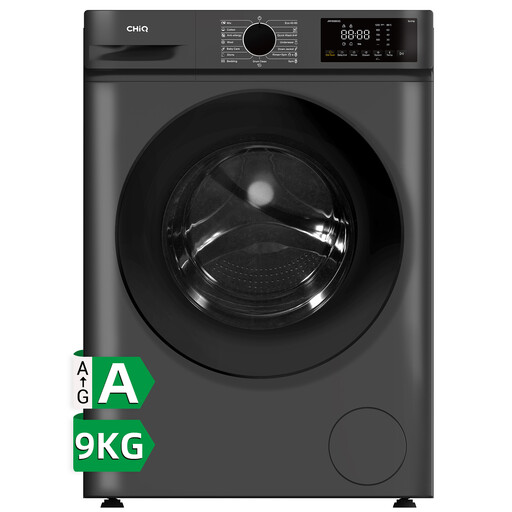 Image unavailable
Worth considering if you’re looking for a front-loader with a stated width of 465 mm.
The product title lists a capacity of 9 kg, a 530 mm drum and a spin speed of 1400 RPM.
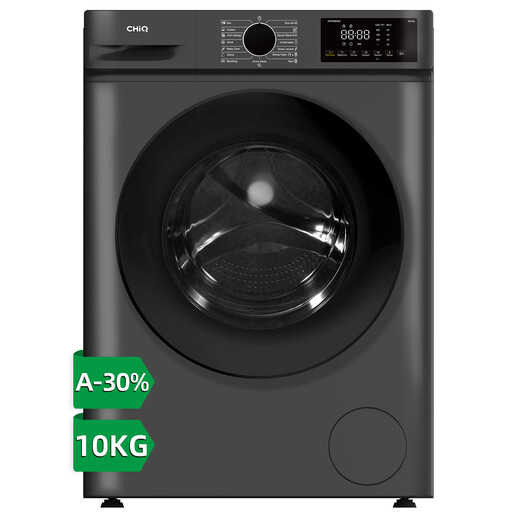 Image unavailable
Worth comparing if you’re looking for a front-loading washing machine and its stated capacity suits your usual loads.
The product title lists a capacity of 10 kg, a 530 mm drum, a spin speed of 1400 RPM and 16 programmes.
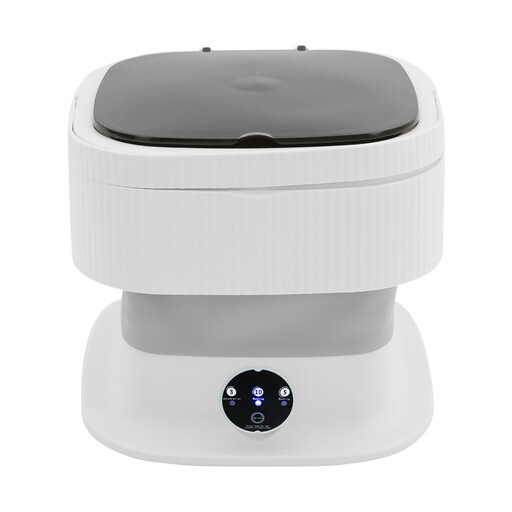 Image unavailable
Worth considering if you’re looking for a foldable portable appliance rather than a conventional front-loading washing machine.
The product title lists a capacity of 10 L, three cycle times of 2, 5 and 10 minutes, a power rating of 40 W and a speed of 320 RPM.
No. The 400 mm listed by Electrolux France for the EW6T5127CE is the machine’s width. It doesn’t include the clearance needed or the height of the lid when open. Before choosing, compare the manual with the actual measurements of your space.
No. Bosch Home Appliances France advises checking that the two models can be stacked and that the kit is suitable for the models in question. For its 17007417 kit, Bosch specifies a washing machine depth of over 55 cm. This isn’t a blanket approval for all appliances or kits.
Compare the stated capacity in kg with your usual loads, including bulky items, rather than simply choosing the smallest appliance. ADEME recommends choosing a capacity that meets your needs; Que Choisir notes that a drum that’s too small can mean running more cycles.
Compare the information on their energy labels, including energy use per 100 cycles, noise levels and spin-cycle details. ADEME recommends taking these factors into account. The figures on the label don’t guarantee the energy use or noise level of each programme you run.
In France, you can claim under the legal guarantee of conformity from the professional seller. The French Ministry of the Economy says you have two years to make a claim for a new product. Any additional commercial warranty offered doesn’t replace this legal guarantee.