What should you check before buying?
Start with anything that could prevent you from installing or using the machine day to day. A good capacity or energy label won’t solve a problem with access to the drum.
| Criteria |
What to check |
Who it matters to |
| Size and access |
Measure the width, depth and height, then allow room to open the door or lid and handle your laundry. |
If access is narrow, the machine needs to fit through without making loading difficult. Around 33% of consumers put size and access at the top of their list. |
| Capacity |
Match the capacity in kg to your household’s usual laundry loads and check the permitted load for your programmes in the manual. |
If laundry piles up between washes, I want a drum that suits my routine, rather than choosing a size based solely on the maximum figure shown. Capacity would be the top priority for around 27% of consumers. |
| Under-worktop or stacked installation |
Decide whether you need to use the space above the machine and check both appliances’ manuals before stacking them. |
In a small utility room, making use of the height available may matter more than choosing a narrower machine. Around 20% of consumers would prioritise this type of installation. |
| Noise and usage information |
Check the noise and consumption figures on the model’s energy label. In France, you should also look at its durability index. |
If the machine is near a living space, I want to compare its noise levels and usage information before choosing. For around 20% of consumers, these factors and durability would be the main priorities. |
The National Consumer Institute distinguishes between the clearance needed in front of a front-loader and the space required above a top-loader. So even with a compact model, you’ll need to check its full dimensions. For capacity, ADEME recommends starting with your household’s needs; the permitted load may vary depending on the programme you use.
Brands to consider
There are no brands to feature in this section.
A Joybuy model to consider
This 8 kg washing machine is aimed at households considering a model described as compact. Check its dimensions and how you access the drum against the space you have available.
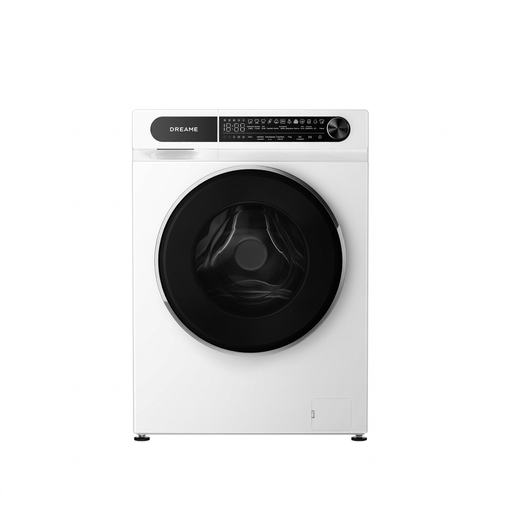 Image unavailable
Dreame DRWASHS8KG Washing Machine S, 8 kg, white
If space is limited at home, consider this model in relation to your household’s laundry loads and the size of your alcove. It has a stated capacity of 8 kg. Before deciding where to put it, check its full dimensions, access to the drum and any stacking instructions.
View on Joybuy
Frequently asked questions
Is a top-loading washing machine always better for a narrow room?
No. It may solve a width problem, but you’ll need enough space above it to open the lid. The National Consumer Institute says top-loaders are typically 40 to 45 cm wide. If height is an issue, consider the full dimensions of a compact front-loader and the space needed in front of its door.
Can you stack a tumble dryer on top of any front-loading washing machine?
No. A front-loading design alone doesn’t mean the machine is suitable for stacking. Check the manuals for both models, the installation requirements and which stacking accessories are designed for them.
How can you choose the right capacity without relying on the maximum figure?
Think about how much laundry you actually produce and how often you wash it. ADEME says that 7 kg is enough most of the time. Check the machine’s manual too, as permitted loads may be lower for certain programmes and fabrics.
What should you look for on the labels of a washing machine sold in France?
The energy label shows information including the model’s consumption and noise levels. ADEME says it’s available online and in shops for washing machines. According to the Ministry for Ecological Transition, the durability index, scored out of 10, has also applied to washing machines since 8 April 2025.
Does the durability index replace the energy label?
No. The durability index provides information about factors related to a product’s lifespan, while the energy label shows usage information such as consumption and noise levels. If space is limited, you’ll also need to check the dimensions and clearance required.


