A niche that is too narrow
When width or access is the main obstacle, compare a top-loader measuring around 40 to 46 cm wide with a 60 cm front-loader. UFC-Que Choisir points out that a top-loader also needs clear space above it for the lid to open.


First, measure the complete installation space, including the opening clearance for the door or lid, connections and access to the filter: the most compact format is not always the most practical for everyday use. A top-loader is mainly suited to a lack of width, a slim front-loader to limited depth, while a standard front-loader or stacked configuration requires a 60 cm space and compatibility confirmed by the manufacturer.
When width or access is the main obstacle, compare a top-loader measuring around 40 to 46 cm wide with a 60 cm front-loader. UFC-Que Choisir points out that a top-loader also needs clear space above it for the lid to open.
If 60 cm of width is available but there is not enough room at the back, a slim front-loader measuring 33 to 45 cm deep could be worth considering. However, make sure there is enough space in front of the appliance to open the door and load the washing.
When stacking two appliances, first check the exact references of the washing machine, tumble dryer and stacking kit. Similar dimensions alone do not confirm that the installation will be compatible.
Start by measuring the space that is genuinely usable, then choose the format that solves your main constraint without preventing loading, maintenance or possible stacking.
| Priority | What to check | Your needs |
|---|---|---|
| Actual footprint | Measure the width, depth and height, then check the delivery route. Allow for the opening of the door or lid, hoses and access to the filter. Top-loaders are generally 40 to 46 cm wide and slim front-loaders around 33 to 45 cm deep, according to UFC-Que Choisir. | I want the appliance to fit into the room without blocking a walkway, worktop or access to the washing. |
| Loading format | A front-loader needs clearance in front for the door. A top-loader reduces the required width, but its lid must be able to open fully above the appliance. | I need to be able to load and unload the washing without moving other furniture or obstructing movement around the room. |
| Usable capacity | Compare the stated capacity with your usual load and bulky textiles. Make sure the smaller format is suitable for everyday use rather than simply occasional extra capacity. | I want to avoid running more cycles or being unable to wash a duvet, towels or household linen. |
| Stable stacking | Check the exact references, loading type, permitted depth and kit specified by the manufacturer. Bosch and Electrolux require compatibility to be checked before stacking. | I want to free up floor space with two stacked appliances, without assuming that a slim washing machine or universal kit will automatically be suitable. |
| Noise and vibrations | Check the exact model’s specification for its spin-cycle noise level and follow the levelling instructions. In a stack, the appliances must be aligned and secured with the appropriate kit. | In a kitchen, bathroom or adjoining utility room, I want to minimise vibrations and disturbance during the spin cycle. |
A front-loader may fit the available width but still be difficult to load if its door cannot open properly. Conversely, a top-loader may suit a narrow bathroom but cannot be used beneath a fixed worktop that blocks its lid.
Use a tape measure or a cardboard template to simulate the opening before ordering, then consult the chosen model’s manual for connection requirements and filter access.
Stacking kits may require a specific depth range, particular references or exclude certain models. A stack without the appropriate kit may not be stable.
Check both references in the manufacturer’s system and allow for the kit before arranging the installation.
A stacking kit may be an additional purchase, depending on the configuration you choose.
A drum that is too small may mean running more cycles and may not be suitable for bulky items. Mini washing machines are better suited to occasional or supplementary use.
Consider your most frequent load, bulky textiles and available space before reducing the capacity.
Being close to water means different positioning and electrical protection requirements from those in a utility room.
Promotelec states that the appliance must be earthed, protected by a 30 mA residual-current device and installed beyond Zone 2. Have the project checked by a professional if the power supply or location needs to be created or modified.
Whirlpool offers top-loading washing machines worth considering when limited width is the main constraint.
Bosch is an option for a standard front-loader and a stacked configuration, provided you check the compatibility of the appliances and kit.
Electrolux is a suitable choice for a stack of two front-loading appliances when the references can be checked in the manufacturer’s system.
Haier lets you compare width, depth and capacity requirements across its top-loading and front-loading ranges.
These Joybuy options include front-loading washer-dryers, helping you avoid a second appliance on the floor, as well as a stacking kit for a compatible configuration.
 Image unavailable
An option for washing and drying with one front-loading appliance, provided the niche can accommodate its dimensions before connections are fitted.
Stated dimensions: 600 × 850 × 590 mm. Stated capacity: 10 kg for washing and 6 kg for drying.
The drying capacity is lower than the washing capacity; check the manual for door clearance, total depth including hoses and access to the filter.
 Image unavailable
Worth considering when 60 cm of width and depth are genuinely available and integrated drying removes the need for a separate stack.
Stated dimensions: 60 × 85 × 60 cm. Stated capacity: 11 kg for washing and 6 kg for drying; spin speed up to 1,400 rpm.
The drying capacity is 6 kg; check the installation depth, door clearance and under-worktop positioning requirements in the manual.
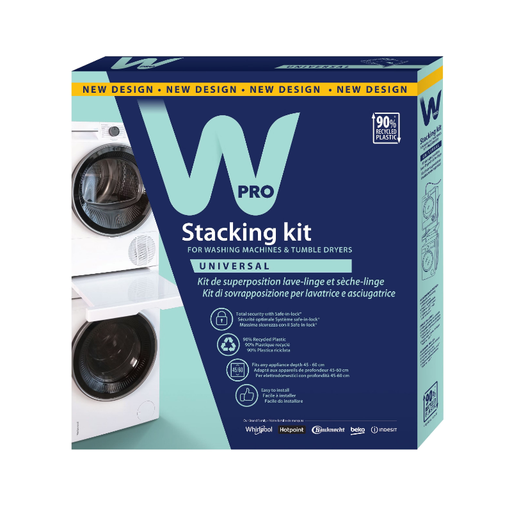 Image unavailable
This kit is designed to free up floor space by securing a tumble dryer above a compatible washing machine.
Stated compatibility with standard or slim appliances measuring 45 to 60 cm deep. Pull-out shelf rated up to 15 kg.
Check the exact references of both appliances, their manuals and the manufacturers’ recommendations before installation.
 Image unavailable
This front-loading washing machine is suited to a wide, deep niche where maintaining a full washing capacity is the priority.
Stated dimensions: 84.7 × 59.7 × 66.0 cm. Stated capacity: 9 kg; spin speed up to 1,600 rpm.
Its 66.0 cm depth may exceed a niche designed for 60 cm. Also check the hoses, door and any stacking compatibility.
Measure the available width, depth and height, then check the projection of the hoses, access to the plug, tap and filter, as well as the delivery route. Allow for the space needed to open the door or lid and room to stand in front of the appliance.
Not if the worktop prevents the lid from opening fully: a top-loader is loaded from above. For under-worktop installation or stacking with a tumble dryer, look instead for a front-loader and a kit that is suitable for the chosen references.
No. Check the exact references, loading type, permitted depth and the manufacturer’s kit. Bosch states that some of its kits require a standard washing machine more than 55 cm deep, while the Electrolux E1WYHSK2 kit is intended for front-loading appliances measuring 52 to 67 cm deep, with verification by PNC.
Not necessarily. An appliance that is too small may mean running more cycles or may not be suitable for bulky textiles. Compare the capacity with your usual volume of washing before prioritising the most compact format.