People living in a studio or small flat
The size of your home alone won’t determine which format is right for you. Measure the space where the machine will go, as well as the room needed to open it and move around in front of it.


First, choose a format that leaves enough room to install, open and connect the washing machine. A top-loading model is best when width is limited; a slim-depth front-loader is better when depth is limited, but needs space in front for the door to open. For a compact or integrated model, also check that its capacity suits your needs and that its installation requirements work for your space.
The size of your home alone won’t determine which format is right for you. Measure the space where the machine will go, as well as the room needed to open it and move around in front of it.
Check the available space alongside the electrical safety requirements. Promotelec sets out the areas to avoid in a bathroom and the electrical protection required.
If the appliance needs to fit under a worktop or behind a cupboard door, check that the model is suitable for this type of installation, that its door can open and that the connections remain accessible.
First rule out formats that won’t fit the space or access route, then compare their capacity with the amount of laundry you usually wash.
| Criteria | What to check | What I need |
|---|---|---|
| Size and opening | Measure the width, depth and height, then allow for the clearance needed to load the machine. Que Choisir describes top-loading models that are 40 to 46 cm wide and slim-depth front-loaders that are 33 to 45 cm deep. Check the dimensions of the specific model you’re considering. | If width is limited, I’ll look at top-loading models, making sure there’s room to lift the lid. If depth is the issue, I’ll also check there’s enough space in front of a front-loader for the door to open. |
| Capacity | Compare the capacity in kg with the amount of laundry you usually wash and how often you run a cycle. Que Choisir describes slim-depth front-loaders with capacities of 4 to 6 kg; this range doesn’t apply to every model. | I want to wash my usual loads without running extra cycles, but I don’t want a larger drum than I need. Que Choisir points out that choosing the wrong capacity can increase energy and water use or mean doing more washes. |
| Installation and connections | Check access to the water inlet and drain, as well as the installation instructions. In a bathroom, Promotelec states that the appliance must be outside zones 0, 1 and 2 and the hidden zone, earthed, and connected to a circuit protected by a 30 mA RCD. | In a bathroom, I need a space that meets these electrical requirements. For a fitted kitchen, I’ll check that an appliance designed for integration is genuinely suitable for the unit: a freestanding front-loader isn’t automatically suitable. |
| Maintenance and durability | Check the instructions and availability of spare parts for the model you’re considering. According to the French Ministry for Ecological Transition, the durability index replaced the repairability index for the washing machines covered by the scheme in France from 8 April 2025. | I want to be able to access the appliance for maintenance after installation and compare the durability information for the models I’m considering. |
A washing machine may fit in the space but still leave too little room to open the door or lift the lid.
Before comparing product details, measure the available width, depth and height, note any obstacles and allow enough clearance to load the machine.
According to Que Choisir, a capacity that doesn’t suit your needs can lead to excessive consumption or more frequent washes.
Once you’ve confirmed the format will fit, compare its capacity with your usual loads and any bulky items you wash.
A compact appliance isn’t necessarily suitable for every space near a shower or bath. Promotelec specifies the areas to avoid and the electrical protection required.
If you’re unsure before buying, ask a suitably qualified professional to check the location and circuit.
Putting a front-loader under a worktop doesn’t mean it’s designed to be integrated into kitchen furniture. The unit may also obstruct the door or access to the connections.
If your plans require an integrated appliance, check that this applies to the specific model and compare its instructions with the dimensions of the unit.
Electrolux France offers, among other options, 6 kg top-loading washing machines.
Whirlpool France states that its TDLR7221BSFR/N top-loading model measures 40 cm wide, 90 cm high and 60 cm deep.
Bosch’s French catalogue distinguishes between freestanding and integrated washing machines.
These two models illustrate the options to consider depending on your main space constraint: a front-loader when depth is limited, and a top-loader when width is at a premium. Before choosing, compare their full dimensions and installation requirements with your space.
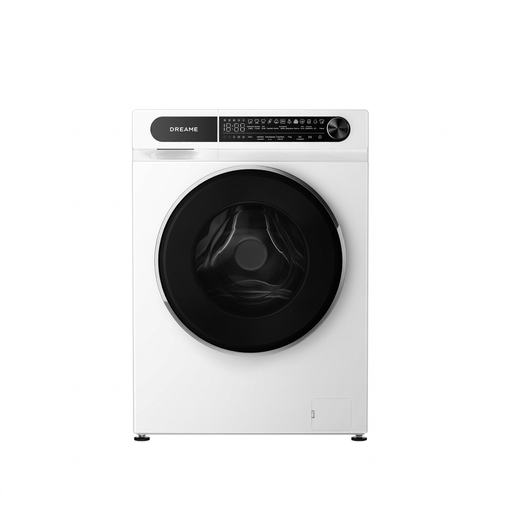 Image unavailable
This front-loader is worth considering if limited depth restricts your choice. Compare its full dimensions, door clearance and access to the connections with your space. Its 8 kg capacity should also suit the amount of laundry you usually wash.
 Image unavailable
A top-loader is worth considering if width is limited or space in front of the appliance is an issue. This model has a spin speed of 1,400 rpm and 17 programmes. Most importantly, check its width, depth and height, the clearance above the lid, the connections and whether its 6 kg capacity suits your laundry needs.
Measure the width, depth and height of the space, remembering to allow room to open the door or lid. Also check the route for the hoses and access to the water inlet, drain and socket.
Yes, provided the location and electrical installation are suitable. Promotelec states that the washing machine must be outside zones 0, 1 and 2 and the hidden zone, earthed, and connected to a circuit protected by a 30 mA RCD. If you’re unsure, ask a suitably qualified professional to inspect the installation.
Check the instructions for your chosen model before planning the connection. Electrolux says its top-loading and front-loading washing machines are designed for a cold-water supply. This is specific to the brand and shouldn’t be assumed to apply to every model.
It may be, as long as its capacity can handle your household’s usual loads. Que Choisir describes slim-depth front-loaders with capacities of 4 to 6 kg. Check the capacity of the specific model, especially if you often wash bulky items, and make sure there’s enough space in front of the door.
Check the durability index that applies to the model you’re considering. According to the French Ministry for Ecological Transition, this index has replaced the repairability index for the washing machines covered by the scheme since 8 April 2025. Check the model’s instructions and maintenance options separately.