Who is each format best for?
A small room doesn’t automatically point to the right washing machine. It depends on which dimension limits installation and how much space you need to load your laundry.
Households short on width
If a doorway, corridor or the space available is too narrow for a front-loader, consider top-loading models. Just make sure there’s enough clearance to open the lid. UFC-Que Choisir lists width as one of the key measurements to check before buying.
Households short on depth
If there’s room for a front-loader width-wise but it would stick out too far and obstruct the way, compare shallow-depth models. Remember to allow space in front for the door to open and behind the machine for the plumbing connections.
Households with an alcove or worktop
A fitted kitchen or space under a worktop means checking the height, depth and access to the pipes. If you plan to fit a decorative door panel, look for a model designed for this type of installation rather than relying on the washing machine’s dimensions alone.
What should you check before choosing?
First, measure the route to the installation space and the usable room available once the machine is connected. You can then rule out formats that won’t leave enough clearance to open the door or lid, and choose a capacity to suit your household.
Top-loading washing machine
Consider it: when the main constraint is the width of the route or installation space.
Bear in mind: top-loading machines need clear space above to open the lid, so they aren’t suitable for an enclosed space under a worktop.
Shallow-depth front-loader
Consider it: when there’s room for the width of a front-loader, but its depth would obstruct the way.
Bear in mind: you’ll still need room to open the door, and the model’s capacity must suit your household.
Integrated washing machine
Consider it: when the appliance is intended for a kitchen unit with a decorative door panel.
Bear in mind: the unit, door and access to the plumbing connections must all meet the requirements for the specific model.
Standard front-loader
Consider it: if the space can accommodate its dimensions and leave room in front of the door.
Bear in mind: measure the full depth needed for installation, not just the depth of the machine itself.
| Constraint |
What to check |
What matters to shoppers |
| Width and loading |
Measure the narrowest part of the route and the installation space, then check there’s room to open the lid or door. |
If I have to get the machine through a narrow doorway, I want to be able to install it without making it difficult to load. Around 33% of shoppers put this constraint first. |
| Depth and clearance |
Compare the available depth with the installation diagram, allowing for the pipes and the door opening. |
In a narrow kitchen, I don’t want the washing machine to block the way or stop the door from opening. This is a priority for around 27% of shoppers. |
| Alcove and worktop |
Measure all three dimensions of the alcove and check whether the model is suitable for the planned installation and door panel. |
If my kitchen is already fitted, I first look for an appliance that suits the unit and its door. Nearly 20% of shoppers prioritise this kind of integration. |
| Connections and stability |
Check the water supply, drainage, pipe routing and whether the machine can be levelled. In a bathroom, have the electrical installation checked too. |
When the plumbing or electrics are difficult to access, I need to be able to install and use the appliance safely and properly. Around 20% of shoppers put connections and safety first. |
Brands to consider by format
The models below illustrate different sizes. One model’s dimensions don’t represent a whole brand’s range, so always check the product details and manual for the specific model you’re considering.
Electrolux
Worth considering when width is the main concern: according to Electrolux France, the freestanding EW8T3653BA top-loader measures 890 × 400 × 600 mm and has a capacity of 6 kg.
- Its 400 mm width gives you a useful reference point for a narrow doorway.
- This model needs clear space above to open the lid, and its 6 kg capacity must be suitable for your household’s laundry needs.
Candy
A brand to consider if depth is your priority: Candy France describes its slim and compact models as having depths of 33 to 46 cm.
- This range gives you a starting point for finding models that suit the depth available.
- Check each product page: Candy lists the front-loading BP 49SBL8-FR as 521 mm deep, despite describing it as a compact model.
Whirlpool
A useful model for comparing a fully integrated washing machine with an existing kitchen unit: Whirlpool France lists the BI WMWG 8146 FR as an 8 kg model measuring 59,5 × 81,5 × 54,5 cm.
- The installation type and published dimensions give you an initial basis for comparing it with your unit.
- Check the fitting instructions to make sure the door panel, clearances and access to connections are all suitable.
Bosch
A front-loader size to compare with more spacious installation areas: Bosch Électroménager France lists the WGE02406FR as measuring 848 × 598 × 588 mm, with a capacity of 7 kg.
- These dimensions give you a precise reference when comparing a front-loader with the available space.
- This size won’t necessarily suit a space with limited width or depth.
Front-loading washing machines on Joybuy
These two front-loading models offer different capacities. Before choosing one for a small space, compare its dimensions and installation instructions with the route to its final position, the available clearance for the door and the space needed for the pipes.
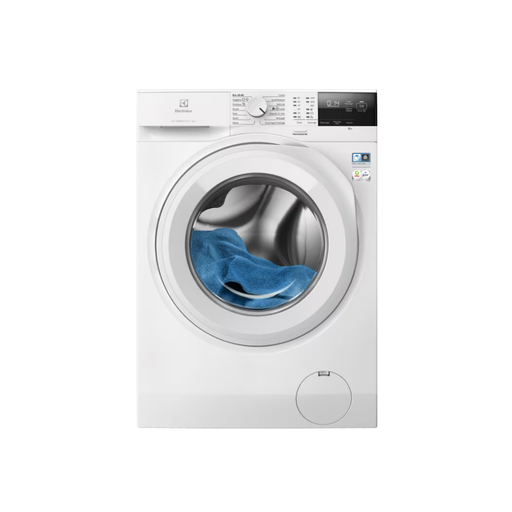 Image unavailable
Electrolux EW6FI4805AW, 8 kg, 1 400 rpm
This front-loader is worth considering if an 8 kg capacity suits your household and there’s enough room in front of the door once it’s installed.
- Stated capacity: 8 kg; stated spin speed: 1 400 rpm.
- For an alcove or under-worktop installation, compare the instructions with the dimensions of your space and the clearance needed for the connections.
View on Joybuy
 Image unavailable
Electrolux EW7FI259160V, 9 kg, 1 600 rpm
This front-loader is worth considering if your household needs a stated capacity of 9 kg and your space can accommodate its dimensions and allow the door to open.
- Stated capacity: 9 kg; stated spin speed: 1 600 rpm.
- Check the manual for under-worktop installation requirements, as well as the space needed for the pipes and door to open.
View on Joybuy
Frequently asked questions
What should I measure before buying a washing machine for a small space?
Measure the route to the room, then the usable width, height and depth of the intended space. Also check how much clearance is needed to open the door or lid and allow for the pipes, using the installation diagram for the specific model.
Is a top-loading washing machine always better for a small room?
No. A top-loader is most useful when width is the main constraint, provided there’s room to open the lid. UFC-Que Choisir gives a width of 40 to 46 cm for this category. If depth is the issue, compare shallow-depth front-loaders instead.
Can a freestanding front-loader replace an integrated washing machine?
Not if your kitchen needs a decorative door panel fitted to the appliance. In that case, you’ll need a model designed for integrated installation. If you simply want to install it under a worktop, check the manufacturer’s instructions, the alcove dimensions and access to the connections before choosing a freestanding front-loader.
Can you install a washing machine in a small bathroom?
It depends on the location and electrical installation, not just the floor space. For a bathroom in France, Promotelec specifies, among other requirements, that the appliance must be positioned outside zones 0, 1 and 2, as well as the concealed zone, and must be earthed and protected by a 30 mA residual-current device. Have the layout checked on site.
When should I compare washing machine durability ratings?
Compare them after identifying the models that can be installed in your home and have a suitable capacity. According to ADEME, a durability rating has been required for washing machines sold in France since April 2025. It doesn’t replace checking the dimensions, door clearance and plumbing connections.


