Buying priorities
Start with the dimension that genuinely limits installation, then check the capacity and the model’s suitability for everyday use.
| Priority |
What to check |
Your needs |
| Compatible dimensions |
Measure the overall width, depth and height. Also check the opening space needed for the front door or top lid. Under-counter installation must be approved for the model. |
I need to know whether the lack of space mainly concerns the width, depth, clearance beneath a worktop or the room around the appliance. |
| Suitable capacity |
Compare the stated kg capacity with your usual loads, including bed linen and towels. The slim models cited by UFC-Que Choisir commonly offer 4 to 6 kg; mini models are intended for small loads. |
I want to keep a drum size that suits my everyday laundry rather than automatically choosing the smallest format. |
| Ease of use |
Compare the noise level and spin-noise class on the energy label. Check the manual for access to the filter and the required maintenance procedures. |
If the machine is near a living area, I want to minimise noise disruption and be able to maintain it easily. UFC-Que Choisir reports that spin-cycle noise, washing time and maintenance received more mixed feedback from respondents to its newsletter. |
| Energy use and durability |
Use the energy label to compare the class, kWh per 100 cycles, litres per cycle and spin performance. In France, also check the model’s durability index. |
Once I have confirmed that the appliance will fit, I want to compare compatible machines based on their stated consumption and whether they can be repaired. |
Washing machine options on Joybuy
These Joybuy options include a narrow top-loader, a high-capacity standard front-loader and a front-loader presented as slim. Compare them with the measurements of your space before choosing.
 Image unavailable
Candy TCA464TM4-S ProWash 500, 6 kg top-loader
Worth considering for a space mainly limited by width, provided the top of the appliance remains accessible.
Stated width of 40.5 cm, 6 kg capacity, 1,400 rpm, 49 kWh/100 cycles and 41 L/cycle.
Its stated depth of 60 cm will not solve a lack of depth. Check the vertical clearance needed for the lid; the stated spin noise is 79 dB(A), class C.
Joybuy
 Image unavailable
Electrolux EW7FI259160V, 9 kg front-loader
This option is better suited to a household that wants to keep a large drum and has sufficient space in front of the appliance.
Stated capacity of 9 kg, dimensions of 84.7 × 59.7 × 66.0 cm, A energy class, 44 kWh/100 cycles, 48 L/cycle and 72 dB during spinning, class A.
The stated depth of 66.0 cm must fit the recess, with enough clearance for the door. Check the manual before considering under-counter installation or stacking.
Joybuy
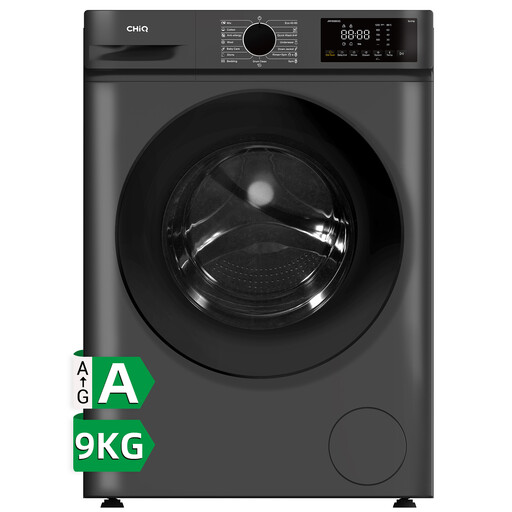 Image unavailable
CHiQ JW95883G, 9 kg front-loader
This model may suit a household looking for a large capacity in a compact front-loader, once all dimensions have been checked carefully.
Stated capacity of 9 kg, 530 mm drum, 1,400 rpm spin speed, 16 cycles and a 15-minute quick programme.
The stated depth measurements are contradictory: 57.7 cm in one place and 465 mm in another. Check the technical specifications or manual, along with the spin noise and any under-counter or stacking compatibility.
Joybuy
Frequently asked questions
Which dimensions should I measure before buying a washing machine for a small space?
Measure the overall width, depth and height of the space, then check the access route needed for delivery. Allow for opening clearance too: in front for a door and above for a top-loader. A top-loader mainly saves width, while a slim model mainly reduces depth.
Is a slim washing machine necessarily suitable for one person?
No, not automatically. UFC-Que Choisir states that slim models generally offer around 4 to 6 kg; a 6 kg model may suit regular small loads, but compare its capacity with the laundry you actually wash. ADEME states that a 7 kg washing machine is sufficient most of the time.
Can I place any front-loading washing machine under a worktop?
No. Check the model’s manual and specifications: Bosch distinguishes, in particular, under-counter washing machines with a removable top, for which an under-counter cover may be required. A standard freestanding appliance should not be assumed to be suitable for under-counter installation based on its height alone.
Can I stack a tumble dryer on a slim washing machine?
Do not assume so. Stacking requires a kit compatible with the specific references involved. For example, Bosch specifies that the WTZ27510 kit is designed for a full-size washing machine with a depth of more than 55 cm; this condition probably rules out many slim models.
Which parts of the energy label matter in a small home?
Compare the energy class, kWh per 100 cycles, litres per cycle, spin efficiency and noise level. ADEME states that washing machine energy labels provide this information and recommends a spin class A when laundry needs to dry quickly indoors or in a tumble dryer.


