In a small home, first choose a washing machine that will fit through the route to its intended spot and leave the drum accessible. A slim-depth front-loader can solve a lack of depth, while a top-loader is better suited to limited width. If drying is also a concern, a washer-dryer combines both functions in one appliance, but can dry a smaller load than it can wash. A compatible stacked pair or an airer in a well-ventilated room may suit other setups.
Who are these options for?
You’re short on depth or width
A shallow alcove and a narrow passage call for different formats. According to Que Choisir, a slim-depth front-loader still gives you access from the front, while a top-loader is loaded from above. Remember to measure the space needed to open the drum, too.
You need to dry your laundry indoors
Whether you choose a washer-dryer, two stacked appliances or an airer depends on the space available and how well it is ventilated. Que Choisir highlights the lower drying capacity of two-in-one appliances, while ADEME draws attention to the moisture released by air-drying laundry.
You want a capacity that suits your laundry loads
If you wash small loads, a large drum that is often only partly full may not be useful; a drum that is too small, on the other hand, can mean more cycles. Compare the capacities with your usual loads and the bulky items you actually wash, as ADEME recommends.
Which factors will help you decide?
Measure the space and delivery route before comparing formats. Then decide how you’ll dry your laundry: this choice could change the whole setup.
Slim-depth front-loader
Consider this: if depth is limited but you have enough width and space in front of the door. Que Choisir describes slim-depth front-loaders measuring 33–45 cm deep while retaining a width of around 60 cm.
Bear in mind: check that the capacity suits your usual loads, and allow for the model’s depth and connections when measuring the installation space.
Top-loading washing machine
Consider this: if width is your main constraint. Que Choisir puts this format at around 40 cm wide, with no door to open in front of the appliance.
Bear in mind: the lid needs space above it, so a fixed worktop could rule out this setup.
Washer-dryer
Consider this: if you can fit only one appliance on the floor and want to wash and then dry your laundry without transferring it.
Bear in mind: according to Que Choisir, the drying capacity is lower than the washing capacity, and drying cycles can take longer than with a separate tumble dryer.
Two stacked appliances
Consider this: if you dry laundry often and have enough height for a stack of two front-loading appliances.
Bear in mind: Que Choisir recommends checking the dimensions, instructions and stability of the stack. The tumble dryer goes on top of the washing machine.
Washing machine and airer
Consider this: if you have a well-ventilated room where laundry can dry without getting in the way.
Bear in mind: damp laundry releases moisture into your home, as ADEME points out. This option is less practical in a small, poorly ventilated room.
| Factor | What to check | Who is this for? |
|---|
| Size and access |
Measure the alcove, passageways and opening space in front of a front-loader or above a top-loader; check the installation dimensions for the model. |
If the appliance might block a passage, I want to make sure I can get it into place and access the drum once it’s installed. Around 29% of consumers would make size and access their priority. |
| Drying |
Compare washing and drying capacities separately. If you’re planning to use an indoor airer, check how well the room is ventilated. |
When laundry needs to dry regularly in a small space, I’m looking for a solution that won’t let moisture build up. Drying would be the main concern for around 29% of consumers. |
| Installation |
Check the suitable power socket, water supply, drainage and floor stability. For a stacked setup, consult the instructions for both appliances. |
Before choosing a format, I need to know whether it can be connected and, if necessary, stacked securely. Installation options would come first for around 21% of consumers. |
| Capacity and use |
Match the capacity to your everyday loads; also compare spin, noise and energy consumption details on the energy label. |
If my loads are small but I sometimes wash bulky items, I want to avoid both extra cycles and a drum that’s often only partly full. Around 21% of consumers would prioritise this balance. |
Mistakes to avoid
-
Choosing the smallest drum just to save space
A drum that’s too small can mean more cycles, while a large capacity that you rarely use often leaves the appliance only partly full.
Before comparing capacities, think about your usual loads and the bulky items you actually wash.
-
Assuming washing and drying capacities are the same
With a washer-dryer, you may not be able to dry the whole load in one go. Que Choisir states that drying capacity is lower than washing capacity.
Compare the two capacities listed for each model and, if needed, plan to remove some of the laundry before drying.
-
Stacking two appliances without checking they’re compatible
Incorrect dimensions or an unstable floor can compromise the stability of the stack.
Check the instructions and load limits, make sure the floor is stable, and place the tumble dryer above the washing machine.
You may also need a compatible stacking kit.
-
Using an airer without considering ventilation
ADEME points out that air-drying laundry releases a lot of moisture into the indoor air. This can be particularly troublesome in a small, poorly ventilated space.
Choose a well-ventilated room or one with suitable extraction for indoor drying, and compare the washing machine’s spin performance if you plan to use an airer regularly.
Brands to know
There are no brands to feature in this section.
Appliances for different spaces and drying needs
These appliances suit three different setups: a top-loader when width is limited, a front-loader when depth needs careful consideration, or a washer-dryer if you want both functions in one appliance. Compare their installation dimensions and capacities with your room and laundry needs.
 Image unavailable
Haier T Series 7 THASN276TM6-S, 7 kg top-loading washing machine
Worth considering if width is your main space constraint and the lid can open freely above the appliance.
Stated washing capacity: 7 kg; spin speed: 1 200 tr/min; energy class A. Check the full dimensions, delivery route and connections before choosing this format.
View on Joybuy
 Image unavailable
Hisense WF5I8043BWF, 8 kg front-loading washing machine
Worth comparing if you prefer front access and have enough room to open the door.
Stated washing capacity: 8 kg; spin speed: 1 400 tr/min. Compare this capacity with your usual loads, then check the overall depth, allowing for the connections.
View on Joybuy
 Image unavailable
Candy TCA464TM4-S ProWash 500, 6 kg top-loading washing machine
Worth considering for smaller loads if a top-loading design suits your space.
Stated washing capacity: 6 kg; spin speed: 1 400 tr/min; energy class B. Leave enough room to open the lid and check whether this capacity will suit your bulkiest items.
View on Joybuy
 Image unavailable
Samsung WD11DG6B85BEU3, 11 kg / 6 kg washer-dryer
Worth considering if you want to wash and dry with a single appliance and it will fit in your room.
Stated capacities: 11 kg for washing and 6 kg for drying; class A stated for washing. If you wash a full load, you’ll need to reduce it before drying. Compare both limits, not just the washing capacity.
View on Joybuy
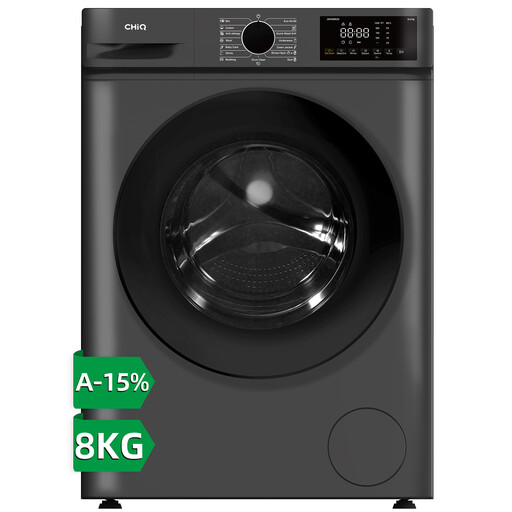 Image unavailable
CHiQ JW85883G, 8 kg dark grey front-loading washing machine
Worth considering for a space with front access, provided you measure the room needed for the door and connections.
Stated washing capacity: 8 kg; spin speed up to 1 400 tr/min. Check the full external dimensions and the energy consumption and noise details that matter for your room before comparing this model with others.
View on Joybuy
Frequently asked questions
What capacity should you choose for one or two people?
A capacity of 5 to 7 kg can be a good starting point for one or two people, according to Que Choisir. Choose a size that suits how often you do laundry and the bulky items you wash, rather than automatically opting for the smallest drum.
Can a washer-dryer dry a full washing load?
Not if the washing load is larger than its drying capacity, which Que Choisir says is lower than its washing capacity. Check the two figures for the specific model and, if necessary, plan to remove or split some of the laundry before drying.
Can you put any tumble dryer on top of a washing machine?
No. Stacking requires compatible appliances and a stable setup. Que Choisir recommends checking the instructions, dimensions and suitable stacking kit. The tumble dryer must be placed above a front-loading washing machine.
Is an airer suitable for a studio flat?
An airer can work if you have a well-ventilated spot where the laundry won’t get in the way. ADEME reminds us that air-drying releases a lot of moisture indoors, so check the room’s ventilation before making it your regular solution.


