People with a narrow alcove
If you’re short on width or depth, compare which dimension each format helps you save. Leave enough room to access the laundry and connections.


Choose a format based on the dimension you’re short of: a top-loading washing machine mainly saves width, while a slim front-loader mainly saves depth. Before comparing capacities, also measure the space needed to open the lid or door, fit the connections and place the machine on a stable floor. An under-counter or integrated front-loader is only suitable if your chosen space can accommodate its dimensions and installation requirements.
If you’re short on width or depth, compare which dimension each format helps you save. Leave enough room to access the laundry and connections.
In a fitted kitchen or bathroom, check the available height, usable depth and door clearance. A cabinet door also requires a compatible model and fittings.
In a block of flats, where vibrations could disturb the neighbours, check the model’s noise level and make sure it’s installed on a flat, stable floor. Que Choisir reports that readers surveyed about their washing machines were more divided in their views on spin-cycle noise.
Start with the dimension that limits your installation, then check the capacity and spin-cycle requirements. Not all formats solve the same space problem.
Consider it: if you’re short on width and there’s enough clearance above to open the lid freely.
Bear in mind: saving width won’t necessarily solve a lack of depth; a fixed worktop prevents you from loading the machine from above.
Consider it: if your space can accommodate the model’s width and depth, with room in front of the door.
Bear in mind: its dimensions may take up too much room in a shallow space; remember to allow for the connections too.
Consider it: if a front-loader fits width-wise, but a standard model is too deep.
Bear in mind: according to Que Choisir’s guide, models in this range generally have a capacity of around 4 to 6 kg.
Consider it: for a space that won’t accommodate either a top-loader or a standard-width front-loader.
Bear in mind: Que Choisir describes compact models as having a capacity of under 5 kg; make sure that’s enough for your usual laundry.
Consider it: if you have a cabinet designed to house a washing machine behind a compatible door.
Bear in mind: an integrated design doesn’t guarantee a smaller appliance; check the cabinet and fittings.
| Consideration | What to check | Who is it for? |
|---|---|---|
| Size | Measure the usable width, depth and height, then allow for opening the machine and fitting the connections. A top-loader mainly saves width; a slim model mainly saves depth. | If the machine might block the way in a narrow alcove, I need to find a format that fits and can still be used easily. Around 33% of consumers would put this consideration first. |
| Under-counter or cabinet installation | Check the clearance beneath the worktop and the door opening. For an integrated model, also check the cabinet’s internal dimensions and the fittings for the cabinet door. | If my kitchen is already fitted, keeping the existing layout matters more to me than choosing the largest drum. Around 27% of consumers would prioritise this need for an integrated appliance. |
| Capacity | Compare the capacity in kg with the amount of laundry you wash and how often you wash bulky items. | If I often wash sheets or towels, I’d rather not have a small drum mean running more cycles. Around 20% of consumers would prioritise finding a suitable capacity. |
| Noise and vibrations | Compare the stated spin-cycle noise levels of the models you’re considering, and plan to install the machine on a flat, stable floor. | If the spin cycle might disturb the neighbours, I want to take noise into account as well as the space the machine takes up. Around 20% of consumers would prioritise reducing noise and vibrations. |
An appliance may fit between two cabinets but still be unusable if its door or lid hits an obstacle. Hoses also take up space behind the machine.
Measure the space in all three dimensions, note any obstacles and the position of the connections, then compare these with the installation diagram for the exact model.
An integrated model is designed to fit inside a cabinet; it isn’t necessarily narrower. The BIWMWG71483FRN listed by Whirlpool France is 59,5 cm wide.
Check the cabinet’s internal dimensions, the cabinet door and its fittings before choosing this option.
A poorly levelled machine may transmit more vibrations. Que Choisir recommends installing it on a flat, stable floor.
Adjust the feet in line with the instructions and make sure the machine is sitting properly before its first spin cycle.
A smaller appliance may have a capacity that’s less suited to sheets, towels or frequent washing. In its guide to different formats, Que Choisir describes compact models as having a capacity of under 5 kg.
Compare the stated capacity with your usual loads before deciding between a compact, slim, top-loading or standard front-loading model.
The range includes front-loaders worth considering if your space can accommodate a standard-width appliance.
Its top-loading models are worth considering when width is the main constraint.
Its listed models include a narrow top-loader and an integrated model, designed for different layouts.
The THASN466TM5-S top-loader is an example of a narrow model for spaces where loading from above is still possible.
These models let you compare a top-loader for a narrow space with several front-loaders, if there’s room to open the door. Before buying, check that your chosen model’s dimensions and connections are suitable for your space.
 Image unavailable
Worth considering if width is your main constraint and there’s enough clear space above to open the lid. The model name indicates a capacity of 6 kg, a spin speed of 1 400 rpm and 17 programmes. Check that its depth and the space needed for the connections also suit your alcove.
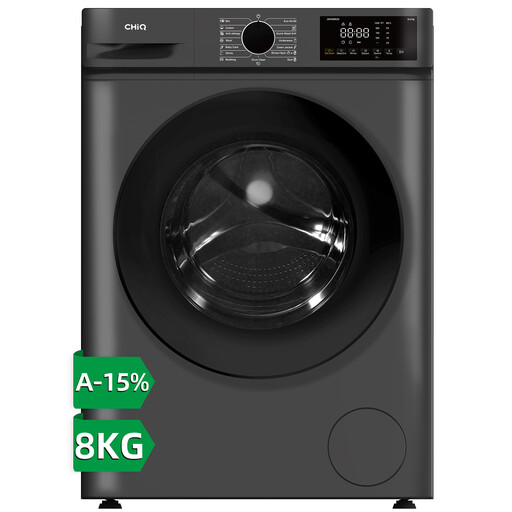 Image unavailable
Worth considering if you’re looking for an 8 kg front-loader for a shallow room. The model name indicates a spin speed of 1 400 rpm and 16 programmes. To check whether it will really fit, confirm its full dimensions, the space in front of the door and the connections. If noise matters, compare its spin-cycle noise rating too.
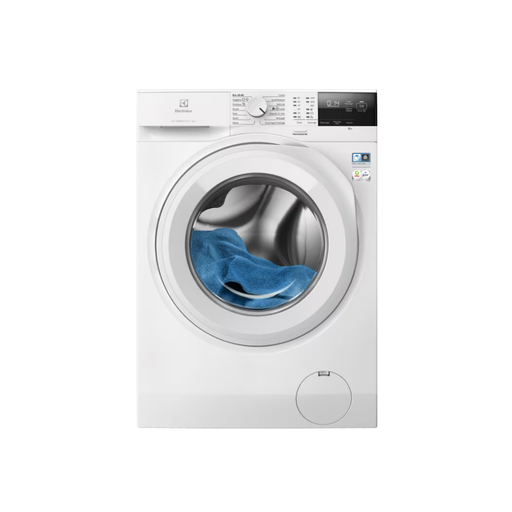 Image unavailable
Worth considering if an 8 kg front-loader will fit in your space, with clear access to the door. The model name indicates a spin speed of 1 400 rpm. Compare its dimensions with your alcove, allowing room for the connections. The noise level shown on a product page isn’t enough on its own to predict how much vibration will travel through your home.
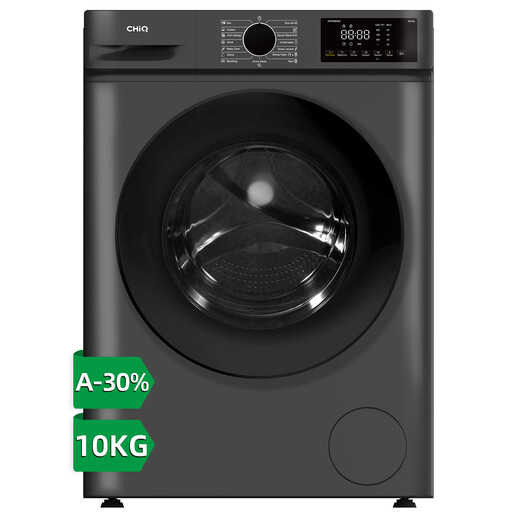 Image unavailable
Worth considering if laundry capacity matters more to you than choosing the smallest drum. The model name indicates a capacity of 10 kg, a spin speed of 1 400 rpm and 16 programmes. That capacity doesn’t tell you whether it will fit in a small alcove: check the full dimensions, connections and door clearance before choosing.
Check the available space, water supply, drainage, floor stability and the safety of the electrical installation near water. Requirements depend on the layout; if you’re unsure, ask a qualified professional to assess the space.
Not under a fixed worktop that prevents the lid from opening: you load the machine from above. For an under-counter installation, consider a front-loader with a suitable height, depth and door clearance.
Que Choisir recommends leaving at least 0,5 cm between the washing machine and neighbouring units. Allow extra space for the hoses, plug and door opening, then follow the clearance requirements in the model’s instructions.
Compare their spin-cycle noise levels under similar conditions, then take your planned installation into account. A noise rating alone can’t predict how much vibration will be transmitted through an unstable floor or a poorly levelled machine.