What to check before buying
Start by identifying the constraint that genuinely prevents installation: width, depth, opening or connections. Capacity comes next, as a very compact appliance may not suit your household’s usual washing routine.
| Priority |
What to check |
Your needs |
| Actual footprint |
Measure the width, depth and height, then allow extra space for the hoses. Also check the opening of the door or lid and the route into the room. |
I want to install the machine without blocking movement or making the drum inaccessible once the appliance is connected. |
| Usable capacity |
Compare the rated capacity with your usual laundry volume. For one or two people, UFC-Que Choisir recommends 5 to 7 kg for daily use. |
I am looking for a main machine for clothes, towels and bedding, rather than one that requires lots of small loads. |
| Connections |
Locate the water inlet, drainage outlet, suitable socket and hose routes. Follow the installation diagram for the model you choose. |
I want to avoid ordering an appliance that cannot be connected correctly in a kitchenette, recess or bathroom. |
| Limitations of a mini model |
Check the capacity for each programme, available temperatures, spin cycle and permitted drainage height. Bulky items often require a larger solution. |
A portable format will only suit me if my loads are small and I am happy to run more cycles for bulky laundry. |
Joybuy products for small homes
These Joybuy options include top-loading washing machines for width restrictions and slim front-loading models where depth is the limiting factor.
 Image unavailable
Haier T Series 7 THASN276TM6-S, 7 kg top-loading
Worth considering for a studio flat or narrow bathroom if loading from the top is possible.
Listed dimensions: 860 × 405 × 600 mm; capacity 7 kg; maximum spin speed 1,200 rpm; 16 programmes.
Allow sufficient clearance above the machine for the lid and check access to the connections at the rear.
View on Joybuy
 Image unavailable
Candy TCA464TM4-S ProWash 500, 6 kg top-loading
This top-loading model could be suitable if a front-opening door would obstruct movement in a narrow kitchen or bathroom.
Listed dimensions: 86 × 40.5 × 60 cm; capacity 6 kg; maximum spin speed 1,400 rpm; 17 programmes.
The lid must be able to open fully, and the 60 cm depth must be measured with the hoses in place.
View on Joybuy
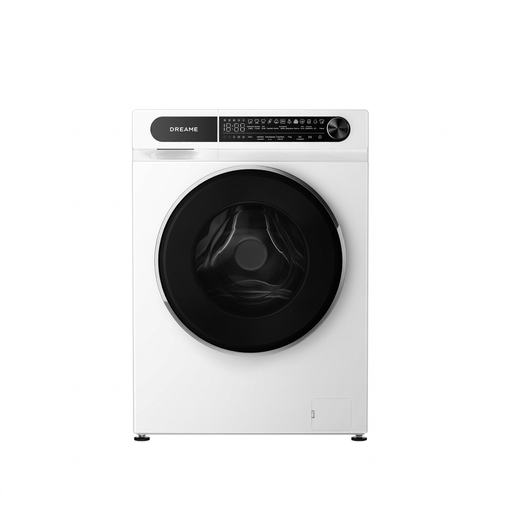 Image unavailable
Dreame DRWASHS8KG, 8 kg slim front-loading
A front-loading option for a home with limited depth, provided 60 cm of width and clearance in front of the door are available.
Listed dimensions: 600 × 450 × 840 mm; capacity 8 kg; maximum spin speed 1,400 rpm; 12 programmes.
Check the door clearance, space for the hoses and installation diagram before choosing this format.
View on Joybuy
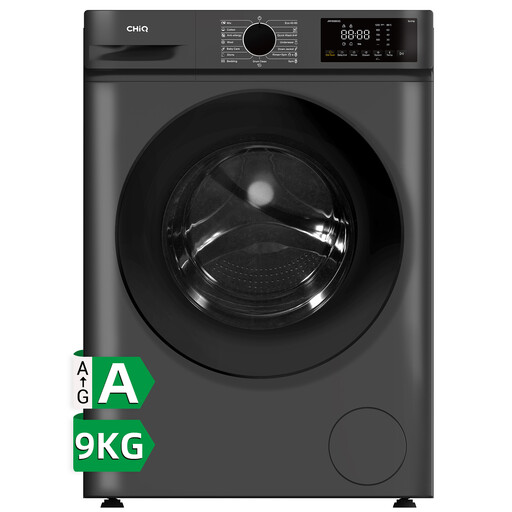 Image unavailable
CHiQ JW95883G, 9 kg slim front-loading
Consider it if you want a large capacity in a model with reduced listed depth, while still having enough room for a front-opening door.
Listed capacity: 9 kg; listed depth: 465 mm; maximum spin speed 1,400 rpm; 16 programmes.
Confirm the complete dimensions, as the width and height details should be checked before preparing the installation space.
View on Joybuy
Frequently asked questions
Can a 3 kg washing machine replace a main appliance in a studio flat?
Generally, no, if you regularly wash bedding, towels, coats or laundry belonging to several people. UFC-Que Choisir presents 2 to 3 kg mini washing machines as supplementary appliances; a 5 to 7 kg model is more suitable for one or two people where installation is possible.
Should you choose a top-loading or front-loading model for a narrow bathroom?
Choose according to the available clearance. A top-loading model takes up less width and avoids the need for a front-opening door, but its lid must be able to open fully; a front-loading model needs more width and clear space in front of its door.
Which connections should you check before ordering?
Check the water inlet, drainage, access to a suitable socket, the route taken by the hoses, the delivery path and the space required to remove the transit bolts. Electrolux France states that connections must be made to installations that comply with current standards.
Can you install a washing machine in a bathroom in France?
This depends on the exact location and the electrical installation. The NF C 15-100 standard sets safety rules around showers and baths; have a competent professional check the relevant zone and electrical circuit if the space is restricted or close to a water source.
What ventilation is needed in a recess or cupboard?
Follow the installation diagram and clearances specified by the manufacturer for the exact model. Keep the necessary access to the hoses and for maintenance, and consult the instructions before finalising a recess or cupboard around the appliance.


