If width is your main constraint, consider a top-loading washing machine and check that its lid can open fully. If the room is short on depth, a shallow front-loader may be a better fit, provided you also measure its width and the space needed in front of the door. In a bathroom, check the location and connections before choosing a model.
Who is this choice for?
The dimension you’re short on and the way you access the drum are better guides to your choice than the word ‘compact’ alone.
People with a very narrow alcove
If the appliance needs to fit between a wall and a bathroom fixture, measure the width first. For a top-loading machine, also check that nothing will get in the way of opening the lid, as the Institut national de la consommation advises.
People with a shallow utility room
If there’s enough width for a front-loader but the appliance could encroach on the walkway, check its depth and the space needed to open the door. Electrolux describes its slim models as front-loaders with a reduced depth.
Households with a large laundry load
A small room doesn’t mean you have less washing to do. Compare the usable capacity with your laundry routine, as well as the full dimensions of each model. Haier’s range of top-loading washing machines shows how capacity varies between models.
What should you check first?
Top-loading washing machine
Consider this when: width is the main limitation in your alcove and the top of the appliance can be kept clear.
The trade-off: according to the Institut national de la consommation, the lid means this style can’t be installed under a worktop; you’ll also need to measure its depth.
Shallow front-loader
Consider this when: depth is the main limitation, but there’s enough width and access from the front.
The trade-off: Electrolux says its slim front-loaders are generally 60 cm wide. You’ll also need enough space in front of the appliance to open the door.
| Consideration |
What to check |
Best for |
| Dimensions and opening |
Measure the available width, depth and height, then check the full opening space needed for the lid or door. Allow room for the connections too. |
Between two units, I need to be able to install the machine and reach the laundry without blocking the walkway; around 36% of consumers rank space requirements as their top priority. |
| Installation and connections |
Check the water supply, drainage and electrical connection. In a bathroom, ask someone to confirm that the location and electrical protection are suitable if you’re unsure. |
Before buying a machine for my bathroom, I want to know whether the connections and location will work; this installation question is the top priority for around 29% of consumers. |
| Washing capacity |
Compare the stated capacity with your usual laundry loads and check the maximum load for the programmes you’ll use. |
If I often wash large loads, a smaller machine could change my routine; around 21% of consumers put finding the right capacity first. |
| Stability and maintenance |
Make sure you have a level, hard floor, access to the adjustable feet and enough room to maintain the appliance. |
In a room close to the living areas, I want to be able to stabilise and maintain the machine easily; this comes first for around 14% of consumers. |
Mistakes to avoid
-
Confusing ‘compact’ with ‘narrow’
A slim front-loader may be less deep without solving a width problem: Electrolux says its slim models are generally 60 cm wide.
Compare the dimensions of the exact model, then check how much space you’ll need in front of its door.
-
Forgetting the space above a top-loader
Top loading can work well in a narrow alcove, but it won’t be practical if a shelf or worktop prevents the lid from opening.
Before choosing this style, measure the available height with the lid open.
-
Choosing a location before checking the installation
In a bathroom, the machine’s dimensions alone won’t tell you where it can be installed. Promotelec draws particular attention to earthing, residual-current protection and the appliance’s position in relation to the bath or shower.
If you’re unsure, ask a qualified professional to check the location and connections, especially if you’re planning to put the machine in a cupboard.
A location that needs electrical or plumbing work could also delay installation.
-
Blaming vibrations on the model alone
Stability also depends on how the machine is installed: Electrolux recommends a level, hard floor and making sure the appliance is level.
Leave room to reach the feet and adjust them, and make sure the machine isn’t touching the wall or another appliance.
Brands to consider for these styles
These ranges give you a starting point for comparing dimensions and capacity. Always check the exact model before making a decision.
Whirlpool
For a narrow top-loader: Whirlpool lists its TDLR6247FR/N as 40 cm wide, 60 cm deep and with a 6 kg capacity.
- This width could work well if space is particularly limited across the alcove.
- The lid needs room to open. Check the dimensions and capacity of any other model you’re considering.
Electrolux
For a shallower front-loader: Electrolux says its slim models are generally between 33 and 45 cm deep.
- This style can suit a space with limited depth while retaining front loading.
- The width is generally 60 cm, and you’ll need room in front of the appliance to open the door.
Haier
For comparing top-loader capacities: Haier’s French range includes models from 6 to 9 kg, with widths from 400 to 405 mm depending on the model.
- These models let you compare different capacities when width is limited.
- A higher capacity doesn’t remove the need to check the depth, height and opening space of the model you choose.
Candy
For comparing slim front-loaders: Candy’s French range includes models from 5 to 9 kg, depending on the model.
- The range makes it easier to compare your capacity needs with the dimensions of different models.
- ‘Slim’ doesn’t guarantee a width that will fit a narrow alcove, or enough room to open the door.
Washing machines available on Joybuy
These two options suit different needs: a top-loader if width is the deciding factor, or a front-loader to consider if you’re looking to save depth. For either one, compare the full dimensions and opening space with your available space.
 Image unavailable
Candy TCA464TM4-S ProWash 500, 6 kg top-loading washing machine
Worth considering if your alcove calls for a top-loader, provided you can open the lid fully.
The model name indicates a 6 kg capacity, a spin speed of 1,400 rpm and 17 programmes. Check the full dimensions and the clearance needed to open the lid.
View on Joybuy
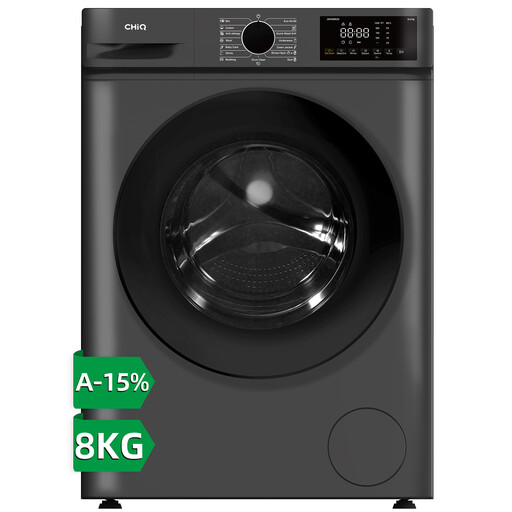 Image unavailable
CHiQ JW85883G, 8 kg front-loading washing machine
Worth considering if you want front loading and an 8 kg capacity in a room where every dimension matters.
The model name indicates a spin speed of 1,400 rpm and 16 programmes. Measure the width, depth and door clearance before deciding whether it will suit your room.
View on Joybuy
Frequently asked questions
Can you install a washing machine in a bathroom?
Yes, if the location and electrical installation are suitable for the room. Promotelec highlights earthing, residual-current protection and the appliance’s position in relation to the bath or shower. If you’re unsure, ask a qualified professional to check your plans.
Is a cupboard enough to make the location suitable?
No. A cupboard alone doesn’t resolve whether the installation is suitable for a bathroom. Promotelec says the location should be assessed with the cupboard doors open; have the layout checked before planning the connections.
How can you reduce vibrations after installation?
Install the washing machine on a level, hard floor, then adjust the feet until it’s stable and level. Electrolux also recommends keeping it clear of walls and other appliances, and following the model’s instructions.
What should you check about the drainage before buying?
Check the drainage height and access against the installation instructions for your chosen washing machine. As a guide specific to its own advice, Electrolux recommends a drain hose height of 60 to 100 cm from the floor. Also make sure the hose won’t be kinked.


