Home with limited depth
If the machine would stick out into a walkway but you have around 60 cm of width to spare, a slim front-loader is worth considering. Leave enough room in front of the door to open it and load your laundry.


If depth is blocking the way, consider a slim front-loader. If you’re short on width, a top-loading washing machine could work, provided you have room to open the lid. A mini washing machine is more of a back-up option when a standard model can’t be installed: check its capacity and connections. If you’re placing it in a bathroom, make sure the position and electrical protection are suitable before ordering.
If the machine would stick out into a walkway but you have around 60 cm of width to spare, a slim front-loader is worth considering. Leave enough room in front of the door to open it and load your laundry.
A top-loading washing machine could be a good fit if width is the main constraint. Check the appliance’s depth and make sure there’s enough clearance above it to open the lid fully.
For a studio or bedroom where a standard model can’t be installed, Que Choisir presents a mini washing machine as a back-up option. Make sure its capacity, water supply and drainage arrangements suit the way you plan to use it.
Worth considering: if the machine sticking out into the room is a problem, but its width and the door’s opening clearance still work for your space.
The trade-off: a reduced depth won’t necessarily free up space at the sides or in front of the appliance.
Worth considering: if width is limited and you can access the top of the machine.
The trade-off: it may still be close to 60 cm deep, and a fixed worktop above it could prevent the lid from opening.
Worth considering: if you can’t install a standard washing machine and the model’s capacity suits the amount of laundry you need to wash.
The trade-off: don’t assume it will do everything a standard model can. In particular, check its capacity, drainage and spin performance.
First, measure what’s actually limiting your installation. Then check that the format you choose suits your laundry needs and available connections.
| Factor | What to check | What I need |
|---|---|---|
| Dimensions and opening clearance | Measure the width, depth and height, then allow space for connections and opening the appliance. Electrolux describes its slim front-loaders as generally 60 cm wide and 33 to 45 cm deep; top-loaders featured by Electrolux and AEG are around 40 cm wide and nearly 60 cm deep. | I want to be able to open the machine without blocking the walkway or hitting a piece of furniture. |
| Capacity | Compare the capacity in kg of dry laundry with the size of your usual loads and any bulky items you wash. Que Choisir points out that an unsuitable capacity can mean more cycles or excessive water and electricity use. | To avoid doing laundry too often, I’d rather choose a capacity that suits the amount of laundry I actually wash. |
| Bathroom installation | According to Promotelec, the appliance must be outside zones 0, 1 and 2, as well as the concealed volume, connected to earth and powered by a circuit protected by a 30 mA RCD. Ask someone to check your plans if you’re unsure about the location or circuit. | Before ordering a machine for my bathroom, I want to know whether the location and electrical installation are suitable. |
| Noise and maintenance | Check the model information for spin noise levels and programme duration. Also make sure you’ll still be able to reach the filter once the machine is installed. | If the machine is close to my living space, spin noise matters. If it’s in a recess, I also need to be able to reach the filter. |
Top-loaders featured by Electrolux, AEG and Whirlpool are around 40 cm wide but nearly 60 cm deep, so they could still encroach on your walkway.
Measure the width, depth and clearance above the space separately.
Promotelec explains that installation also depends on the appliance’s position relative to the bathroom zones, earthing and circuit protection.
If you’re unsure, get the location and electrical circuit checked before delivery.
You may need to have the installation checked or adapted before you can use the machine.
According to Que Choisir, too small a capacity may mean running more cycles, while a capacity that doesn’t suit your needs can lead to excessive energy use.
Before choosing a capacity, think about how much dry laundry you wash per load and how often you do laundry.
Que Choisir recommends it as a back-up option when a standard model can’t be installed.
Check the model’s capacity, water supply, drainage, spin performance and electrical connection.
Electrolux France’s product information lets you compare a slim front-loader with a 6 kg top-loader, depending on the space available.
The LTR8C7331A top-loader is a useful reference if you’re looking for a stated capacity of 7 kg in a narrow-width format.
The TDLR6253BFR is an example of the dimensions of a 6 kg top-loading washing machine.
These two top-loading models are suited to situations where width is the main constraint. For either one, also check the depth, lid clearance and connections at the intended location.
 Image unavailable
Worth considering if width is a constraint and the lid can open fully. It has a stated capacity of 6 kg, a spin speed of 1,400 rpm and a B energy rating. Also measure the depth and allow enough room for the connections.
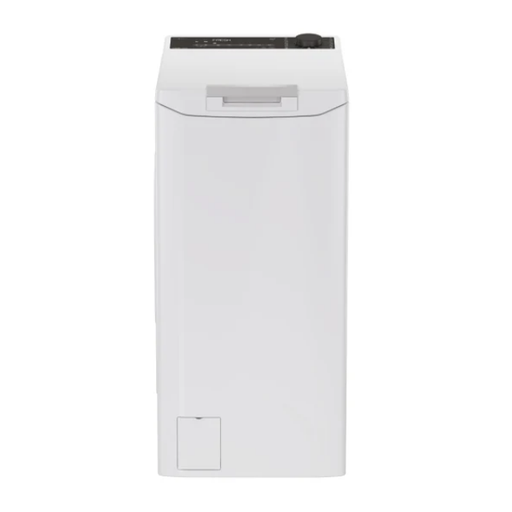 Image unavailable
Worth considering if you want a top-loading model with a stated capacity of 7 kg. The product name lists a spin speed of 1,200 rpm and an A energy rating; check the depth and lid clearance too. The safety section of the product description refers to Candy, so make sure the instructions you use for installation are for the Haier THASN276TM6-S.
Measure the available width, depth and height, then check how much room is needed for connections and opening the machine. A front-loader needs clearance in front of its door; a top-loader must be able to open its lid without hitting a worktop or piece of furniture.
It depends on which dimension is in short supply. Electrolux France lists the slim front-loader EW6S1064NA as 411 mm deep, while its EW6T4613HA top-loader is 400 mm wide and 600 mm deep. So a top-loader may suit a lack of width, while this slim front-loader may suit a lack of depth, provided you have room to open the appliance.
Yes, provided the location and electrical installation are suitable. Promotelec says the machine must be outside zones 0, 1 and 2, as well as the concealed volume, connected to earth and powered by a circuit protected by a 30 mA RCD. If you’re unsure, ask a qualified professional to check your plans.
Compare their energy labels and product information on a like-for-like basis, including capacity, kWh per 100 cycles and litres per cycle. The European Commission explains that the energy label scale runs from A to G, and that regulated consumption figures relate to the Eco 40-60 programme. Your actual household consumption will depend on how you use the machine.
Consider one as a back-up option if you can’t install a standard washing machine. Que Choisir mentions studios and student rooms as examples; before buying, check the model’s capacity, water supply, drainage, spin performance and electrical connection.