Which format suits you?

If width is the main constraint

If the machine needs to fit between two units or into a narrow alcove, a top-loader is worth considering. Check its depth too, and allow enough room to lift the lid: its narrower width does not solve either of those constraints. UFC-Que Choisir highlights the benefits of top-loaders where width is limited.

If depth is the main constraint

In a kitchen, bathroom or near a walkway, a shallow front-loader may project less into the room. You will still need enough room for its width and to open the door. The dimensions published by Electrolux for its slim EW6S1064NA model illustrate the difference between width and depth.

If you prioritise capacity or stacking

If your space can accommodate a standard front-loader, capacity and the possibility of stacking may guide your choice. Bosch, for example, lists the WAN2827TFR at 8 kg. For a stacked set-up, check that a stacking kit is compatible with both specific models; matching dimensions alone are not enough.

How do the formats compare?

Top-loading

Consider it: when the alcove’s width is the main obstacle; UFC-Que Choisir describes top-loaders that are 40 to 46 cm wide.

Bear in mind: you need room above the machine to open the lid, and it may still be quite deep.

Shallow front-loading

Consider it: when you need a machine that does not project too far into the room but still want front-loading.

Bear in mind: reduced depth does not mean reduced width; Electrolux lists its EW6S1064NA as 60 cm wide.

Standard front-loading

Consider it: if your space allows you to prioritise capacity or explore a stacked set-up.

Bear in mind: allow for the machine’s depth and access to the door; stacking requires a kit designed for the models in question.

Consideration What to check Best suited to
Dimensions and access Measure the alcove’s width, depth and height, then compare your measurements with the installation diagram, including connections and door clearance. If I need to fit the machine between units without blocking the walkway, I want to be able to install it and use it once it’s in place. Around 33% of consumers prioritise this dimensional fit.
Front access and depth Compare the model’s stated depth with the space needed in front of its door; check the width separately. In a room where the machine could project too far, I want to keep front-loading without blocking access. For around 27% of consumers, reducing depth while retaining front access comes before other considerations.
Capacity and how you use it Choose a capacity in kilograms that suits your household’s laundry; check the energy label for water and energy use, spin performance and noise, as recommended by ADEME. If I have large or frequent loads of laundry, I don’t want to choose a machine that is too small just to save a few centimetres. The right capacity and practical features are a priority for around 20% of consumers.
Installation and durability Check the electrical supply, whether a stacking kit is compatible if needed, and the durability index for the model you choose. In a bathroom or for a stacked set-up, I want to make sure the planned installation is suitable before choosing a model. Around 20% of consumers prioritise these installation requirements and durability.

Installation mistakes to avoid

  • Confusing narrow with shallow

    A top-loader may fit into a narrow alcove without projecting any less into the room. Conversely, a shallow front-loader may be almost as wide as a standard front-loader.

    First identify which measurement is the constraint, then compare all three dimensions for every model you are considering.

  • Measuring the alcove without allowing for everyday use

    A machine may fit in the space but leave too little room to open the lid or door, reach the controls or connect the hoses.

    Include doors, skirting boards, connections and obstacles in your measurements, then check the instructions and installation diagram for the exact model.

  • Planning a stacked set-up based on dimensions alone

    Two appliances of a similar width are not necessarily compatible for stacking. Miele’s guidance for its WTV 501 stacking kit, for example, lists exclusions for certain models.

    Check that a stacking kit is explicitly designed for both appliances you have chosen.

    You may need to budget for this kit as an additional accessory.

  • Treating a bathroom like any other room

    Available space alone is not enough to determine whether a washing machine can be installed in a bathroom: the machine’s position in relation to the shower or bath, as well as the electrical installation, also matters. Promotelec sets out precautions specific to this location.

    Before buying, ask a qualified professional to check the space and its electrical supply if you are unsure whether they are suitable.

Brands to consider by format

Electrolux

The French-market EW6T3264AK and EW6S1064NA models let you explore options for width and depth constraints respectively.

  • Electrolux lists the EW6T3264AK top-loader as 400 mm wide and the EW6S1064NA slim front-loader as 41 cm deep.
  • The EW6S1064NA slim front-loader is still listed as 60 cm wide; check the full installation requirements before choosing it for an alcove.

Whirlpool

The brand offers top-loading models worth considering when width is limited.

  • Whirlpool lists the TDLRBX 6252BS FR/N as a top-loader measuring 40 cm wide, with a 6 kg capacity.
  • This width tells you nothing about the available depth or the clearance needed to open the lid.

Bosch

Its standard and integrated front-loading models are worth considering if your space can accommodate a width of around 60 cm.

  • Bosch lists the WAN2827TFR at 8 kg, with dimensions of 845 × 598 × 590 mm.
  • For under-counter or integrated installation, the published dimensions are not enough: consult the instructions for the specific model.

Washing machines to consider on Joybuy

These models suit different needs: front-loaders to consider when depth is limited, a top-loader for a width constraint, and a front-loader for a roomier space. Check the installation dimensions of each model before deciding which format is right for your room.

Hisense WF5I8043BWF washing machine

Hisense WF5I8043BWF, 8 kg

A front-loader to consider if depth is your main constraint; also check its width, connections and door clearance.

The product name lists an 8 kg capacity, a 1,400 rpm spin speed and an Inverter motor.

View on Joybuy
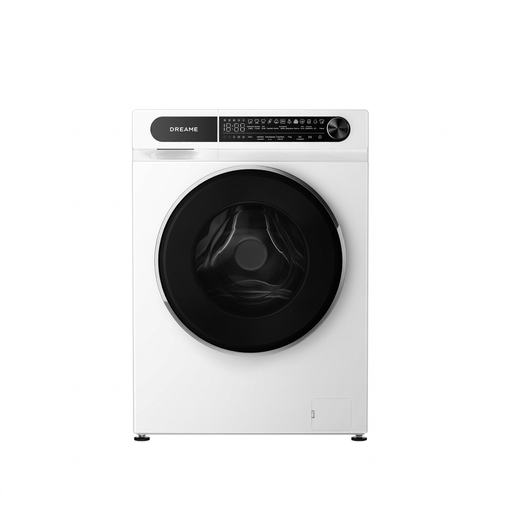
Dreame DRWASHS8KG Washing Machine S washing machine

Dreame DRWASHS8KG Washing Machine S, 8 kg

Worth considering if you want to keep front-loading in a space with limited depth. Before choosing it, compare all its dimensions and the door clearance with your available space.

Capacity listed in the product name: 8 kg.

View on Joybuy

Candy TCA464TM4-S ProWash 500 top-loading washing machine

Candy TCA464TM4-S ProWash 500, 6 kg

Its top-loading design suits the need for a narrower machine, provided you have room to open the lid and enough depth available.

The product name lists a 6 kg capacity, a 1,400 rpm spin speed and energy class B.

View on Joybuy
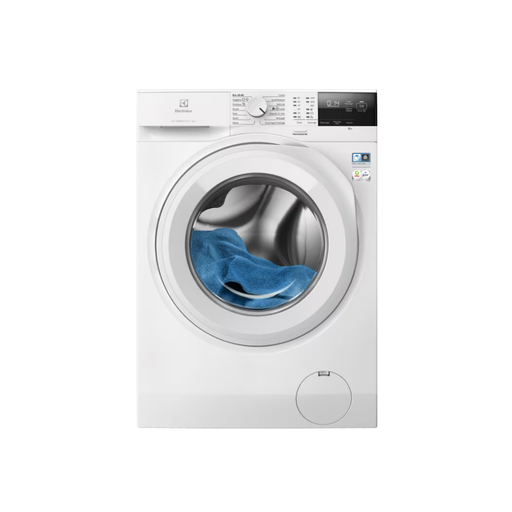
Electrolux EW6FI4805AW front-loading washing machine

Electrolux EW6FI4805AW, 8 kg

Consider this front-loader if your space can accommodate a standard-sized model and an 8 kg capacity suits your needs. Allow room for the door to open and for the connections too.

The product name lists a 1,400 rpm spin speed; Steam Hygiene and SensiCare are advertised features, not evidence of proven efficiency here.

View on Joybuy
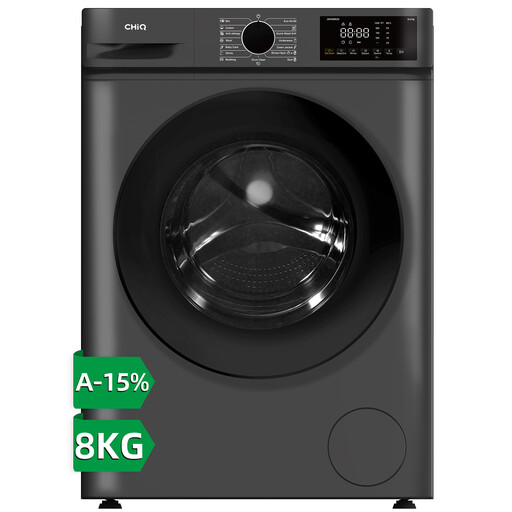
CHiQ JW85883G front-loading washing machine

CHiQ JW85883G, 8 kg

Worth considering if you are looking for a front-loader for a room where depth matters. Check the full external dimensions, door clearance and space for connections before deciding whether it will fit.

The product name lists an 8 kg capacity, a 1,400 rpm spin speed and 16 programmes.

View on Joybuy

Frequently asked questions

What should I measure before ordering a washing machine for a narrow space?

Measure the width, depth and height of the space, then allow for the room needed to open and load the machine. Also check for skirting boards, doors and connections, and compare your measurements with the installation diagram for your chosen model. For example, Electrolux lists its EW6T3264AK top-loader as 400 mm wide but 600 mm deep.

Can a top-loading washing machine go under a worktop or in a stacked set-up?

A top-loader needs to be accessible from above: a fixed worktop or a tumble dryer placed on top could prevent you from loading it. For stacking, consider a front-loader instead and check that a stacking kit is designed for both models; dimensions alone do not prove they are compatible.

Can you install a washing machine in a bathroom?

Installation depends on the machine’s exact position in relation to the shower or bath, as well as its electrical supply. Promotelec draws particular attention to bathroom zones and electrical protection. If you are unsure whether the location is suitable, ask a qualified electrician to check it before you buy.

Which index should I check to compare washing machine durability?

For front-loading and top-loading washing machines in France, check the durability index for the specific model. According to the ministry responsible for ecological transition, it replaced the repairability index for these appliances from 8 April 2025. This rating helps you compare models but does not guarantee how long they will last.

What should I look for on the energy label once I have chosen a format?

Compare the washing machine’s energy and water use, spin performance and noise, while choosing a capacity suited to your household’s laundry. This is the approach recommended by ADEME: a machine that fits the room should also suit the way you plan to use it.