If you have a narrow alcove or doorway
If width limits the route into the space or makes it difficult to move around, compare a top-loader with a front-loader first. Then check the depth: a narrow top-loader may still project into the room.


If width is limited, consider a top-loading washing machine, provided there’s enough clearance to open the lid. If depth is the main issue, compare slimline front-loaders and leave enough room in front of the door. A compact model may work when several dimensions are restricted, as long as its capacity is sufficient. A standard front-loader is also an option if you have room for its full dimensions. In a bathroom, check the proposed location and electrical installation before you buy.
The dimension that’s making installation difficult matters more than simply choosing something labelled a ‘small washing machine’.
If width limits the route into the space or makes it difficult to move around, compare a top-loader with a front-loader first. Then check the depth: a narrow top-loader may still project into the room.
If there’s enough width but a sink, door or walkway is opposite the machine, consider a slimline front-loader. You’ll still need enough room to open the door and load the laundry.
As well as checking its overall size, consider where the machine will sit in relation to the shower or bath, and have the electrical supply checked. Choosing a smaller model won’t, by itself, resolve these installation requirements.
Start by measuring the usable space and checking how the machine loads, then compare the capacity of models that can actually be installed.
| What to check | Points to consider | Your needs |
|---|---|---|
| Width and access | Measure the alcove and the route to it. Que Choisir gives a width of 40 to 46 cm for top-loading washing machines; check the width of each model rather than relying on its type. | “The machine needs to fit through the door and leave enough room for me to move around once it’s installed.” |
| Overall depth | Compare the depth on the product specifications and installation diagram with the space available for connections and any parts that protrude. The specifications for the Electrolux EW8T3653BA and Whirlpool TDLR55140SFR both give a depth of 60 cm, despite their width of 40 cm. | “I don’t want the washing machine to stick out into the walkway or get in the way of furniture opposite it.” |
| Opening and loading | Allow space above the lid of a top-loader or in front of the door of a front-loader. If it’s going under a fixed worktop, check that the model and installation will allow you to use it properly. | “I need to be able to open the machine, take out the laundry and reach the controls without moving anything out of the way.” |
| Capacity | Compare the stated capacity of each model with the size of your usual loads. A smaller machine is only useful if its capacity still suits your laundry needs. | “I need to wash my everyday laundry without choosing an unsuitable capacity just to save a few centimetres.” |
| Bathroom installation | Have the location and electrical circuit checked before choosing a model. Promotelec notes, among other requirements, earthing and 30 mA residual-current protection for a washing machine in a bathroom. | “The machine needs to be positioned and connected correctly, not just squeezed between two units.” |
The specifications for the Electrolux EW8T3653BA and Whirlpool TDLR55140SFR give a width of 40 cm, but also a depth of 60 cm. You’ll also need enough clearance above the machine to open the lid.
Before choosing a model, measure the available depth and overhead clearance, and check access to the connections.
These terms are no substitute for checking the model’s measurements: two machines described as space-saving may suit very different requirements.
Check the height, width, depth, capacity and door clearance on the specifications and installation diagram for the exact model.
In a bathroom, floor space alone doesn’t determine whether the location and electrical installation are suitable. Promotelec highlights requirements including earthing and 30 mA residual-current protection.
Before ordering the machine, ask a professional to assess the location and any new or altered electrical circuit.
A narrow width or shallow depth tells you about the machine’s dimensions, not how well it washes your laundry.
Once you’ve found models that fit the space, look for test results for the exact models and compare the features that matter for your laundry.
These models show some of the available options; their dimensions won’t apply to every machine from the same brand.
The EW8T3653BA top-loader is an example of a narrow machine for situations where width is the main constraint.
Whirlpool’s top-loading range includes several models; the TDLR55140SFR is one example to compare with your available space.
Bosch offers freestanding front-loaders, as well as integrated models and machines designed to fit under a worktop.
This front-loader has a stated capacity of 8 kg. Before choosing it for a narrow bathroom, check its full dimensions and door clearance against the space you have available.
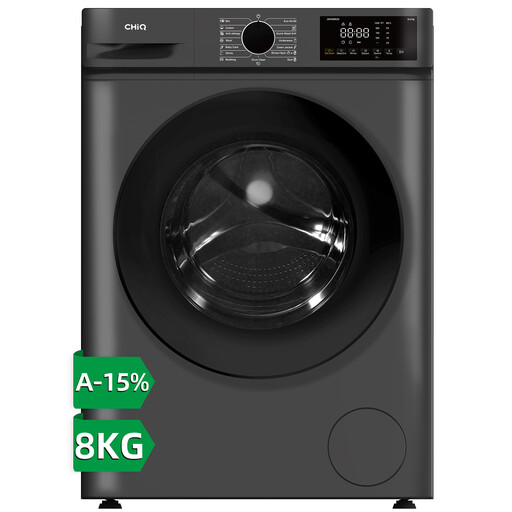 Image unavailable
Worth considering if you’re looking for a front-loader with a stated capacity of 8 kg. The product name also lists 1 400 rpm, 16 programmes and a steam function, but this doesn’t establish how well it washes. Check the full dimensions, door clearance and installation diagram against your available space.
Yes, provided the location and electrical installation are suitable. For bathrooms in France, Promotelec notes requirements including earthing and circuit protection by a 30 mA residual-current device. Have your plans checked, particularly if a new circuit needs to be installed or an existing one altered.
Measure the usable height, width and depth, as well as the clearance needed to move the machine into position. Check for skirting boards, sockets and connections, then compare the space needed for the lid or door with the installation diagram for the exact model.
Not necessarily: ‘slimline’ refers to depth, not width. Que Choisir gives a width of 40 to 46 cm for top-loaders; compare this with the exact width of the front-loader you’re considering, and allow space in front of its door too.
No. Bosch offers models designed for under-worktop installation, but you’ll need to check the dimensions, permitted installation type, access to connections and door clearance for each model. A top-loader won’t be suitable under a fixed worktop if its lid can’t open.
Don’t assume you can without checking the instructions for the model you’ve chosen. Electrolux says its front-loading and top-loading washing machines are designed for a cold water supply.