If you do laundry frequently, start by choosing a capacity that suits the loads and programmes you actually use. UFC-Que Choisir suggests 8 to 10 kg as a guide for families with children, particularly if you often wash bulky items. A top-loading washing machine is better suited to a limited-width space, with a capacity usually ranging from 5 to 8 kg. Then compare each model’s cycle times, washing, rinsing and spin performance, noise levels and energy and water consumption: the stated capacity alone doesn’t tell you everything about day-to-day use.
Who is this advice for?
Households with children or frequent bulky washing
If clothes, sheets and towels regularly fill your laundry basket, start by considering the loads you wash together. UFC-Que Choisir suggests 8 to 10 kg as a guide for families with children, but you should also check the capacities of the programmes you use.
Households with limited space
If width is a limiting factor, a top-loading washing machine is worth considering. UFC-Que Choisir gives a typical width of 40 to 46 cm for this style, with a capacity usually ranging from 5 to 8 kg.
Households mindful of time and noise
If the machine runs frequently in a busy home, programme duration, spin noise and access to the filter matter just as much as capacity. Compare these details for the models you’re considering rather than assuming they’ll be the same across a brand.
Which criteria should you compare first?
First, work out how much space you have and what your usual loads are. Then compare the cycles and features of models that suit the way you do laundry.
Front-loading washing machine
Consider this if: you often wash large loads and have enough room for the machine and its door to open.
Keep in mind: UFC-Que Choisir notes that larger-capacity front-loading models may have longer programmes to maintain washing performance.
Top-loading washing machine
Consider this if: width is your main constraint: UFC-Que Choisir gives a typical width of 40 to 46 cm for this style.
Keep in mind: its usual capacity of 5 to 8 kg may limit the size of family loads. Also check that you have enough clearance to open the lid.
| Criterion |
What to check |
What I need |
| Usable capacity |
Check the maximum dry laundry load for the programmes you use, rather than looking only at the cotton or Eco 40–60 capacity. Also consider how much room bulky items take up. |
I often wash sheets and towels: UFC-Que Choisir’s guide of 8 to 10 kg for a family with children helps me choose a capacity, but I still need to check the limits for each programme. |
| Dimensions |
Measure the available width, depth and height, as well as the clearance needed to open the machine. According to UFC-Que Choisir, top-loading models are usually 40 to 46 cm wide and hold 5 to 8 kg. |
In my narrow space, I’ll prioritise a machine that genuinely fits, even if that limits the size of the loads I can wash. |
| Cycles and noise |
Compare the duration of the programmes you use most, the stated spin noise level and how easy it is to access the filter on the specific model. A quick programme alone doesn’t tell you how long the other cycles take. |
My machine runs frequently, so I want to plan my laundry without overlooking noise or routine maintenance. |
| Washing and spin performance |
If comparable test results are available, look separately at washing, rinsing and spin performance. UFC-Que Choisir’s testing protocol assesses these criteria, as well as cycle duration and noise levels. |
I want to choose based on how well it cleans clothes, rather than assuming that one spin speed tells me everything about its performance. |
| Energy and water use |
Compare water and electricity use on the same measurement basis, and check which programme the figures refer to. Then consider how they relate to the cycles you use regularly. |
With frequent washing, I’m looking for comparable figures that reflect my laundry habits, not just a number in isolation. |
| Durability |
Check the durability rating for the model sold in France and the details behind its score. ADEME says the rating applies to washing machines put on sale since April 2025; it does not directly measure washing performance or noise. |
I want to take maintenance and repairability into account without confusing the rating with programme performance. |
Which mistakes should you avoid?
-
Assuming the stated capacity applies to every fabric
The maximum load shown may not apply to synthetics, jeans or wool. Lower load limits for these fabrics can mean more cycles than you expected.
Before choosing a drum size, check the manual for the maximum load allowed on the programmes you use most often.
-
Choosing a large drum without measuring the space
A larger capacity won’t help if the machine is difficult to install or the door can’t open properly. UFC-Que Choisir also notes that programmes on front-loading models may take longer as capacity increases.
Measure the space and required clearances, then compare usable capacity and the duration of the cycles you plan to use.
-
Judging the machine by its spin speed alone
The stated spin speed doesn’t tell you about washing or rinsing performance, or noise levels. UFC-Que Choisir’s testing protocol assesses these aspects separately.
To choose between two models, compare several results obtained using the same method, along with the information for each individual model.
-
Confusing durability with washing performance
The durability rating offers insight into a model’s reliability and repairability; it doesn’t directly tell you how long a cycle takes, how noisy the machine is or how well it washes.
Use it alongside the dimensions and programme details, and, where available, comparable test results for the model you’re considering.
Which brands should you consider?
If you do laundry frequently, compare specific models rather than assuming a brand offers the same capacities and cycles across its entire range.
Miele
A brand worth considering in light of the capacity and programmes offered by the model you have in mind.
- Check the noise level, cycle duration and durability rating for the specific model.
Siemens
Another option to compare when choosing a washing machine for frequent use.
- The brand name alone won’t tell you the usable capacity or noise level of a specific model.
Bosch
Compare its dimensions and programmes with the needs of your household.
- Check the cycle duration, energy and water use, and load limits for each programme on the specific model.
AEG
Worth considering if you’re weighing up installation constraints against the capacity you need.
- Check the style and dimensions of the model rather than assuming they’re the same across the range.
LG
Compare this brand with the others using the same criteria for load size, cycles and installation.
- Compare the details of the specific model and, where available, test results obtained on a consistent basis.
A washing machine option on Joybuy
This 8 kg front-loading washing machine could suit regular laundry loads, provided its capacity matches the fabrics and programmes used in your household.
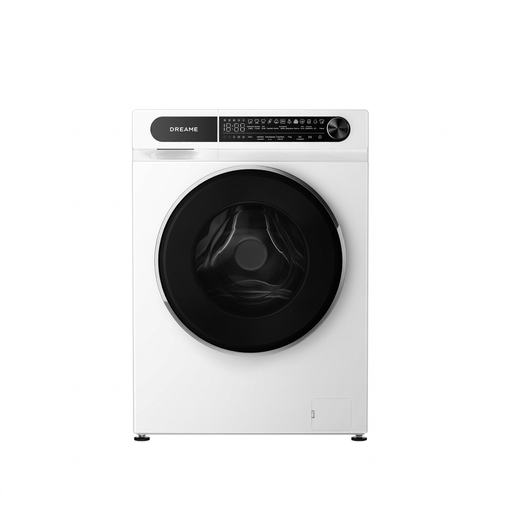 Image unavailable
Dreame DRWASHS8KG Washing Machine S 8 kg, white
For regular laundry, compare its stated 8 kg capacity with your usual loads. Before choosing this model, check the manual for the load limits and cycle times for each programme, as well as the dimensions required for installation.
View on Joybuy
Frequently asked questions
Will an 8 kg washing machine take 8 kg of every type of fabric?
No. The stated capacity doesn’t apply to every programme in the same way. For an 8 kg machine, UFC-Que Choisir gives the examples of 3.5 kg for synthetics, 3 kg for jeans and 2 kg for wool. Always follow the limits in the manual for the model you choose.
Is a top-loading washing machine suitable for frequent family laundry?
It can be a good choice if width is your main constraint and its capacity suits your household’s loads. UFC-Que Choisir gives typical dimensions of 40 to 46 cm wide and a capacity of 5 to 8 kg for top-loading models. If you often wash large loads of sheets and towels, also compare a front-loading machine that fits your available space.
What does a washing machine’s durability rating tell you?
The rating gives an indication of a model’s durability, particularly its reliability and repairability; it doesn’t replace information on washing performance, noise or cycle duration. In France, ADEME says the rating applies to washing machines put on sale since April 2025. Check the score and its breakdown for the model you’re considering.
What regular maintenance should I do if the machine runs frequently?
UFC-Que Choisir recommends running a wash at at least 60 °C, either with an empty drum or a load of laundry, at least once a month. Also check the manual for instructions on accessing the filter and maintaining the model you choose.


