Households doing several loads a week
Compare the amount of laundry that builds up between washes with the drum capacity. ADEME recommends choosing a capacity to suit your actual loads, rather than running extra cycles with a partly filled drum.


Start by choosing a capacity that suits your usual loads: according to ADEME, 7 kg is enough in most cases. A front-loading machine needs space in front for the door to open, while a top-loader can make it easier to reach the drum; however, Que Choisir says its capacity generally doesn’t exceed 8 kg. If your current machine still meets your needs, consider keeping or repairing it before replacing it.
Compare the amount of laundry that builds up between washes with the drum capacity. ADEME recommends choosing a capacity to suit your actual loads, rather than running extra cycles with a partly filled drum.
The spin efficiency class helps you compare how much moisture remains in your laundry. If the machine is near a room in use, check its spin noise level too.
Measure the space needed to open the door or lid and access your laundry. UFC-Que Choisir notes that available space and ease of loading can influence your choice of a top-loader.
Consider it: if the door can open in front of the machine and the capacity suits your regular loads.
Bear in mind: check the clearance needed for the door; a large capacity is only useful if you fill it regularly.
Consider it: if access from the top works better for your space or saves you from bending down, as UFC-Que Choisir notes.
Check: according to Que Choisir, top-loaders generally don’t exceed 8 kg; make sure the model’s capacity can handle your larger loads.
Consider it: if the machine still meets your needs and can be used safely, or if a fault can be repaired.
Check: a fault needs to be diagnosed; whether it can be repaired depends on factors including the appliance and the parts required.
| Priority | What to check | What I need |
|---|---|---|
| Capacity | Compare the capacity in kg with your usual loads of dry laundry, including sheets and towels. ADEME says 7 kg is enough in most cases. | I want to wash my usual loads without running extra cycles or choosing a drum that’s rarely full. |
| Energy and water use | On the label, compare water use per cycle and energy use in kWh per 100 cycles for the Eco 40-60 programme, using the same basis. The European Commission links these label measurements to this programme. | I do laundry regularly, so I want to compare the stated consumption of machines that suit my loads. |
| Spin performance and noise | Check the spin efficiency class, then the spin noise level in dB and its class. Don’t judge these results by the stated rpm alone. | If I dry laundry indoors, how damp it is after washing matters. Noise matters too when the machine is close to rooms in use. |
| Installation | Measure the model and the space needed to open the door or lid. UFC-Que Choisir says that available space and access to the drum can influence the choice between a front-loader and a top-loader. | I need to be able to install the machine and load the laundry without blocking access or exceeding the capacity I need. |
| Durability | In France, the ministries responsible for ecology say that the durability index replaced the repairability index for washing machines on 8 April 2025. For your current machine, have its repair options assessed. | Before replacing my machine, I want to know whether it still meets my needs and whether a fault can be repaired. |
A large drum won’t save you from frequent cycles if your usual loads are small. ADEME recommends matching the capacity to the laundry you actually wash.
For a week or two, keep track of your usual loads, including sheets and towels, then choose a capacity that suits this regular volume.
The stated spin speed doesn’t replace the spin efficiency class or the noise rating. Both are useful criteria if you dry laundry indoors.
Compare the spin class, dB level and noise class on the label of each model you’re considering.
UFC-Que Choisir says top-loading washing machines generally don’t exceed 8 kg. This limit may matter if you often wash large loads.
Measure the space and lid clearance, then check the capacity of the specific model.
A fault alone doesn’t tell you whether the appliance can be put back into service.
Before deciding to replace the machine, find out what caused the fault and whether the parts needed are available.
If you’re comparing Miele front-loaders, assess each model against your loads and available space.
Compare Bosch front-loader specifications with your laundry volume and installation requirements.
LG front-loaders may be worth including in your comparison, as long as you assess them model by model.
These Joybuy options are front-loading; they include washing machines and a washer-dryer. Compare their capacities with your usual loads before considering their other features.
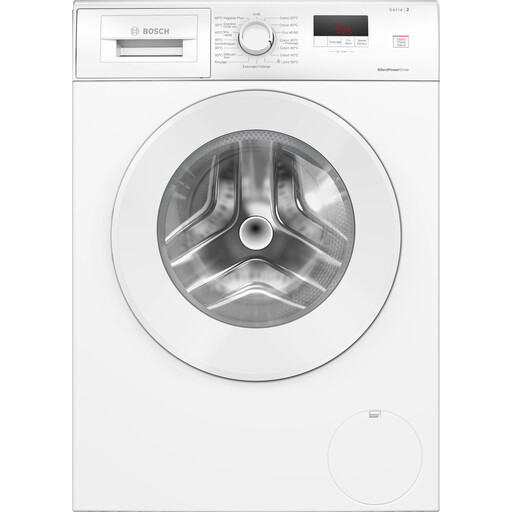 Image unavailable
Consider it if your usual loads suit a capacity of 7 kg. If you dry laundry indoors, compare the spin efficiency class and spin noise level; also check the door clearance.
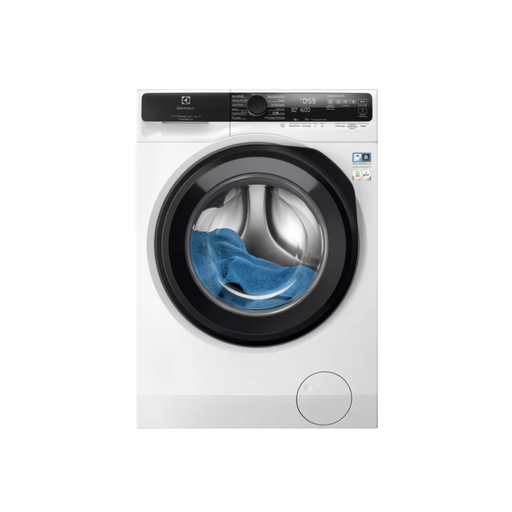 Image unavailable
Consider whether the 9 kg capacity suits your regular loads: an occasional large load alone isn’t enough to determine the capacity you need. The stated 1,600 rpm doesn’t replace comparing the spin efficiency class and noise level.
 Image unavailable
This option combines washing and drying, with different stated capacities: 11 kg for washing and 6 kg for drying. If you plan to use both functions, compare the figures for the wash cycle and combined cycle separately, and check that your regular loads justify an 11 kg capacity.
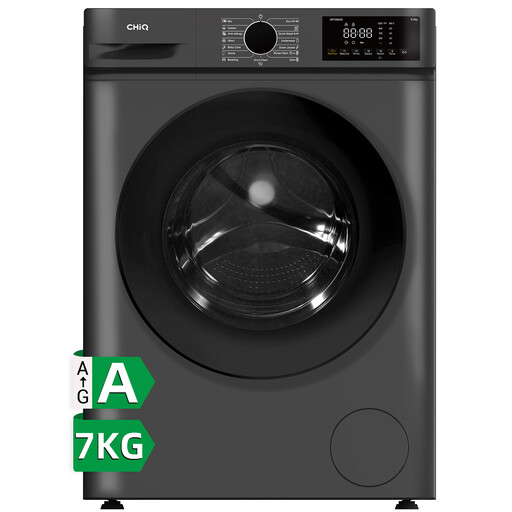 Image unavailable
Compare the 7 kg capacity with the laundry you actually build up between cycles. If you dry laundry indoors, check the model’s spin efficiency class and noise level: you can’t infer these from the stated 1,200 rpm.
Choose a capacity based on your usual loads of dry laundry, rather than the number of people in your household alone. According to ADEME, a 7 kg washing machine is enough in most cases; go for more if your regular loads call for it.
No. Focus on the specific model’s spin efficiency class, as well as its spin noise level in dB and noise class. The stated maximum speed doesn’t tell you everything about either of these criteria.
It depends on the model’s capacity and the size of your usual loads. UFC-Que Choisir says top-loaders generally don’t exceed 8 kg, so check this if you often wash lots of household linen.
It gives you another way to compare new appliances, but doesn’t replace checking capacity, spin performance or dimensions. According to the ministries responsible for ecology, this index replaced the repairability index for washing machines on 8 April 2025.
Not necessarily. Find out what the fault is and check whether the machine can be repaired before deciding. If you’re considering a new appliance, also think about the capacity you actually need.