Households with regular large loads
You often wash bed sheets, towels, blankets or duvets, and your laundry basket fills up quickly. You want to know whether a larger drum would genuinely mean fewer loads.


A 10–12 kg washing machine is worth considering if you regularly wash large loads or bulky items. If most of your loads are small, a more modest capacity may suit your household better; check how the specific model adjusts its settings to the load. In either case, compare the available depth with the machine’s dimensions and check the figures on its energy label.
You often wash bed sheets, towels, blankets or duvets, and your laundry basket fills up quickly. You want to know whether a larger drum would genuinely mean fewer loads.
You alternate between large loads and smaller ones, separated by fabric type or programme. Your machine needs to suit both, rather than being chosen solely for the occasional largest load.
You’d like more capacity, but also need to get the machine through the doorway and leave enough room for the door and connections. Check the depth of each model individually.
Start with the loads you wash most often, then check the available space and the consumption figures for each model.
| What matters | What to check | Consumers concerned |
|---|---|---|
| Large loads | Capacity in kg, drum volume and a programme suited to bulky items. | When bed sheets, blankets or duvets often fill the basket, I want to avoid running extra loads. Around 44% of consumers would prioritise these regular large loads. |
| Capacity and consumption | The energy label for the exact model: energy per 100 cycles and water per cycle, compared with machines of a similar capacity. | If I rarely fill a large drum, I want a capacity that suits my usual laundry. Nearly 33% of consumers would prioritise this balance between capacity and consumption. |
| Smaller, variable loads | Settings adjusted to the load and the programmes the function applies to. | I often separate sportswear or delicate fabrics, so I run smaller loads. Around 23% of consumers would put the way a machine handles variable loads first. |
According to UFC-Que Choisir, how often you wash large loads matters more than the size of your household alone. A large drum that is rarely filled can use more water and electricity than necessary.
Think back over your laundry in recent weeks: how many loads were large, and which items need to fit in the drum regularly?
Dimensions vary even between machines with the same capacity. The product specifications for Candy, Hisense and Haier list depths of 613 mm for the GD 412L10-S, 660 mm for the W1214QE and 679 mm for the X11 HW120-BD14397PGU1, respectively.
Measure the space and doorway, then allow room for the door to open and for the connections.
The features manufacturers offer do not necessarily adjust the same settings. Their presence alone does not mean that two machines will have comparable energy and water consumption.
Check the manual for the model you’re considering to see which programmes are covered and what settings are adjusted, then compare its energy label.
UFC-Que Choisir says that top-loading washing machines generally have a maximum capacity of 8 kg. This format may limit your options if you regularly wash bulky items.
If a top-loading machine is essential for you, check the available capacity and the limits for your fabrics before choosing this format.
The X11 HW120-BD14397PGU1 is worth considering for regular 12 kg loads.
The GD 412L10-S is a 12 kg front-loading washing machine to consider if this capacity suits your usual loads.
The W1214QE lets you explore a 12 kg capacity using figures specific to this model.
Some Bosch models are worth considering if you alternate between small and large loads.
The 8 kg TimeCare EW2F6812AW is an option to consider if your loads vary and bulky items are occasional.
These 9 kg and 10 kg models are suited to two different household needs: handling loads of varying sizes or having more capacity for larger loads. Check the dimensions and programmes of the model that suits your laundry.
 Image unavailable
Worth considering if your loads vary and very bulky items are only occasional. The listed spin speed reaches 1 600 tr/min; check which programmes use SmartSelect and whether the drum suits your duvets.
 Image unavailable
Its 10 kg capacity is worth considering if you regularly wash large loads. Before choosing this model for a duvet, check the maximum size it can take and the programme designed for it. If you also run small loads, check the adjustment features available on this model.
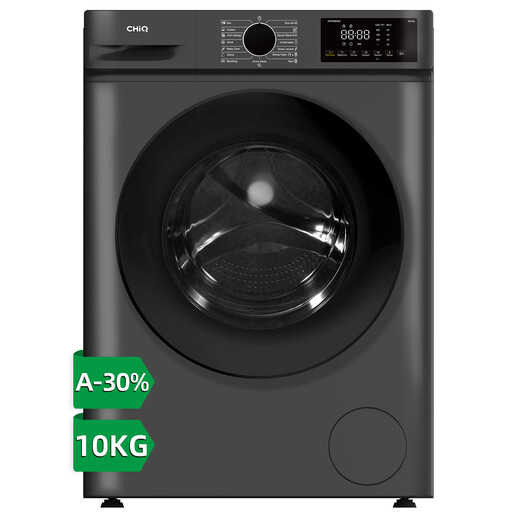 Image unavailable
This capacity is worth considering for regular large loads. The model name indicates a 530 mm drum, a spin speed of 1 400 tr/min and 16 programmes; check the manual for limits on the size of duvet you can wash, and measure the space before buying.
It’s most worthwhile if you regularly wash large loads and bulky items. UFC-Que Choisir generally puts the needs of a household of three to four people at around 8 to 9 kg, so compare the capacity you’re considering with your actual loads and the space available.
No. It can save you from running extra loads if you fill it regularly, but a drum that is rarely full may use more water and energy than necessary. Compare the water and energy figures for the models you’re considering, rather than looking at capacity alone.
For a washing machine, check the energy rating, energy per 100 cycles, water per cycle, programme duration and noise level shown on the European energy label. Compare these figures for machines with similar capacities and features, taking your washing frequency into account.
No. A load-adjustment feature may be useful if you often run small loads, but it does not make all capacities equivalent. Bosch describes ActiveWater Plus as adjusting water use to the load, while Electrolux describes AutoSense as adjusting cycle settings. Check the feature and the programmes it applies to on each specific model.