What should you check before buying?
First rule out any designs that won’t fit in your home, then compare capacity and spin noise with the laundry you usually do.
Front-loader
Choose this if: you have around 60 cm of width and enough room for the door to open in front of the machine.
Bear in mind: you’ll need space in front, even if the machine fits in the available space.
Top-loader
Choose this if: width is your main constraint; UFC-Que Choisir describes models around 40 cm wide.
Bear in mind: the lid needs to open freely above the machine.
Compact
Choose this if: depth is limited; the slim front-loaders described by UFC-Que Choisir are 33 to 45 cm deep.
Bear in mind: these machines have a more limited capacity; a mini washing machine may mean running more cycles if you do laundry frequently.
| What matters |
What to check |
Who is this for? |
| Spin-cycle noise |
Check the noise level in dB and the spin-cycle noise class on the energy label for the exact model. Make sure the machine is level as instructed in its manual. |
If the machine runs near a living area or neighbours, my main priority is to minimise disruption during the spin cycle; around 36% of consumers would put peace and quiet first. |
| Drum capacity |
Compare the weight of your dry laundry loads with the stated capacity, and check the limits for delicate or synthetic programmes. |
If I often wash small loads as well as bedding, I need a drum I can fill without having to run extra cycles; around 36% of consumers would consider choosing a suitable capacity their top priority. |
| Space and installation |
Measure the width, depth and height, as well as the space needed to open the machine, including room for hoses. Check that you have a water supply, drainage and an electrical socket. |
In a narrow alcove, I need to be able to position and open the machine without compromising its connections; around 28% of consumers would put finding a machine that fits their space first. |
Two front-loading washing machines on Joybuy
These two 7 kg front-loaders are worth considering if this design suits your space and regular laundry loads. Their inclusion here doesn’t mean that front-loaders are better than top-loaders or compact models for a more restricted space.
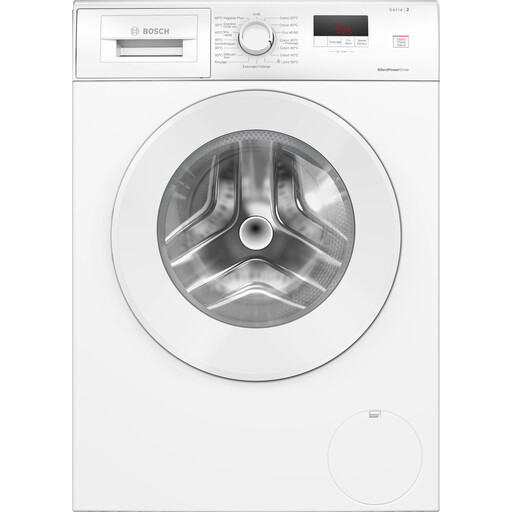 Image unavailable
Bosch WGE02407FR, 7 kg front-loader
Worth considering for regular loads that suit a 7 kg capacity, if you have enough space in front of the door. The product title gives a maximum spin speed of 1,400 rpm. Check the spin-cycle noise level on the label for this model separately, and make sure you have the required installation clearance.
View on Joybuy
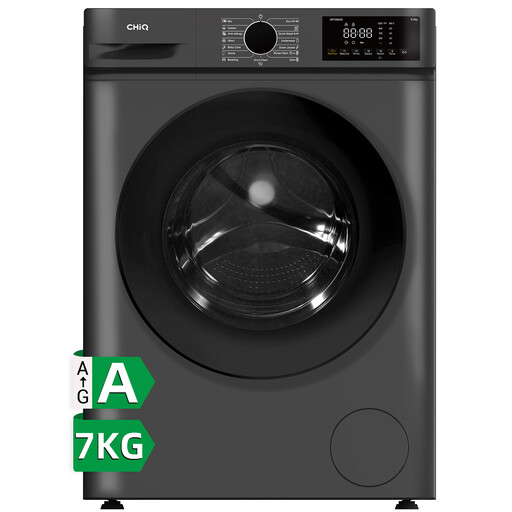 Image unavailable
CHiQ JW75883G, 7 kg front-loader
Worth comparing for a small household’s regular laundry, once you’ve measured the space available. The title lists a spin speed of 1,200 rpm, an A energy rating and 16 programmes. Check the spin-cycle noise level and the installation dimensions for this model.
View on Joybuy
Frequently asked questions
Can I install a washing machine in a bathroom?
Check the location before buying, particularly how close it is to the shower or bath and where the electrical supply is. Promotelec sets out specific requirements for installations in bathrooms. If you’re unsure about the location or electrical circuit, ask a qualified professional to check them.
Is a 7 kg capacity always suitable for one or two people?
No. It’s a useful guide, not a fixed requirement. ADEME says 7 kg is enough in most cases, but your actual loads, bulky laundry and the limits of programmes other than the reference cycle should all inform your choice.
What’s the difference between a slim front-loader and a top-loader?
A slim front-loader mainly takes up less depth, while a top-loader is designed for spaces where width is the main constraint. UFC-Que Choisir describes slim models that are 33 to 45 cm deep and top-loaders that are around 40 cm wide. Always measure the exact model and allow space for it to open.
What should I check before the first spin cycle?
Follow the instructions to remove the transit bolts and level the machine before using it for the first time. As Bosch points out in its installation advice, these steps help prevent the machine from moving or making unusual noises. They don’t replace comparing the stated noise levels of different models.
Which rating should I check to compare durability?
In France, the durability index is gradually replacing the repairability index for washing machines from 8 April 2025, according to the ministry responsible for the ecological transition. Check the index shown for the specific model you’re considering.


