Which criteria should you compare?
Start with the space available and your usual laundry loads, then compare the labels of models that meet both requirements.
| Criterion |
What to check |
My needs |
| Spin-cycle noise |
Check the noise class and dB level on the label for the exact model. The label gives information about the appliance’s noise emissions, but not how vibrations travel through the building. |
The machine will be close to a living area, so I want to compare spin-cycle noise without assuming a good label rating will eliminate all disturbance. |
| Format and capacity |
Measure the space available and the clearance needed to load the machine. Compare the capacity in kg with your usual loads: ADEME says that 7 kg is usually enough, while UFC-Que Choisir notes that front-loaders can offer larger capacities. |
If I mainly wash small loads, a large drum may often be underfilled. If I regularly wash bulky items, I need to check that they’ll fit the capacity I choose. |
| Cycle and consumption |
Compare the Eco 40-60 cycle duration, the electricity use shown in kWh per 100 cycles and the water use per cycle on the label. The European Commission says these are among the details included on washing machine energy labels. |
I want the wash cycle to fit into my routine, without choosing based on capacity or energy rating alone. |
| Spin-drying efficiency |
Check the spin-drying efficiency class and the noise level during the same phase. Don’t assume efficiency from the stated speed in tr/min alone. |
If I dry laundry indoors, I want to take spin-drying into account without overlooking the noise it makes. |
| Routine maintenance |
Check the manual to find the filter and see how to access it. Also check the service and spare-parts information for the model you’re considering. |
I want to be able to carry out routine maintenance without discovering after installation that the filter is difficult to reach. |
Brands to assess model by model
When choosing a washing machine for a flat, the brand name is no substitute for checking the energy label and dimensions of the model you’re considering.
Miele
When looking at a Miele washing machine, start with the specific model rather than a general impression of the brand.
- Check the spin-cycle noise, capacity and cycle duration of the model you choose.
Siemens
Compare Siemens models that genuinely fit the space available.
- A general impression of the brand won’t tell you how noisy a specific model is.
Bosch
For a Bosch model, compare its capacity and loading requirements with your usual laundry loads.
- Check its noise class and spin-cycle dB rating separately on the label.
AEG
With AEG, first choose a format that suits your space and the way you load your laundry.
- Neither a top-loader nor a front-loader format tells you how noisy the model is.
LG
To compare an LG washing machine, use the details for its exact model.
- In particular, check noise, spin performance and consumption; you can’t infer these from the brand name.
Washing machines to compare on Joybuy
This selection includes front-loading washing machines and a 7 kg top-loader. Compare their formats with the space available, then check each model’s label to assess noise and consumption.
 Image unavailable
Bosch WGE02407FR, 7 kg front-loader, 1 400 tr/min
This front-loader could suit you if you have enough clearance for the door and a 7 kg capacity meets your needs. Before choosing it for a flat, compare its noise figures and cycle duration with those of the other models you’re considering.
View on Joybuy
 Image unavailable
Haier T Series 7 THASN276TM6-S, 7 kg top-loader, 1 200 tr/min
A top-loading machine is worth considering if a front-loader’s door doesn’t suit your space or your day-to-day routine. If you live in a flat, compare the spin-cycle noise of this model carefully before choosing it for its format.
View on Joybuy
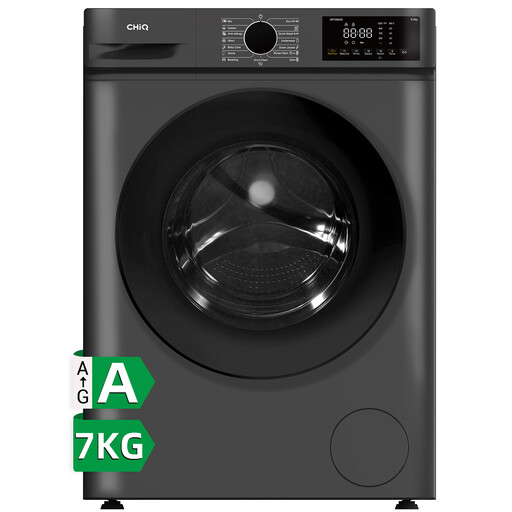 Image unavailable
CHiQ JW75883G, 7 kg front-loader, 1 200 tr/min
Compare this 7 kg front-loader with the space you have and the size of your usual laundry loads. If noise is a priority, check the dB level and noise class during the spin cycle on this model’s label. Also check its water and electricity use, and the duration of the Eco 40-60 cycle.
View on Joybuy
Frequently asked questions
What should I check first on the energy label for a flat?
If noise is a priority because the machine is close to your living areas, check the noise class and dB level during the spin cycle. Then compare electricity use, water per cycle, cycle duration and spin-drying efficiency. ADEME recommends using the label to assess these criteria together.
Will a good noise class stop the neighbours from hearing the machine?
No. The noise class describes the appliance’s noise emissions, not how the building transmits vibrations. Use it to compare models, while also considering where the machine will go and following the installation instructions.
Is a top-loader necessarily quieter than a front-loader?
No. The loading style doesn’t tell you how noisy the spin cycle will be. First choose a format that suits your space, then compare the noise class and dB ratings of specific models.
Is the speed in tr/min enough to help me choose a spin cycle?
No. If you dry laundry indoors, check the spin-drying efficiency class as well as the stated speed. Then check how noisy the machine is during this phase and how long the cycle takes.
What should I check before buying when it comes to maintenance?
Check the model’s manual to see how to access the filter, and make sure you’ll still be able to reach it once the machine is installed. Also check the service and spare-parts information for the model you’ve chosen.


