Flat-dwellers with a nearby living area
You live in a flat, studio or open-plan kitchen, and the spin cycle could disturb sleep, working from home or shared living. Compare the stated spin-cycle noise level and plan for a stable installation.


Start by comparing the stated spin-cycle noise level, then check that the capacity, dimensions and loading type are genuinely suitable for your space. A declared noise level helps you distinguish between comparable models, but a stable, level installation is still essential for minimising vibrations. A top-loading machine can help when width is limited, while a front-loading model is worth considering if you need more capacity.
You live in a flat, studio or open-plan kitchen, and the spin cycle could disturb sleep, working from home or shared living. Compare the stated spin-cycle noise level and plan for a stable installation.
Your installation space may be on an uneven floor or have restricted connections. Check the floor’s stability, levelling, water inlet, drainage and available space before prioritising capacity or features.
You have limited width or difficult access to the installation space. A top-loading model may suit this layout constraint, provided you also compare the precise model’s capacity and spin-cycle noise.
Worth considering: if you have the necessary width and depth and want greater capacity than is typically available with top-loading machines.
Bear in mind: measure the usable depth, connections and door clearance; a poorly levelled appliance can vibrate even with a low stated noise level.
Worth considering: when the space cannot accommodate the standard width of a front-loading washing machine, or when top loading is more convenient.
Check: a top-loading design does not guarantee less noise or fewer vibrations; compare the exact model’s capacity and noise level.
ADEME recommends checking an appliance’s noise level and spin performance, particularly when laundry is dried indoors or put in a tumble dryer.
| Priority | What to check | Your needs |
|---|---|---|
| Spin-cycle noise | Compare spin-cycle noise emissions in dB and the noise class on the label. Consult independent tests where available for the model you are considering. | I want to be able to run a spin cycle without the noise becoming intrusive in a nearby living space. |
| Stability and vibrations | Check that the transit bolts will be removed, the feet can be adjusted and locked, and that the floor is hard and stable. | My home has a suspended floor, an old floor or a nearby bedroom: installation matters just as much as the technical specifications. |
| Size and capacity | Measure the usable width, height and depth, including hoses and the door or lid opening. Match the capacity to your usual laundry loads. | I am looking for an appliance that genuinely fits the space without being too small for everyday laundry. In the UFC-Que Choisir newsletter survey carried out in France from 15 to 24 May 2025 among 4,350 respondents, 7 out of 10 appliances owned were front-loading models; this proportion describes their equipment, not a universal preference. |
| Spin and drying | Compare the spin-drying efficiency class, water consumption, energy consumption and duration of the Eco 40-60 programme. | When laundry is dried indoors or put in a tumble dryer, I prefer a suitable spin cycle to make drying easier to manage. |
A marketing term is no substitute for comparing spin-cycle noise in dB, the noise class and the dimensions. A technology promoted by a brand does not demonstrate the results of all its models.
For each shortlisted model, note the spin-cycle noise, its class, capacity, depth and the label or EPREL data for the exact reference.
Transit bolts left in place, incorrectly adjusted feet, an unstable floor or an unbalanced load can cause the appliance to move and vibrate excessively.
Before first use, remove the transit fittings, check that the appliance is level, tighten the locknuts and place it on a hard, stable floor. Distribute the laundry evenly if the load becomes unbalanced during the spin cycle.
An appliance may fit in a recess but still be difficult to connect, drain or maintain if the hoses are pinched or there is insufficient usable depth.
Measure the usable width, height and depth, as well as the space needed for the hoses, socket, door or lid opening and access to the filter.
The format depends first and foremost on the available space. UFC-Que Choisir states that top-loading models generally do not exceed 8 kg, and that spin-cycle noise remains something to monitor across all categories.
First choose the format required by the layout, then compare the exact model’s capacity, spin-cycle noise, spin-drying class, dimensions and installation requirements.
A brand available on the French market, offering front-loading and top-loading washing machines, as well as a range marketed under the Supreme Silence name.
A brand offering, among other products, narrow top-loading washing machines and large-capacity front-loading models on the French market.
A brand worth considering if you want to consult installation documentation and manuals by E-Nr reference after delivery.
A relevant brand when the risk of an uneven floor or an unbalanced load needs to be assessed before purchase and installation.
Joybuy option for a flat with space for a front-loading washing machine, offering an 8 kg capacity and a spin cycle to compare against the home’s noise and installation requirements.
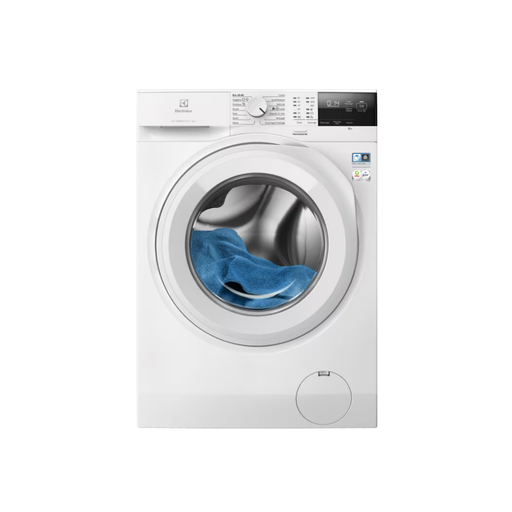 Image unavailable
Worth considering for an available front-loading space and everyday laundry volumes; check the floor’s stability and the required clearances before installation.
Stated dimensions: 847 × 596 × 576 mm. Capacity: 8 kg; adjustable spin speed up to 1 400 rpm; spin-drying class B; stated spin-cycle noise: 75 dB.
Compare the airborne acoustical noise emission class and usable depth with other models, taking the door, hoses and connections into account.
Compare the noise emissions during the spin cycle, expressed in dB, as well as the noise class shown on the label or in EPREL. European regulations govern this labelling; compare appliances of the same type and remember that the floor and levelling can also affect the result in your home.
The stated noise level is measured under standardised conditions, while the vibrations you feel also depend on the installation. Bosch and Electrolux specifically recommend removing the transit fittings, levelling the appliance, locking the foot adjustments and installing it on a hard, stable floor; an unevenly distributed or very small load can cause an unbalanced drum.
Choose a top-loader if the available width is insufficient for a front-loader, or if loading from above better suits the layout. Consider a front-loader if space allows and you need more capacity or are planning a washer-dryer stack; in both cases, check the precise model’s spin-cycle noise.
Check access to the water inlet tap, the route of the drain hose, that no hose will be pinched and that there is enough space to connect and maintain the appliance. Follow the manual for the model’s specific electrical and plumbing requirements, and do not alter a rented property’s installation without the appropriate permission or professional assistance where necessary.
No. It helps you compare energy, water, spin performance and noise, but it is also useful to check the durability index, documentation, warranty, after-sales service and dimensions. ADEME states that a durability index has applied to washing machines since the beginning of 2025.