Which features should you compare?
First, choose a door type that suits the space, then compare the capacity and label information with the laundry you actually wash.
Front-loading washing machine
Worth considering: if the front door can open freely and you’d like to explore different capacities. UFC-Que Choisir notes that front-loaders can offer greater capacities than top-loaders.
Keep in mind: you’ll need enough space in front of the machine to open the door, as well as space for the appliance itself.
Top-loading washing machine
Worth considering: if loading from the top is more convenient or better suited to the space.
Keep in mind: leave enough room above the lid. UFC-Que Choisir says top-loader capacities do not exceed 8 kg.
Washer-dryer
Worth considering: if you need washing and drying in a single appliance.
Keep in mind: you may not be able to dry a full wash load in one go. For example, Electrolux lists an 8 kg washing capacity and a 5 kg drying capacity for its EW7IW2856BG.
| Feature |
What to check |
My needs |
| Capacity |
Compare the stated capacity in kg of dry laundry with your usual loads and any bulky items. ADEME gives 7 kg as a guideline that is usually sufficient, not a rule for every household. |
Are my loads generally small, or do I regularly need to wash a lot of laundry at once? I want to avoid both extra cycles and a drum that’s rarely full. |
| Water and electricity |
On the model’s label, compare electricity use per 100 cycles and water use per cycle on the same Eco 40-60 basis. Also check the capacity associated with the figures shown. |
I want to compare the stated consumption figures without assuming that a larger machine, or an energy class on its own, will better suit my habits. |
| Spin cycle and noise |
Check the spin-cycle noise in dB and the noise class, as well as the spin performance information. The maximum speed in rpm does not, on its own, tell you how well the machine spins or how noisy it is. |
The machine will be near a room that’s in use, so spin-cycle noise matters to me just as much as how I organise drying. |
| Installation |
Measure the width, height, depth, access routes and clearance needed for the door or lid. Check the model’s manual for connection and installation requirements. |
The appliance needs to fit in its space and be easy to open and connect. I can’t rely on the front-facing dimensions alone. |
| Durability |
In France, according to the ministry responsible for ecology, the durability index, scored out of 10, has replaced the repairability index for washing machines since 8 April 2025. For models covered by the index, compare the score shown and its breakdown. |
If I’m choosing between several models suited to my laundry, I want to check this index rather than rely on a general claim about how long the machine will last. |
A few brands to know
These range examples can help you identify formats and features to check for each model. They don’t necessarily reflect the models featured below.
Bosch
Bosch offers front-loading and top-loading washing machines, with capacities from 7 to 10 kg highlighted in its French range.
- Bosch says the load detection feature on the WOT24457FF top-loader adjusts water use for a half or full load.
- This feature applies to the model mentioned. Check the specifications, noise levels and label for any other model separately.
Electrolux
Electrolux offers appliances that combine washing and drying in a single unit.
- For the EW7IW2856BG, Electrolux states an 8 kg washing capacity, a 5 kg drying capacity and a spin speed of 1,600 rpm.
- For this same model, the brand states an A rating for washing alone and a D rating for washing and drying. These figures don’t represent its entire range.
Whirlpool
Whirlpool offers front-loading, top-loading and integrated models, each with different installation requirements.
- Whirlpool lists an 11 kg capacity for the FFDD 11489 BV FR front-loader and an 8 kg capacity for the BIWMWG81485EU integrated model.
- For the BIWMWG81485EU, the stated dimensions are 59.5 cm wide, 81.5 cm high and 54.5 cm deep. Also check the clearance required in the manual.
Washing machines to explore on Joybuy
This selection includes front-loading washing machines, top-loading models and a washer-dryer. Compare each one with your usual loads, the space available and the label information that matters to you.
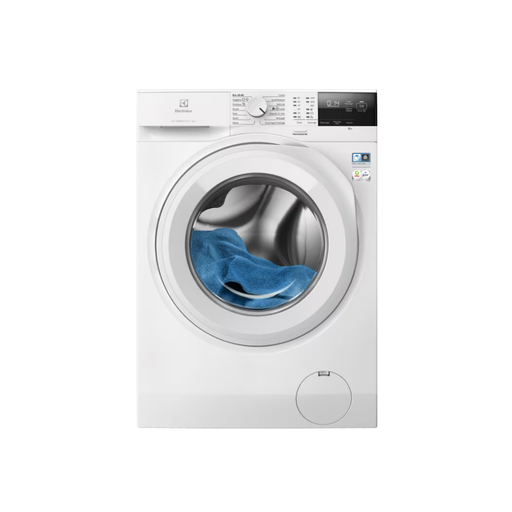 Image unavailable
Electrolux EW6FI4805AW front-loader, 8 kg
This front-loading model is worth considering if loads of around 8 kg suit your laundry habits and there’s enough room for the door to open.
The model lists a spin speed of 1,400 rpm and features SensiCare and steam. Check the dimensions and connections in the manual before deciding.
View on Joybuy
 Image unavailable
Candy TCA464TM4-S ProWash 500 top-loader, 6 kg
The top-loading design and stated 6 kg capacity are worth considering if your loads are generally small. Check there’s enough clearance above the lid.
The model name indicates 1,400 rpm, a B rating, Wi-Fi and 17 programmes. If the machine will be near a living area, compare its spin-cycle noise on the label.
View on Joybuy
 Image unavailable
Haier T Series 7 THASN276TM6-S top-loader, 7 kg
Its 7 kg capacity matches ADEME’s guideline for many households, but you’ll still need to check your own loads and the clearance needed above the machine.
This model lists 1,200 rpm, an A rating and Wi-Fi. Also compare the stated water and electricity use and noise levels for the exact model.
View on Joybuy
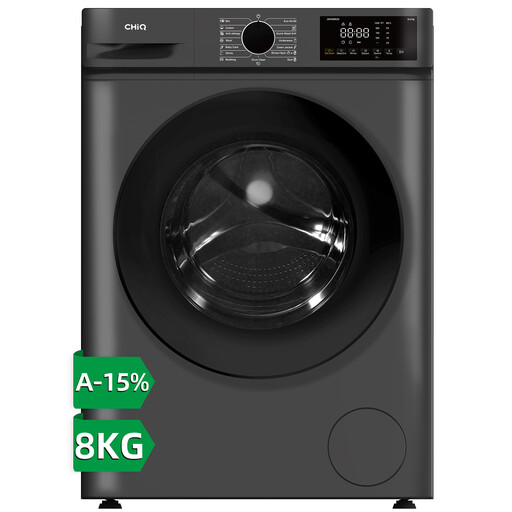 Image unavailable
CHiQ JW85883G front-loader, 8 kg
This capacity may suit you if you regularly wash large loads and have enough room for a front-opening door.
The model lists 1,400 rpm, 16 programmes and a steam function. Check its full dimensions and the water, electricity and noise figures on its label. The “A-15%” claim is no substitute for these figures.
View on Joybuy
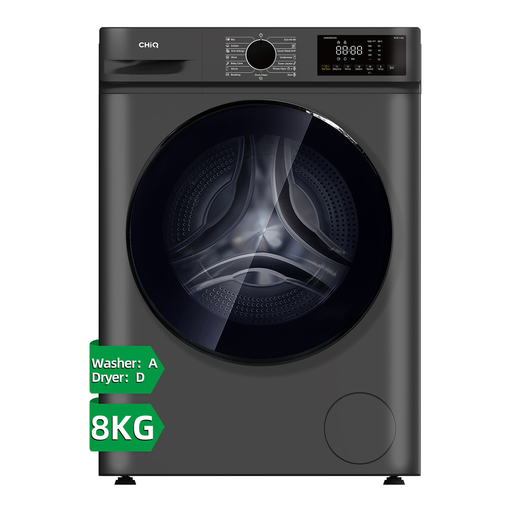 Image unavailable
CHiQ JW85882HG washer-dryer, 8/5 kg
This washer-dryer is worth considering if integrated drying suits your space. It has a stated washing capacity of 8 kg but a drying capacity of 5 kg, so you may need to split a full load.
The stated spin speed is 1,400 rpm. The listed dimensions for this model are inconsistent, so check the measurements and connections in the manual, along with the information for the wash-and-dry cycle.
View on Joybuy
Frequently asked questions
Is a 7 kg capacity enough for regular laundry?
Often, according to ADEME, but the number of loads alone won’t tell you: consider their size, too. If you regularly wash bulky items or a lot of laundry at once, compare this guideline with your actual needs.
What should I compare on a washing machine’s energy label?
Compare the energy class, electricity use per 100 cycles, water use per cycle, capacity, Eco 40-60 programme duration, spin performance and spin-cycle noise. ADEME recommends checking this information rather than judging a machine by its capacity alone. Use the same details to compare each model.
Is a top-loading washing machine always better for a small space?
No. A top-loading door may solve an access issue, but the lid needs clearance above it. Measure the space for the exact model. UFC-Que Choisir also says top-loader capacities do not exceed 8 kg.
Can a washer-dryer dry a full wash load?
Not necessarily. Electrolux lists an 8 kg washing capacity and a 5 kg drying capacity for the EW7IW2856BG, so you may need to split a full wash load before drying it. Check both capacities for the appliance you’re considering.
What should I measure before ordering a washing machine?
Measure the space, access routes and clearance needed to open the door or lid, then check the position of the water inlet, waste outlet and plug socket. Confirm these details against the full dimensions and installation diagram for the model you’ve chosen; measurements for a different model won’t be enough.


