Essential buying criteria
Start with the amount of laundry you need to dry after each wash, then check the installation space, ventilation and consumption figures using the same basis for comparison.
| Priority |
What to check |
Your needs |
| Spin cycle and drying time |
Compare the washing machine's spin-cycle specifications. Also check the stated drying capacity and the programmes documented for the exact model. |
I want laundry to remain damp for as little time as possible indoors. An effective spin cycle reduces residual water, but laundry hung up to dry remains a source of indoor moisture according to ADEME and the Q-WASH study. |
| Actual drying capacity |
Compare the washing and drying capacities of the same appliance separately. For a tumble dryer, match the capacity to your usual volume of sheets, towels and clothes. |
I need to know whether a full wash load can go straight into the dryer or whether I will have to split it. On washer-dryers, the drying capacity may be lower than the washing capacity, as UFC-Que Choisir points out. |
| Space, noise and resources |
Measure the height, width, depth and door-opening clearance. Compare noise levels on the same basis, along with the energy label and the consumption figures given for the relevant cycle. |
I am looking for a compact appliance without accepting an excessively long cycle, disruptive spinning near a living area or consumption levels that do not suit my routine. |
Joybuy products for indoor drying
Joybuy options for households looking for a separate tumble dryer or washer-dryer to reduce the amount of laundry hung up to dry indoors.
 Image unavailable
Hotpoint CHD84MWBSEE 8 kg heat-pump tumble dryer
Worth considering for regular mechanical drying of family-sized loads, provided there is room for a separate appliance.
Stated capacity of 8 kg, heat pump, declared noise level of 64 dB and the option of connecting a drain hose. Check the full dimensions, door clearance and drainage compatibility before installation.
Joybuy
 Image unavailable
Samsung WD11DG6B85BEU3 washer-dryer 11 kg / 6 kg
A single-appliance option for a utility room or bathroom where there is no space for two machines.
Stated capacities of 11 kg for washing and 6 kg for drying, 1,400 rpm and a stated size of 60 × 85 × 60 cm. The wash-and-dry cycle is stated as taking 7 h 32 min and using 90 L per cycle; the 72 dB level applies to spinning.
Joybuy
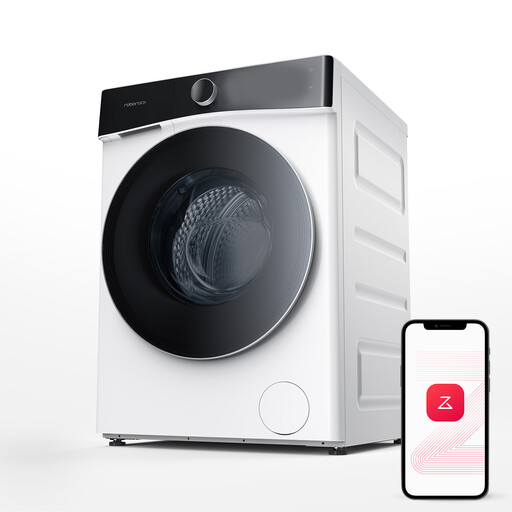 Image unavailable
Roborock Zeo Lite washer-dryer 10 kg / 6 kg
This washer-dryer may suit households where one appliance needs to wash and then dry a defined portion of the load.
Stated capacities of 10 kg for washing and 6 kg for drying, with low-temperature Zeo-Cycle drying, 27 programmes, automatic dosing and a LintClear system. Check the dimensions, noise level, connections and cycle durations for your intended location.
Joybuy
 Image unavailable
Samsung WD10HG6U34BEU3 washer-dryer 10 kg / 6 kg
Worth considering if one appliance needs to handle both washing and mechanical drying in a space measured in advance.
Stated capacities of 10 kg for washing and 6 kg for drying, stated dimensions of 600 × 850 × 590 mm and energy class D. Be prepared to reduce a full wash load before starting a drying cycle.
Joybuy
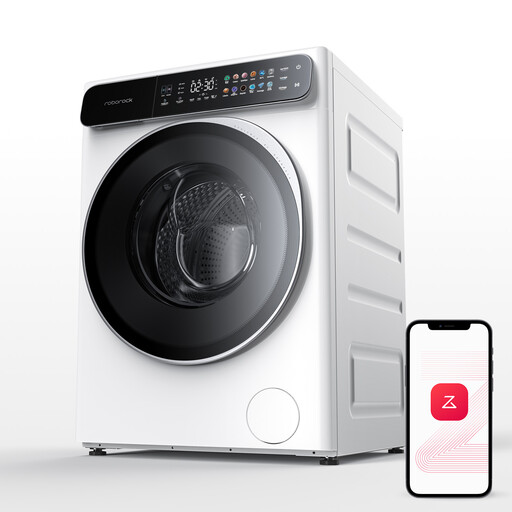 Image unavailable
Roborock Zeo One washer-dryer 10 kg / 6 kg
An option for reducing the space needed with a single appliance, provided the loads intended for drying stay within the stated limit.
Stated capacities of 10 kg for washing and 6 kg for drying, with Zeo-Cycle technology, a LintClear system and automatic dosing. Check the dimensions, connections, noise level, consumption and cycle duration before buying.
Joybuy
Frequently asked questions
Does a more effective spin cycle help if laundry is left to dry indoors?
Yes, because spinning removes some of the water before drying. ADEME states that mechanically extracting moisture before thermal drying uses far less energy than extracting it through heating. However, this does not eliminate the moisture released by laundry that is still drying in the room.
Can you wash and dry a full load in a washer-dryer?
Not necessarily: always check the two capacities stated for the model. The AEG LWR98B166X, for example, is stated as 10 kg for washing and 6 kg for drying, so a maximum wash load cannot be dried completely in one go.
What should you check before installing a heat-pump tumble dryer?
Measure the space, including the depth and the clearance required, then check how condensation is managed in the manual or product page: a tank to empty, a hose or a drainage kit. Also check the manufacturer's requirements for stacking or side-by-side installation.
Should you switch off the ventilation when laundry is drying indoors?
No. In France, the decree of 24 March 1982 requires home ventilation to be capable of operating generally and continuously while windows remain closed. This rule applies to the home and does not mean that an appliance can compensate for inadequate ventilation.
Does a washer-dryer use water during drying?
This depends on the model and its technology: do not assume that a combination appliance dries without using water. UFC-Que Choisir states that the majority of washer-dryers tested use water during drying. Consult the energy label, product page and manual for the exact model.


