If depth is limited, consider a slim washing machine, provided you can open its door. If width or clearance in front of the machine is the issue, a top-loading model may work, but it needs depth and enough space above. When there’s no room for a conventional machine, a mini washing machine can handle small loads, though it may not meet all your laundry needs. Measure the entire space, then compare the capacity, spin performance and noise levels of the model you’re considering.
Who might these formats suit?
In a studio flat with limited depth
If there’s a water supply nearby, a slim model is worth considering when depth is the main installation constraint. However, it still needs around 60 cm of width and space in front for the door to open, as Que Choisir points out.
In a narrow home with space above
A top-loading washing machine avoids the need for a door to open outwards and can be around 40 cm wide. You’ll still need enough room to lift the lid, and the models cited by AEG France and Whirlpool France require close to 60 cm of depth.
With no space for a conventional machine
In a student bedroom or mobile home, a small appliance can let you wash small loads on the spot. Que Choisir describes 2 to 3 kg mini formats as handy extra machines, particularly because bulky items and spin performance can be limiting factors.
How do the different formats compare?
Slim washing machine
Consider it: when depth is the main obstacle, and there’s enough width and clearance to open the door.
Bear in mind: saving depth doesn’t free up width or the space in front of the machine.
Top-loading washing machine
Consider it: when limited width or a front-opening door rules out a front-loading model.
Bear in mind: the models we looked at need close to 60 cm of depth, as well as enough room to open the lid.
Compact or portable mini format
Consider it: when there’s no room for a conventional washing machine and a small on-site wash meets your needs.
Bear in mind: its capacity and difficulty handling bulky items may make it more suitable as an extra machine.
| Criteria |
What to check |
Who is it for? |
| Dimensions and access to the drum |
Measure the width, depth and height, as well as the space needed to open the door or lid, including room for connections. |
If there isn’t enough room in my studio flat to open a door without blocking the way, I’ll first look for a machine I can install and load. Around 36% of consumers would prioritise size and access. |
| Usable capacity |
Compare the capacity in kg with your usual laundry and bulky items, rather than looking only at the number of people in your household. |
I want to wash my everyday laundry without running lots of small loads or having to leave out larger items. Capacity would be the top priority for around 29% of consumers. |
| Installation requirements |
For an extra machine, check the power supply, water inlet and drainage. If it’s wall-mounted, check the fixing requirements in the instructions too. |
With no room for a conventional machine, I’d prioritise being able to wash small items at home, even if there are some limitations. This would be the top priority for around 21% of consumers. |
| Ease of use |
Compare the label figures for kWh per 100 cycles, water per cycle, noise and spin efficiency. Check the model’s durability index too. |
In a room where I live and dry my laundry, I want to compare compatible machines by their noise, spin performance and consumption. Around 14% of consumers would put these criteria first. |
What should you look out for before buying?
-
Choosing based on width alone
A narrow top-loading machine can still be deep, while a shallow slim model still needs space in front for its door to open. So a machine that fits on paper won’t necessarily be practical to use.
Before ordering, note down all three dimensions, allow for the connections and check how much room the door or lid needs to open.
-
Expecting a mini washing machine to handle all your laundry
Que Choisir describes 2 to 3 kg mini formats as extra machines: bulky items and spin performance can be an issue.
Compare their capacity with a week’s worth of laundry and the items you actually need to wash at home.
Running lots of small loads can also take more time.
-
Comparing maximum capacity alone
A drum that’s too small can mean extra cycles, while a large capacity that goes unused won’t necessarily meet your needs either.
Choose a machine to suit the volume and frequency of your laundry, taking your bulkiest items into account.
-
Overlooking noise and spin performance
Noise can matter day to day in a single-room home, while spin performance deserves particular attention if you dry your laundry indoors.
ADEME recommends comparing the energy labels of different models, including their noise and spin-efficiency information.
Brands to consider by format
Electrolux
Electrolux France lists the EW6T4613HA top-loading model with a 6 kg capacity and also offers a compact 3 kg range.
- Two formats to consider, depending on whether width or the space available for a compact machine is the deciding factor.
- Check the dimensions, connections and label for the specific model before choosing either format.
AEG
According to AEG France’s product details, the LTR8C7331A top-loading model has a 7 kg capacity and measures 39,7 cm wide by 59,9 cm deep.
- Its width may suit a narrow space, provided its capacity is right for the laundry you need to wash.
- Allow for close to 60 cm of depth and enough room to open the lid from above.
Whirlpool
Whirlpool France states that the TDLR6253BFR top-loading model is 40 cm wide and 60 cm deep, with a 6 kg capacity and a spin speed of 1 200 rpm.
- Top loading means you don’t need to leave space in front of the machine for a door to open.
- Check the depth and space above, as well as the noise and consumption figures for your chosen model.
Daewoo
Fnac lists the Daewoo DWD-CV801CG mini washing machine with a 3 kg capacity, a depth of 29,2 cm and a spin speed of 700 rpm.
- This format is worth considering for small loads when depth is very limited.
- Its low capacity limits the size of items it can wash. For wall mounting, check the instructions, the supporting surface and the requirements of your home.
Products for two different needs
These two products suit different situations: a top-loading washing machine to consider if width is limited, and a portable mini format for small loads when installing a conventional machine is difficult. For each one, check the dimensions and that its requirements for use are suitable for your home.
 Image unavailable
Candy TCA464TM4-S ProWash 500, 6 kg top-loading washing machine
Worth considering if top loading suits your access requirements, as long as you leave enough clear space to open the lid.
The product name lists a 6 kg capacity, a spin speed of 1 400 rpm, a B rating, Wi-Fi and 17 programmes. Check the depth and the model’s noise and consumption figures before choosing.
View on Joybuy
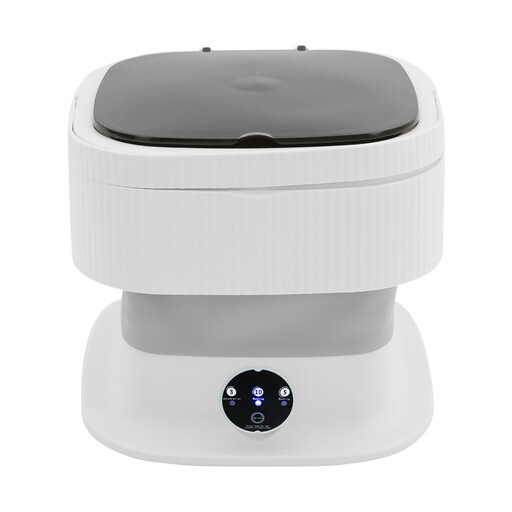 Image unavailable
10 L foldable portable mini washing machine, 2/5/10-minute programmes
Worth considering for small loads at home when a conventional washing machine won’t fit. Check that its requirements for use are suitable for your home.
The product name lists a 10 L volume, three programme durations of 2, 5 and 10 minutes, a 40 W motor and a draining basket. The 10 L figure isn’t a laundry capacity in kg: check the maximum load, dimensions when unfolded, and water supply and drainage requirements before deciding whether this machine will meet your laundry needs.
View on Joybuy
Frequently asked questions
Is a slim washing machine enough when space is limited in a studio flat?
Not if width or clearance in front of the machine is limited too. Que Choisir says slim models mainly reduce depth, so check there’s room for their width of around 60 cm and for the door to open.
Is a 40 cm-wide top-loading washing machine shallow?
Not necessarily: the models cited by AEG France and Whirlpool France are close to 60 cm deep. You’ll also need enough space above to open the lid and load the laundry.
Can a mini washing machine be used as your main machine?
Only if its small loads are enough for your usual laundry. Que Choisir describes 2 to 3 kg mini formats as handy extra machines, with limitations for bulky items and generally lower spin performance.
What should you compare on the energy label if you dry laundry in your studio flat?
Compare spin efficiency and noise in particular, then kWh per 100 cycles and litres per cycle. ADEME recommends paying close attention to the spin-drying class if you dry laundry indoors.


