Buying priorities for a very small home
Start with the space and connections, then choose a capacity suited to your washing routine before comparing noise levels, spin performance and durability.
| Priority |
What to check |
Your needs |
| Size and opening clearance |
Measure the height, width and depth, including room for the hoses. Check the clearance in front of a door or above a lid. According to UFC-Que Choisir, slim models remain around 60 cm wide, while top-loading models are close to 40 cm. |
I want the appliance to fit into the alcove without blocking movement or preventing the drum from opening. |
| Suitable capacity |
Compare the maximum load with the number of occupants, how laundry is sorted and the programmes used. Check the capacities for synthetics, jeans and woollens, which may be lower than those for cotton or the Eco 40-60 programme. |
For my regular washes, I want a drum that avoids having to run several cycles without taking up unnecessarily more space. |
| Water, drainage and stability |
Locate the cold-water inlet, drainage outlet and access to both after installation. Check that the drain hose can remain correctly positioned and that the feet can be adjusted on a stable floor. |
I want an installation that drains water correctly and remains stable in a nearby living area. |
| Bathroom safety |
Check the location in relation to the safety zones, the earthing and the 30 mA residual-current protection. If in doubt, have the electrical installation inspected before buying. |
If the bathroom is my only available location, I want to avoid choosing an appliance that cannot be installed safely. |
| Noise and everyday use |
Check the energy label for consumption, spin performance and noise level. ADEME also recommends looking at the durability index and repair information. |
As laundry is dried and washed close to my living space, I want to minimise disruption and compare usage data on a clear basis. |
Joybuy products for a studio flat
These Joybuy options include a narrow, plumbed-in top-loading washing machine and a supplementary mini washing machine for small loads where space is extremely limited.
 Image unavailable
Candy TCA464TM4-S ProWash 500, 6 kg, 1,400 rpm
A worthwhile choice when limited width is the main obstacle and a plumbed-in appliance can be installed.
Top loading, stated dimensions of 86 × 40,5 × 60 cm, 6 kg capacity, spin speed of 1,400 rpm, B energy label and stated spin noise level of 79 dB(A).
The depth remains 60 cm: check the alcove, hose route, rear access and the clear space above the lid. In a bathroom, also check the electrical safety conditions set out by Promotelec.
Joybuy
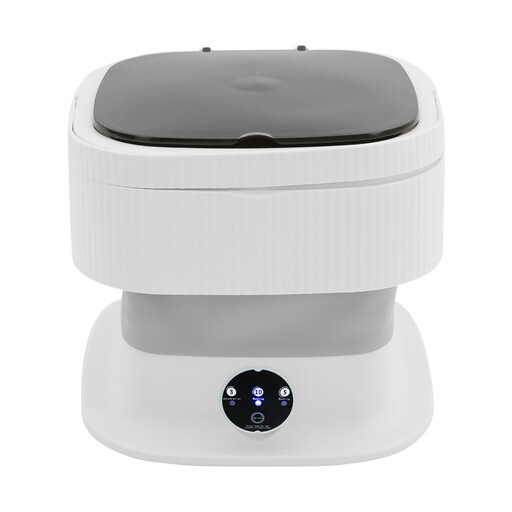 Image unavailable
10 L portable foldable mini washing machine
This option is suitable for small supplementary loads in a student room, flat or space where a conventional appliance cannot be installed.
Stated 10 L tub, three timers of 2, 5 and 10 minutes, 40 W motor, stated speed of 320 rpm, drainage basket and suction cups.
Check the unfolded and folded dimensions, filling and drainage instructions, and the electrical requirements that apply to your installation in the manual. The dry laundry load and suitability for bulky items should be assessed before considering it as your main appliance.
Joybuy
Frequently asked questions
What measurements should you take before choosing a washing machine for a studio flat?
Measure the available width, depth and height, then add the space needed to open the appliance. According to UFC-Que Choisir, a slim front-loading model remains around 60 cm wide with a depth of 33 to 45 cm, while a top-loading model is mainly narrow in width, at around 40 cm.
Can a washing machine be installed in a bathroom in France?
Yes, subject to certain conditions: Promotelec states that the appliance must be located outside zones 0, 1 and 2 and the concealed zone, be earthed and supplied by a circuit protected by a 30 mA residual-current device. If you are unsure about the zones or consumer unit, have the installation checked by a qualified electrician.
Which connections should you check before buying a plumbed-in washing machine?
Check the cold-water inlet, an accessible drainage outlet and a suitable electrical socket. Electrolux describes a connection to a cold-water tap with a 3/4-inch gas-threaded opening; consult the manual for the chosen model for hose lengths, drainage heights and appliance-specific requirements.
Why should you allow access to the rear and filter?
Rear access is needed for connections and certain maintenance tasks. Bosch states that a bent, excessively inserted or blocked drain hose can affect drainage, so make sure there is realistic access to the hoses and filter before pushing the appliance into a cabinet.
How can you limit vibration and noise in a studio flat?
Remove the transit bolts and adjust the feet to level the appliance, following the instructions in the manual. Also compare the noise level shown on the energy label, which is particularly noticeable when the machine is close to your living space.


