Which homes and uses is it suitable for ?

Tenant or student with a narrow access route

If the available width or access route is the main obstacle, compare a narrow top-loading machine with a slim front-loading model, depending on the free space above and in front of the appliance. Que Choisir states that top-loading models are generally around 40 cm wide, while slim front-loading models retain a width close to 60 cm.

Studio flat resident with limited depth

When an alcove or access route provides around 60 cm of width but little depth, a slim front-loading machine may be suitable. However, check the door opening, hoses and connections: the term “compact” alone does not guarantee that installation will be possible.

Resident without a conventional installation

Without a water inlet, drainage, suitable socket and stable flooring for a standard appliance, a mini washing machine can handle small loads. Que Choisir nevertheless points out that this format does not match the capacity or spin performance of a standard washing machine.

What to check before buying

Slim or compact front-loading machine

Choose this if : the available width is close to 60 cm, but depth is the real constraint and the door can open without blocking the passage.

Bear in mind : reduced depth does not reduce the width or the clearance needed at the front; a capacity that is too small may also mean running more cycles.

Narrow top-loading machine

Choose this if : the access route requires a machine around 40 to 46 cm wide and the lid can open freely.

Bear in mind : the depth may still be close to 60 cm, and a cupboard above the machine would prevent loading.

Mini washing machine for occasional use

Choose this if : installing a standard washing machine is impossible and only small loads need to be dealt with.

Bear in mind : capacity and spin performance are more limited, making it harder to wash bulky laundry.

Priority What to check Your needs
Size and access Measure the available width, depth and height. Check the opening direction, hoses and clearance around the machine. A top-loading model is often 40 to 46 cm wide; a slim front-loading model generally remains close to 60 cm wide, according to Que Choisir. I want to load laundry without blocking a hallway, kitchenette or small bathroom.
Usable capacity Compare the capacity in kg of dry laundry with your usual loads. For one or two people, 5 to 7 kg can be a useful starting point, adjusted according to household linens and washing frequency. I want to wash everyday laundry without choosing such a small drum that I have to run more cycles.
Installation Before buying, check the socket, water inlet, drainage and a flat, stable floor. Also consult the model’s instructions for installation and connection requirements. I need to be able to install the appliance without improvising the connections or putting up with vibrations in the living space.
Use, noise and durability On the energy label, compare kWh per 100 cycles, litres per cycle, the Eco 40-60 programme duration and spin noise. In France, the durability index has also been displayed on washing machines since April 2025, according to ADEME. I want to minimise noise near a sleeping area and compare appliances on more than just their dimensions.

Mistakes to avoid

  • Confusing shallow depth with a small overall footprint

    A slim front-loading machine generally retains a width close to 60 cm, and its door opens forwards. Even with reduced depth, it may be impractical in a narrow passage.

    Measure the access route and the door-opening area before comparing depths, then check the exact dimensions of the model.

  • Choosing the smallest drum without considering your laundry

    A drum that is too small may mean running more cycles, while a very large model that is rarely full may not suit the way you use it.

    For one or two people, start with 5 to 7 kg, then adjust according to sheets, bulky clothing and how often you wash.

    Additional cycles can increase the time spent doing laundry, as well as water, electricity and detergent consumption.

  • Buying a top-loading machine to place under a worktop

    The top opening, which is useful in a narrow passage, becomes impossible to use if a cupboard blocks the lid.

    Reserve a top-loading machine for a location with sufficient clearance above. Under a worktop, check the installation requirements for a compatible front-loading model instead.

  • Treating a mini washing machine as a complete replacement

    Mini washing machines designed for very small spaces have more limited capacity and spin performance; bulky or heavily soiled laundry may require another solution.

    Choose this format only after confirming that a standard washing machine cannot be installed, and check the loading, drainage and power requirements of the model you select.

    More frequent washes and occasional trips to a launderette for bulky items may become necessary.

Brands mentioned for comparing formats

Electrolux

A useful reference for comparing a narrow top-loading washing machine: Electrolux presents the EW6T3465DA as a 6 kg top-loading appliance measuring 890 × 400 × 600 mm.

  • A width of 400 mm can help when the access route is the main constraint.
  • You need to leave clearance above the lid, and the stated depth remains 600 mm.

Candy

In France, Candy offers a range of slim washing machines, including front-loading models with different capacities.

  • This range makes it possible to compare several capacities and spin speeds in a reduced-depth format.
  • Always check the exact model’s dimensions, door opening, noise level and connections: “slim” alone does not describe every installation requirement.

Bosch

Bosch provides a comparison point with a standard front-loading machine: the WGE03207FR is specified as an 8 kg model measuring 848 × 598 × 588 mm.

  • Its dimensions illustrate the difference between a standard front-loading machine and a genuinely shallow format.
  • With a stated depth of 588 mm, it does not address the same constraint as a slim front-loading model measuring around 47 cm deep.

Washing machine options on Joybuy

These Joybuy options cover the two formats best suited to a standard installation in a compact home: a narrow top-loading model when width is limited, and a shallow front-loading model when the alcove has limited depth.

Candy TCA464TM4-S ProWash 500, 6 kg top-loading washing machine

Candy TCA464TM4-S ProWash 500, 6 kg top-loading washing machine

Worth considering when the access route is narrow and there is enough clearance above to open the lid.

Stated dimensions: 86 × 40,5 × 60 cm. Stated capacity: 6 kg; spin speed up to 1 400 rpm.

The depth remains 60 cm. Check the clearance needed above the machine, as well as the stated spin noise of 79 dB(A) if it is near a sleeping area.

View on Joybuy
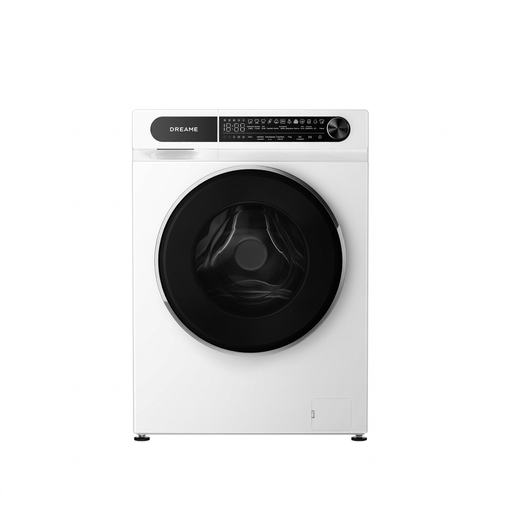
Dreame DRWASHS8KG S, 8 kg white washing machine

Dreame DRWASHS8KG S, 8 kg white washing machine

Worth considering if depth is limited but the room can accommodate an appliance 60 cm wide with a front-loading door.

Stated dimensions: 600 × 450 × 840 mm. Stated capacity: 8 kg; 12 programmes and stated spin noise of 74 dB.

The stated width remains 600 mm. Check the instructions for the clearance required in front of the door, drainage conditions and floor stability before installation.

View on Joybuy

Frequently asked questions

How should I measure the space before choosing between a slim front-loading machine and a top-loader ?

Measure the width, depth and height, then allow for the door or lid to open. A front-loading machine needs clearance in front of the door, whereas a top-loader requires free space above. Que Choisir also recommends leaving at least 0,5 cm between the machine and surrounding furniture; the instructions for the chosen model remain the reference for precise installation.

Is a top-loading washing machine always suitable for a small home ?

No. It mainly reduces width, generally to around 40 to 46 cm, but its depth may still be close to 60 cm and the lid must open upwards. It is therefore suitable for a narrow access route with clearance above, but not necessarily for a shallow alcove or a space under a worktop.

What installation requirements should I plan for a standard washing machine ?

Check that you have a suitable electrical socket, a water inlet, drainage and a flat, stable floor. Also consult the instructions for information on adjusting the feet and any model-specific requirements; if the connections are unsuitable, ask a qualified person to carry out the work rather than improvising the installation.

Which energy-label figures are useful in a studio flat ?

Compare kWh per 100 cycles, litres per cycle, the duration of the Eco 40-60 programme and spin noise. The European Commission explains that these figures relate to the regulated Eco 40-60 programme, so they do not predict the exact consumption of every programme.

Should I look at the durability index ?

Yes, alongside the dimensions and energy label. According to ADEME, washing machines sold in France have displayed this index since April 2025; it helps you compare repairability and reliability, but does not replace checking the capacity and installation requirements.