Which homes and uses is it suited to?

Single person or couple in a studio flat

For regular washing for one or two people, every centimetre of width, depth and door clearance matters. Que Choisir recommends a capacity of 5 to 7 kg as a guide for this type of household, adjusted to the actual volume of laundry.

Tenant with a narrow alcove

A kitchen or bathroom alcove means checking the dimensions, access and connections before delivery, particularly if the plumbing, electrics or cabinetry cannot be altered.

Home where depth is limited

If the space can accommodate a width of around 60 cm but lacks depth, a slim front-loader may be suitable. However, you will still need to allow for the door to open and check that a capacity of 4 to 6 kg meets your expected laundry needs.

Priorities before buying

Narrow top-loader

Choose this if: the alcove or access route is too narrow for a front-loader, but the top of the appliance remains fully accessible.

Bear in mind: the main benefit is the reduced width; the depth may still be close to 60 cm.

Slim front-loader

Choose this if: a width of around 60 cm is available, but the room has limited depth.

Bear in mind: a porthole door requires clear space in front of the appliance for loading and unloading.

Standard front-loader

Choose this if: the alcove, access route and clearance in front of the door are not particularly restricted.

Bear in mind: this format generally requires a width and depth of around 60 cm.

Priority What to check Your needs
Actual footprint Measure the clear width of the alcove and access routes. Also compare the depth, height and space needed to open a lid or porthole door. I want the machine to fit into the room without blocking a walkway or preventing access to the drum. Que Choisir distinguishes between top-loaders measuring 40 to 46 cm wide and slim front-loaders, which have reduced depth but remain close to 60 cm wide.
Suitable capacity Match the capacity in kg to the volume of laundry and frequency of washing. Compare the capacity with the information on the energy label. For regular washing for one or two people, I want a drum that avoids running multiple cycles without taking up unnecessary space. Que Choisir gives 5 to 7 kg as a guide; ADEME states that a 7 kg model is often sufficient.
Water, energy, noise and spin cycle Compare kWh per 100 Eco 40-60 cycles, litres per cycle, programme duration, noise level and spin-efficiency class. I want to compare appliances of a similar size, particularly if laundry is dried in the living area. ADEME recommends checking the energy label and taking the spin cycle into account when drying laundry indoors.
Delivery and installation Check the stairs, lift, water inlet, drainage, electrical socket, flooring and the instructions for the chosen model. I want the appliance to be delivered and connected without unexpected alterations to the property. Electrolux’s pre-installation guide states that installers do not carry out plumbing, electrical or carpentry work.

Mistakes to avoid

  • Relying only on the smallest stated width or depth

    A narrow top-loader may still be deep, while a slim front-loader retains a substantial width and needs clearance for its porthole door. An incomplete measurement can restrict movement or prevent normal use of the machine.

    Measure the width, height, depth, space in front of the appliance, space above it for a top-loader, delivery route and position of the connections separately. Then check the instructions for the exact model.

  • Installing a top-loader under a worktop without checking the opening

    Laundry is loaded from the top, so a worktop or fixed unit may prevent the lid from opening and block access to the drum.

    For an under-worktop installation, look for a suitable front-loader and confirm the dimensions and the manufacturer’s instructions.

  • Comparing only the energy class

    Two appliances in the same class may have different consumption figures in kWh per 100 cycles and litres per cycle, as well as different Eco 40-60 durations, noise levels or spin efficiencies.

    Read the entire energy label and compare models with a capacity and format suited to your needs. Avoid choosing an oversized drum without a genuine reason.

  • Assuming installation will solve an unsuitable alcove or connections

    An appliance may arrive at your home but still be impossible to use if the location or connections require additional work.

    Before ordering, confirm the water inlet, drainage, electrical socket, access to the tap, floor stability and access dimensions. If you rent, arrange the necessary permission or work before making any alterations.

A guide to the brands

Electrolux

A useful option for a slim front-loader when depth is limited but standard front-loader width is possible.

  • Electrolux France lists the EW6S1064NA with a 6 kg capacity, a depth of 411 mm and an energy class of A.
  • The stated depth does not remove the need to check porthole-door clearance, hoses and the installation instructions for the exact model.

Whirlpool

A useful option for a top-loader when limited width is more of a concern than limited depth.

  • Whirlpool France gives the TDLR 62667 FR a capacity of 6 kg, a width of 40 cm, a depth of 60 cm and a spin speed of 1 200 rpm.
  • Top loading requires clearance above the appliance and is not suitable beneath a worktop that would prevent the lid from opening.

Bosch

Worth considering if the alcove can accommodate a standard front-loader and a larger capacity would be useful.

  • Bosch states that the WAN2827TFR measures 845 × 598 × 590 mm and has an 8 kg capacity.
  • This format is not suitable for an alcove with insufficient depth or without enough clearance in front of the porthole door.

Washing machine options on Joybuy

These Joybuy options match the two situations discussed here: an alcove where width is the main restriction, or a sufficiently spacious location for a standard front-loader.

Candy TCA464TM4-S ProWash 500 6 kg top-loading washing machine

Candy TCA464TM4-S ProWash 500, 6 kg top-loader

Worth considering when the alcove’s width is the main restriction: this top-loader is 40,5 cm wide and has a capacity of 6 kg.

Stated dimensions: 86 × 40,5 × 60 cm; 1 400 rpm; energy class B; 49 kWh/100 cycles; 41 L/cycle; 79 dB.

Its 60 cm depth will not solve a lack of depth. Also check the clearance needed above the appliance to open the lid and load laundry.

Joybuy
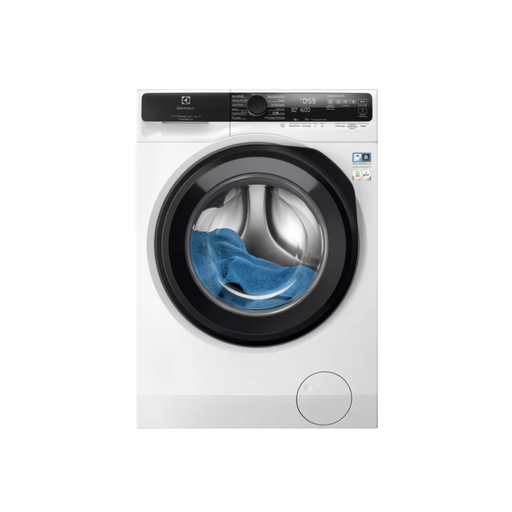
Electrolux EW7FI259160V 9 kg front-loading washing machine

Electrolux EW7FI259160V, 9 kg front-loader

This front-loader is suitable only for a sufficiently wide and deep space, with enough clearance to open the porthole door.

Stated dimensions: 84,7 × 59,7 × 66,0 cm; 9 kg capacity; energy class A; 44 kWh/100 cycles; 48 L/cycle; up to 1 600 rpm; 72 dB, class A.

A 9 kg capacity may be more than a single person or couple needs for regular washing. Check the alcove, delivery route and connections before buying.

Joybuy

Frequently asked questions

Is the stated depth enough to confirm that a machine will fit in an alcove?

No. Allow for the clearance needed to open and use a front-loader’s porthole door, the connections, access to the tap and drainage, as well as the instructions for the exact model. Que Choisir points out that a front-loader requires sufficient space in front of the appliance.

Is a top-loading washing machine always more compact than a slim front-loader?

No. A top-loader mainly reduces width: the top-loaders cited by Que Choisir are commonly 40 to 46 cm wide, but may still be 60 cm deep. A slim front-loader remains close to 60 cm wide while reducing depth to around 33 to 45 cm.

What capacity should a single person or couple in a studio flat choose?

According to Que Choisir, a capacity of 5 to 7 kg is a useful guide for one or two people. Increase it if you regularly wash bulky laundry or workwear, or if you want to run cycles less often.

What should you check before booking delivery with installation?

Check the route to the room, stairs or lift, the cleared alcove, the appliance dimensions and the existing connections. Electrolux’s pre-installation guide states that installers do not carry out carpentry, plumbing or electrical work.

How should you compare water, electricity, noise and spin performance?

Compare the energy label on the same basis: class from A to G, kWh per 100 cycles, litres per cycle, Eco 40-60 programme duration, noise level and spin-efficiency class. ADEME also recommends considering spin performance when laundry is dried indoors.