Single person or couple in a studio flat
You need an appliance suited to regular use without having to run numerous cycles. Que Choisir recommends 5 to 7 kg as a guide for one or two people.


Start by measuring the width, depth including the hoses and the space needed to open the appliance. Then choose the format that suits your main constraint: a front-loading model under a worktop if there is enough clearance in front, a slim front-loading model if depth is limited, or a top-loading model if width is the issue. For one or two people, Que Choisir gives 5 to 7 kg as a useful guide for everyday use; a mini washing machine is better suited to occasional small loads when installing a standard appliance is not possible.
You need an appliance suited to regular use without having to run numerous cycles. Que Choisir recommends 5 to 7 kg as a guide for one or two people.
You have a space beneath a worktop or between units: the width, total depth and room needed to open the door determine the right format.
You are considering installing an appliance in a bathroom where space to move around is limited. The location must also comply with the electrical safety rules that apply to the room.
Start with the actual installation space, then check that the capacity and connections match your everyday needs.
| Priority | What to check | Your needs |
|---|---|---|
| Size and opening clearance | Measure the width, depth, height, hoses and opening area. A slim front-loading model is generally around 60 cm wide and 33 to 45 cm deep; a top-loading model is approximately 40 to 46 cm wide. | I want to keep a usable walkway and be able to load the laundry without blocking a door or unit. |
| Drum capacity | For one or two people, compare the capacity with the 5 to 7 kg guide cited by Que Choisir. Slim and mini formats may limit the size of each load. | I want to wash everyday laundry without running lots of small cycles or regularly having to leave out bulky items. |
| Bathroom installation | Check the water inlet, drainage and the instructions in the manual. In a bathroom, check the earth connection, 30 mA residual-current protection and positioning beyond zone 2. | My installation location must remain suitable for use near water and comply with electrical safety requirements, including when the appliance is inside a cupboard. |
| Noise, consumption and long-term use | Compare energy labels on a like-for-like basis: kWh per 100 cycles, water per cycle, Eco programme duration and noise level. Also check the durability index displayed in France for applicable washing machines. | In a small home, I want to minimise disturbance during the spin cycle and better anticipate energy use and maintenance needs. |
A drum that is too small can mean running more cycles and make washing bulky items more difficult.
For one or two people who do their laundry regularly at home, use the 5 to 7 kg guide cited by Que Choisir, then reduce the capacity only if the available dimensions require it.
A slim front-loading model reduces depth, but its door must still be able to open fully. A top-loading model often reduces width but needs clearance above it; the hoses must not be kinked.
Draw up a simple plan showing the appliance, rear connections, the door or lid when open and the remaining walkway.
Saving space does not automatically make a location suitable: areas close to a shower or bath require particular care.
Before buying, check the earth connection, 30 mA residual-current protection and positioning beyond zone 2. If you are unsure, particularly when the appliance is going in a cupboard, ask a qualified professional for advice.
Spin-cycle noise, consumption, maintenance and durability also affect everyday comfort in a studio flat.
Compare the energy-label data on a like-for-like basis and check the durability index where it is displayed.
This Joybuy selection features a compact, foldable option for very small loads. Consider it as a backup solution when installing a standard washing machine is not possible.
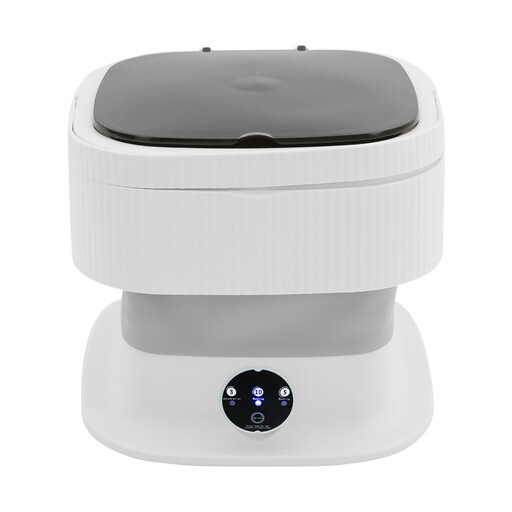 Image unavailable
A space-saving format for occasional small loads in a studio flat, dormitory or temporary accommodation.
Three advertised durations: 2, 5 and 10 min; 40 W motor, advertised speed of 320 RPM, drainage basket and suction cups.
Before choosing this option, check the manual for the actual laundry capacity, filling method, drainage, power requirements and suitability for sheets or towels.
Measure the width, depth and height of the alcove, then add the space taken up by the hoses and opening. A standard front-loading model is generally around 60 cm wide and needs clear space in front of the door; a slim front-loading model remains around 60 cm wide with a depth of 33 to 45 cm; a top-loading model is approximately 40 to 46 cm wide but must have enough clearance to open above.
For everyday use, Que Choisir cites 5 to 7 kg for one or two people. A significantly smaller capacity can mean more cycles and make washing bulky items more difficult.
Yes, for a standard washing machine. Check the water inlet, tap, supply hose, drain and trap in line with the model’s manual; Bosch notes that a kinked, blocked or overly inserted hose can prevent water intake or drainage.
Generally, no, not for a typical daily laundry load. Que Choisir presents 2 to 3 kg mini washing machines as backup solutions: their limited capacity, often restricted spin cycle and difficulty handling large items mean you will have to make compromises.
Compare the energy labels on a like-for-like basis: energy class, kWh per 100 cycles, litres per cycle, Eco programme duration and noise level. ADEME states that the durability index has been displayed in French shops for applicable washing machines since the beginning of 2025.