What should you compare before buying?
First identify what’s getting in the way of installation, then check that your chosen format can handle your usual laundry loads.
Narrow top-loading washing machine
Consider this if: width is your main constraint and the lid can open freely above the machine.
Check: a top-loading machine can still be deep, so it may not fit under a fixed worktop.
Slim front-loading washing machine
Consider this if: depth is limited, with enough width and clearance in front of the door.
Check: “slim” doesn’t mean the same depth across all models; compare the dimensions of the specific model you’re considering.
Compact washing machine
Consider this if: several dimensions are restricted, but a front-loading machine and access to it are still possible.
Check: a compact model may still be front-loading, so you’ll need access from the front and should check its capacity against your usual laundry loads.
Mini washing machine for occasional use
Consider this if: there’s no room for a full-size machine and you mainly need to wash small loads.
Plan for: another solution for items your chosen model can’t handle, such as some bulky pieces.
The percentages below reflect consumers’ main priorities when choosing a washing machine for a small space.
| Priority |
What to check |
Who is it for? |
| Width and top access |
Overall width and depth; clear space above the lid. |
If my access route is narrow, I’m looking for a machine that will fit through without stopping the lid from opening. Around 27% of consumers prioritise width. |
| Depth and door opening |
The model’s actual depth; clearance in front of the door for loading and unloading. |
If my alcove is shallow, I want to save space without blocking access to the door. Around 27% of consumers prioritise a shallow depth. |
| Smaller dimensions across the board |
Width, depth and height; the capacity listed for the specific model. |
When several dimensions are restricted, I’m looking for a smaller frame without immediately ruling out my usual laundry loads. Around 20% of consumers are primarily concerned with the overall size. |
| Washing smaller loads |
Washing and spin capacities; installation requirements and a solution for bulky items. |
If I don’t have room for a full-size machine, I can use another solution for larger loads. Around 13% of consumers prioritise a very compact appliance for occasional use. |
| Capacity and wash quality |
A capacity suited to your usual loads; test results available for the exact model. |
I want to avoid splitting my laundry into multiple loads while choosing a machine that fits my space. Around 13% of consumers highlight useful capacity and wash quality. |
Que Choisir Ensemble says mini washing machines often have a capacity of just 2 or 3 kg and notes that some models require more cycles or aren’t well suited to bulky items. Check the specifications of your chosen model and plan a separate solution for laundry it can’t handle.
Joybuy products for small spaces
The products shown include a top-loading washing machine and a portable mini washing machine for occasional use. Check which one suits your needs and your space.
 Image unavailable
Candy TCA464TM4-S ProWash 500 top-loading washing machine, 6 kg
A top-loading machine may suit you if width is your main constraint, provided there’s enough clear space above to open the lid.
Listed capacity: 6 kg. Listed spin speed: 1400 RPM. Class B, Inverter motor, Wi-Fi and 17 programmes.
Joybuy
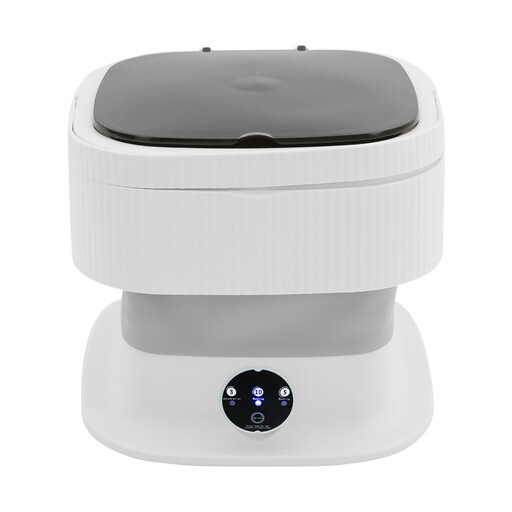 Image unavailable
Foldable portable mini washing machine, 10 L
This portable mini washing machine is presented as an appliance for occasional use; check that its capacity suits the items you want to wash.
Listed volume: 10 L. 40 W motor, listed speed of 320 RPM and three wash durations: 2, 5 or 10 min. The title mentions a draining basket and suction cups.
Joybuy
Frequently asked questions
What should I measure before choosing a top-loading or front-loading washing machine?
Measure the width, depth and height of the space, then check access to the drum separately: a top-loading machine opens upwards, while a front-loading machine opens at the front. Compare these measurements with the specifications and instructions for the exact model, as the frame dimensions alone won’t confirm whether it will be practical to use in the room.
Can a mini washing machine handle all my laundry?
Not necessarily: Que Choisir Ensemble describes mini washing machines as appliances for occasional use, often limited to small loads. If some items exceed your chosen model’s capacity, plan to use another machine or a launderette for those loads.
What should I compare for electricity, water and noise?
For household washing machines covered by EU energy labelling, the label includes information such as energy consumption per 100 cycles, water consumption per cycle and spin noise. The European Commission explains these indicators; compare them on the stated basis and don’t confuse them with wash quality.
What regulatory information should I check when buying a washing machine in France?
The French Ministry of the Economy says the statutory guarantee of conformity applies to new, second-hand and refurbished goods sold by a business to a consumer. Since 8 April 2025, the durability index has applied to front-loading and top-loading washing machines in this category; check that it’s displayed for the model you’re considering.
Does the retailer have to take away my old washing machine when I replace it?
The DGCCRF confirms that retailers must offer free “one-for-one” take-back of an equivalent used appliance when selling a new one. Check the retailer’s arrangements to organise collection, which is separate from an installation service.


